
 2-5
2-5R MAGELLAN
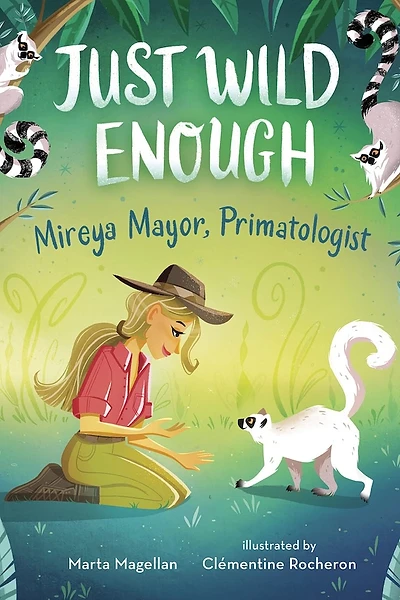
Just Wild Enough: Mireya Mayor, Primatologist
by Marta Magellan, illustrated by Clémentine Rocheron
Pacing MaterialThe true story of Mireya Mayor, a primatologist who followed her passion for animals from childhood dreams to groundbreaking work with lemurs in the wild.
Big Idea
Passion and curiosity can lead to extraordinary careers — Mireya Mayor followed her love of animals from a young dream to real scientific discovery.
Discussion Questions
- 1.What does a primatologist do?
- 2.How did Mireya Mayor become interested in animals?
- 3.What challenges did she face as a woman in science?
- 4.What animal would you want to study and why?
Classroom Activity
Animal Scientist Profile
Students research an animal scientist and create a one-page profile of their work and discoveries.
Lesson Plan
Learning Goals
- Describe the career of a primatologist.
- Identify the steps to becoming an animal scientist.
- Research and profile a real scientist.
- Explain how passion fuels perseverance.
Activity Steps
- 1.Read the book, noting how Mireya Mayor became a primatologist.
- 2.Discuss what a primatologist does and how you become one.
- 3.Students pick an animal scientist to research.
- 4.Create a profile page with name, animal studied, and key discovery.
Standards Connections
- ELA: RI.2.1 — Ask and answer questions about key details
- ELA: RI.2.2 — Identify main topic and retell key details
- ELA: RI.2.3 — Describe connection between events
- ELA: RI.5.6 — Acknowledge differences in characters' points of view
- ELA: SL.2.1 — Participate in collaborative conversations about the text
- ELA: W.2.3 — Write narratives recounting events with descriptive details
- SEL: Responsible Decision-Making
Pace-Write-Read Study with Pace-Write It!
Focus question: How can a biography use repetition, contrast, and page turns to show a real person growing into her purpose? Just Wild Enough: Mireya Mayor, Primatologist follows Mireya Mayor from a childhood full of animals to field science, National Geographic wildlife reporting, and primate research. Part of the She Made History series, the book presents Mayor's life as a story of courage, curiosity, and persistence, illustrated by Clémentine Rocheron.
| Element | How to notice or teach it in the novel |
|---|---|
| Pace | Read: The story moves quickly through childhood, dance, college, jungle work, and discovery. Classroom Activity: Create a 5-step life timeline with one strong verb for each stage. |
| Plot | Read: The plot is a real-life journey: interest, obstacles, training, exploration, achievement. Classroom Activity: Write a biography arc: "She wanted… She faced… She learned… She became…" |
| Prosody | Read: The repeated idea of being "wild enough" gives the read-aloud a bounce. Classroom Activity: Add one repeated phrase that changes meaning each time. |
| Word pause | Read: Short moments let readers stop on big shifts: animals, ballet, jungle, discovery. Classroom Activity: Place a line break before the moment your subject changes direction. |
| Concept | Read: The concept is that curiosity can grow into scientific purpose. Classroom Activity: Write one sentence that explains the big idea of your biography. |
| Voice & World View | Read: The voice celebrates curiosity, courage, and trying unexpected paths. Classroom Activity: Write in a voice that sounds curious and energetic. |
| Setting & Place | Read: Settings shift from home to ballet class, college, jungle, National Geographic work, and Madagascar. Classroom Activity: Use place changes to speed up your biography. |
| Point of View | Read: Third-person nonfiction narration keeps the focus on Mireya's choices and growth. Classroom Activity: Write one paragraph in third person about a real person's turning point. |
| Original Characters | Read: The "characters" are real people: Mireya, family, teachers, scientists, and animals she studies. Classroom Activity: Make a real-person cast list: main person, helper, doubter, challenge. |
| Dialogue | Read: Dialogue is not the main engine; action and narration carry the story. Classroom Activity: Add one short quoted or paraphrased moment only if it teaches character. |
| Details | Read: Specific details make her life memorable: pets, dance, fieldwork, primates, Madagascar. Classroom Activity: Add three exact researched details to your biography draft. |
| Descriptions | Read: Descriptions show contrast between polished performance spaces and wild field settings. Classroom Activity: Describe two very different places your subject enters. |
| Strong First Lines | Read: A strong opening can begin with Mireya's love of animals and the idea that ordinary life was not "wild enough." Classroom Activity: Begin with a surprising trait or desire. |
| Immediacy & Engagement | Read: Readers are pulled in by the repeated question: what will finally be wild enough? Classroom Activity: Create a "what next?" feeling at the end of each paragraph. |
| Story scenes, summaries, unique structures | Read: The book blends quick summary with key scenes from childhood, school, and field research. Classroom Activity: Write one scene and one summary sentence, then compare their speed. |
| Flashback, flash forward, cliffhangers | Read: The structure is mostly chronological, with suspense built through next steps. Classroom Activity: End one section with a future-facing line: "But she wasn't finished." |
| Tension, suspense, surprise | Read: Tension comes from expectations: dancer, cheerleader, scientist, explorer. Classroom Activity: Use a contrast: "People saw ___, but she was also ___." |
| Page turns and chapter breaks | Read: Page turns can reveal a new setting, new challenge, or new version of Mireya. Classroom Activity: Mark three page turns: childhood, obstacle, discovery. |
| Performance | Read: The repeated phrase and energetic life events make the book good for expressive reading. Classroom Activity: Read your draft aloud and emphasize the repeated phrase. |
| Personality | Read: Mireya's personality comes through as brave, curious, persistent, and adventurous. Classroom Activity: Choose three personality words and prove each with an action. |
| Humor | Read: Humor can come from surprising animals, unexpected career turns, or "not wild enough" repetition. Classroom Activity: Add one light, true detail that makes readers smile. |
| Pause | Read: Pauses help big life changes land. Classroom Activity: Use a short sentence after a major turning point. |
| Poetry and poetic devices | Read: Repetition, contrast, rhythm, and strong verbs give the biography poetic energy. Classroom Activity: Add alliteration or repetition to one sentence. |
| Repetition | Read: "Wild enough" works as a refrain that tracks Mireya's growth. Classroom Activity: Repeat one phrase three times, changing the context each time. |
| Rhythm | Read: The rhythm alternates between quick life movement and slower discovery moments. Classroom Activity: Write one fast paragraph, then one slow close-up paragraph. |
| Punctuation | Read: Punctuation can create excitement, surprise, and pause. Classroom Activity: Use one dash or colon to reveal a surprise. |
| Questions | Read: The story is driven by curiosity: What animals? What places? What discovery? Classroom Activity: Add two research questions your subject might have asked. |
| Compare-Contrast | Read: The book contrasts ballet/cheerleading with jungle science and fieldwork. Classroom Activity: Compare two sides of your subject's life. |
| Objects | Read: Objects can symbolize stages: pets, dance shoes, field gear, notebook, camera. Classroom Activity: Pick one object that shows your subject changing. |
| Threes | Read: A three-part list can show growth quickly. Classroom Activity: Write three places, three actions, or three challenges. |
| Whitespace & negative space | Read: Picture book pages let illustrations carry mood and movement. Classroom Activity: Leave one important sentence standing alone. |
| Art & graphics | Read: Clémentine Rocheron's illustrations help show setting, movement, and emotion. Classroom Activity: Sketch a page plan with subject, setting, and one symbolic object. |
| Interactives & gamification | Read: Students can track "wild enough" moments like levels in a quest. Classroom Activity: Create a "Wild Enough Meter" from 1 to 5 for each life stage. |
Pace-Write It!
20-Minute Classroom Flow: 1. Read (5 min) — Read a spread or short section aloud. Students listen for the repeated idea and notice how the page moves the biography forward. 2. Notice (5 min) — Students mark: one repeated phrase or idea, one setting shift, one contrast, one strong verb, one page-turn moment. 3. Write (7 min) — Write a "just ___ enough" biography paragraph using this frame: As a child, ___ was always ___. At first, people saw ___. But ___ wanted ___. So ___ tried ___. And when that still wasn't ___ enough, ___. 4. Share (3 min) — Students read one line aloud. Classmates listen for the pacing move: repetition, contrast, surprise, or strong verb. Exit ticket: What makes Just Wild Enough move quickly: the repeated phrase, the changing settings, the contrasts in Mireya's life, or the page turns? Write one sentence explaining your choice.