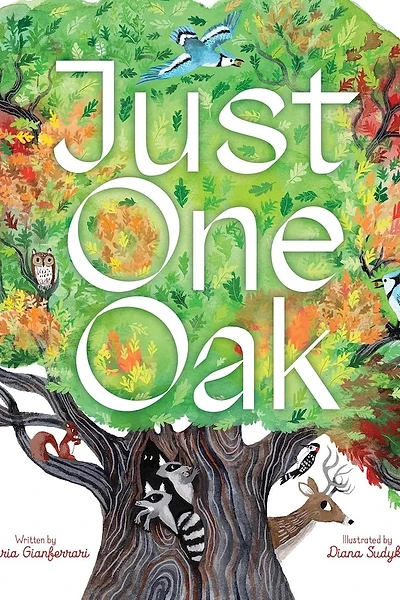
 K-4
K-4R GIANFERRARI
Just One Oak
by Maria Gianferrari
Pacing MaterialA single oak tree becomes a whole world — home to birds, insects, squirrels, and a cycle of life that spans seasons and generations.
Big Idea
One tree is an entire ecosystem, and every living thing is connected to something bigger.
Discussion Questions
- 1.How many animals depend on one oak tree?
- 2.How does the oak change through the seasons?
- 3.What happens when a tree falls?
- 4.Why is one tree important?
- 5.What tree is important to you?
Classroom Activity
One Tree Web
Draw an oak tree and add arrows connecting it to at least five animals that depend on it.
Lesson Plan
Learning Goals
- Identify at least five animals that depend on the oak tree in Just One Oak.
- Explain how an oak provides food, shelter, or nesting space for different animals.
- Create a labeled web showing connections between one oak tree and the living things it supports.
- Describe how seasonal changes affect the oak tree and its animal community.
Activity Steps
- 1.Read Just One Oak aloud. Pause to notice birds, insects, squirrels, and other animals that use the oak. Ask: “How does this tree help each animal?”
- 2.Make a class list of at least five animals featured in the book. Beside each, record how it uses the oak, such as eating acorns, feeding on leaves, or finding shelter.
- 3.Have students draw a large oak tree with roots, a trunk, branches, leaves, and acorns. Invite them to include details that show a season depicted in the book.
- 4.Ask students to draw at least five animals around their tree. Draw an arrow from the oak to each animal and label the connection with a word or phrase, such as “acorns for food” or “branches for a nest.” Younger students may dictate labels.
- 5.Have partners share their One Tree Webs and explain two connections. Ask: “What might happen to these animals if the oak disappeared?”
- 6.Close with an oral or written response: “One oak tree is an ecosystem because….” Invite students to explain how one connection might change with the seasons.
Standards Connections
- ELA: RI.1.7 — Use illustrations and details in an informational text to describe its key ideas.
- ELA: SL.1.1 — Participate in collaborative conversations about a text, listening and responding to others.
- Science: NGSS K-LS1-1 — Use observations to describe patterns in what animals need to survive.
- Science: NGSS 2-LS4-1 — Make observations of plants and animals to compare the diversity of life in different habitats; use the oak community as a starting point for habitat comparison.
- Science: NGSS 3-LS4-3 — Construct an argument that organisms survive well when a habitat meets their needs; use tree-web connections as supporting evidence.
Pace-Write-Read Study with Pace-Write It!
Focus question: How does an author slow down and speed up time to show that one tree can hold many lives and many seasons? In Just One Oak by Maria Gianferrari, a single oak tree becomes the center of an interconnected world filled with birds, insects, squirrels, and changing seasons. The pacing stretches across a life cycle and generations, but it also pauses to linger on small moments in nature, helping readers feel both the tree’s long story and the busy life happening on and around it.
| Element | How to notice or teach it in the novel |
|---|---|
| Pace | Read: Notice how Just One Oak moves between slow, observant moments under the oak’s branches and larger seasonal shifts that carry time forward. The pacing helps readers see both daily life in the tree and the long ecological cycle it supports. Classroom Activity: Write 4-6 sentences about one living thing in a schoolyard tree, using one slow sentence to zoom in on a tiny action and one faster sentence to show time passing. |
| Plot | Read: The plot in Just One Oak is built around the life of the oak and the many creatures that depend on it, rather than one problem to solve. Events grow from nature’s cycles as the tree shelters, feeds, and connects living things over time. Classroom Activity: Make a beginning-middle-end plot sketch for a 'just one tree' story, showing who arrives, what happens through the seasons, and what the tree gives back to the world. |
| Prosody | Read: Listen to the smooth, flowing sound of the language in Just One Oak as it mirrors wind, rustling leaves, and repeated natural rhythms. The phrasing invites expressive reading and supports the calm, wonder-filled tone. Classroom Activity: Choose 3 lines you imagine could describe the oak and practice reading them aloud with a soft, steady voice, then write 2 original lines with the same natural flow. |
| Word pause | Read: Notice where individual words and short phrases in Just One Oak create little pauses that make readers stop and picture birds, insects, acorns, bark, or branches. These word-level pauses help the book dwell on small parts of a larger ecosystem. Classroom Activity: Write one sentence about an oak tree, then revise it by adding 3 short pause words or phrases separated by commas to slow the reader down. |
| Concept | Read: The big concept in Just One Oak is interconnectedness: one oak supports many lives across time. Maria Gianferrari uses pacing to help readers understand that ecology is both immediate, in one creature’s movement, and expansive, across seasons and generations. Classroom Activity: Write 3 sentences explaining how one object in nature can help many living things, using the frame 'Just one ___ can ___, ___, and ___.' |
| Voice & World View | Read: The voice in Just One Oak feels reverent, curious, and deeply respectful of the natural world. Its worldview suggests that even one tree matters and that every creature, from squirrel to insect to bird, belongs in a shared living system. Classroom Activity: Write a short paragraph in a respectful, wonder-filled voice about one plant or tree, showing why it matters to many living things. |
| Setting & Place | Read: The setting in Just One Oak is centered on the oak tree itself, which becomes more than a backdrop—it is the place where life happens. Notice how the author makes bark, branches, roots, canopy, and surrounding habitat feel alive and important. Classroom Activity: Draw and label a tree setting, then write 5 sentences that describe different parts of the place where animals might live, hide, eat, or rest. |
| Point of View | Read: Just One Oak presents the tree and its community from an observational point of view that lets readers watch the ecosystem unfold. This broad perspective helps readers see many creatures connected to the same oak rather than following only one animal. Classroom Activity: Rewrite one moment from the perspective of a bird, squirrel, or beetle living in the oak, using 'I' to tell what it sees and needs. |
| Original Characters | Read: The 'characters' in Just One Oak include the oak itself and the many birds, insects, and squirrels that depend on it. Their originality comes from how each creature plays a different role in the tree’s living world. Classroom Activity: Invent one new animal character that could live in an oak tree and write 3-5 sentences explaining what it does there and how it interacts with the tree. |
| Dialogue | Read: Just One Oak is not driven by spoken dialogue, which keeps attention on observation, description, and the rhythms of nature. This choice slows the pace and lets the ecosystem itself do the storytelling. Classroom Activity: Add imagined dialogue between two oak-tree animals, such as a squirrel and a bird, to show what they need from the tree in different seasons. |
| Details | Read: Notice the precise details in Just One Oak that show how an oak can be a home, food source, shelter, and meeting place for many species. Specific details make the ecological relationships believable and memorable. Classroom Activity: Make a detail list of at least 6 things a tree might offer living things, then turn the list into a short descriptive paragraph. |
| Descriptions | Read: The descriptions in Just One Oak help readers see textures, movement, and change—rough bark, growing leaves, falling acorns, and busy animal life. These descriptions slow pacing so readers can picture the tree’s world clearly. Classroom Activity: Write 4 descriptive sentences about one tree using texture words, color words, and movement words. |
| Strong First Lines | Read: Think about how Just One Oak begins by centering one tree and immediately suggesting that it holds a larger world. A strong opening in a nonfiction-style or realistic nature text can quickly make something ordinary feel important. Classroom Activity: Write 3 different opening lines for a nature piece that begin with one small thing, such as 'Just one...' or 'In one...,' and choose the strongest one. |
| Immediacy & Engagement | Read: Just One Oak creates engagement by making readers feel close to the life happening right now in the tree, even while the book also spans long stretches of time. Readers are pulled in by noticing who is visiting, nesting, climbing, feeding, or sheltering in the oak. Classroom Activity: Write a present-tense snapshot of one moment in a tree habitat so the reader feels they are there watching it happen. |
| Story Scenes & Summaries & Unique Structures | Read: Notice how Just One Oak blends scene-like moments of animal activity with summary-like movement across seasons and life cycles. This structure matches the theme of ecology because it shows both individual moments and the larger pattern of interconnected life. Classroom Activity: Write one scene of an animal using a tree for 3 sentences, then one summary sentence that jumps ahead to a new season. |
| Flashback & Flash Forward & Cliffhangers | Read: While Just One Oak may not use dramatic cliffhangers, it does suggest backward and forward movement through the tree’s long life and the generations it supports. This time movement expands the sense of scale beyond one moment. Classroom Activity: Write 2 sentences that flash back to when an oak was an acorn and 2 sentences that flash forward to who might live there in the future. |
| Tension & Suspense & Surprise | Read: The tension in Just One Oak is gentle and natural, coming from the constant uncertainty of life in an ecosystem—who finds food, who finds shelter, and how seasons change life in the tree. Surprise can come from realizing how many creatures depend on just one oak. Classroom Activity: Write a short paragraph that begins with an animal needing something from the oak and ends with a small natural surprise. |
| Page Turns and Chapter Breaks | Read: In a picture book like Just One Oak, page turns help reveal new creatures, new seasonal changes, or new ways the oak supports life. The pacing of the turns can make readers pause, wonder, and then discover more. Classroom Activity: Plan a 4-page mini-book about one tree, writing what new thing the reader will discover on each page turn. |
| Performance | Read: Just One Oak works well as a read-aloud because its calm, patterned language and shifting pace invite readers to slow down, emphasize key words, and notice wonder. Performance helps bring out the tree’s steadiness and the lively motion of its animal visitors. Classroom Activity: Mark up a short nature paragraph with slashes for pauses and underlines for words to emphasize, then practice reading it aloud. |
| Personality | Read: The oak in Just One Oak has a strong personality even without acting like a human character; it feels steady, generous, sheltering, and enduring. The creatures around it add energy and busyness, creating contrast. Classroom Activity: Write 5 sentences that give a tree a personality through its actions and effects, not by calling it a person. |
| Humor | Read: Just One Oak is shaped more by awe than by comedy, but readers may still find delight in the lively, busy behaviors of squirrels, insects, and birds moving through the oak. Small playful observations can lighten a nature text without losing its respectful tone. Classroom Activity: Write a gentle, funny line about an animal in a tree, then add 2 more serious lines to keep the ecology theme strong. |
| Pause | Read: The book pauses often to let readers study one creature, one branch, or one seasonal change before moving on. These pauses make the interconnected world of the oak easier to notice and appreciate. Classroom Activity: Write a 3-sentence passage about a tree and intentionally add a pause after each sentence by focusing on one new detail at a time. |
| Poetry and Poetic Devices | Read: Just One Oak uses poetic language to elevate a real natural subject, making the oak’s ecosystem feel musical, vivid, and meaningful. Notice imagery and sound patterns that make the science of interdependence feel beautiful. Classroom Activity: Write a 4-line poem about an oak tree using imagery and at least one sound device, such as alliteration. |
| Repetition | Read: Repetition in Just One Oak helps unify the many creatures and moments by bringing readers back to the central image of the single oak. Repeated wording can reinforce the idea that many lives connect to one source. Classroom Activity: Write a paragraph that repeats the phrase 'Just one oak' or 'Just one tree' in 3 different sentences for effect. |
| Rhythm | Read: The rhythm of Just One Oak rises and falls like the natural world—busy with life in some moments, then quiet and lingering in others. This rhythm supports the theme that nature is both active and steady. Classroom Activity: Write 4 sentences about a tree habitat, making sentence 1 short, sentence 2 long, sentence 3 short, and sentence 4 long to create rhythm. |
| Punctuation | Read: Notice how punctuation in Just One Oak likely helps shape the pace, with commas and line-like phrasing slowing readers so they can absorb details about the oak and its inhabitants. Punctuation can guide breathing, emphasis, and wonder. Classroom Activity: Write a descriptive sentence about an oak, then revise it twice: once with commas to slow it down and once with a dash to add emphasis. |
| Questions | Read: Even when the text is declarative, Just One Oak invites readers to ask questions such as who lives here, what happens next season, and how one tree can support so much life. These silent questions keep readers engaged. Classroom Activity: Write 3 curiosity questions about an oak ecosystem, then answer one of them in 2-3 sentences. |
| Compare-Contrast | Read: Just One Oak encourages compare-contrast thinking by showing one tree as both one living organism and a whole habitat. Readers can also compare quiet seasonal changes with busy animal movement, or one creature’s needs with another’s. Classroom Activity: Use a T-chart to compare the oak tree itself with one animal that lives in it, then write 3 compare-contrast sentences. |
| Objects | Read: Important objects in Just One Oak include acorns, leaves, bark, nests, branches, and other natural parts that support life. These objects are not random; each one helps show the oak’s ecological role. Classroom Activity: Choose one tree object, such as an acorn or branch, and write a short paragraph explaining why it matters to more than one living thing. |
| Threes | Read: Notice whether ideas in Just One Oak can be grouped in threes, such as three creatures, three seasons, or three gifts the tree gives. Grouping in threes can make information feel balanced and memorable. Classroom Activity: Write 3 sentences naming three ways an oak helps the world, or three creatures that depend on it, using a repeated sentence pattern. |
| Whitespace & Negative Space | Read: In a picture book like Just One Oak, open space on a page can create calm, focus attention, and slow the reading experience so readers notice one part of the ecosystem at a time. Whitespace can make the oak feel grand and give each creature room to matter. Classroom Activity: Create a page layout for one sentence about a tree, leaving empty space around the most important word or phrase, then explain why you placed it there. |
| Art & Graphics | Read: The illustrations in Just One Oak are essential to pacing because they reveal the many lives gathered around the tree and help readers notice relationships the text may only suggest briefly. Art deepens the theme of interconnectedness by showing the oak as a living community. Classroom Activity: Draw an oak with at least 5 creatures in or around it, then label each relationship with a short caption. |
| Interactives & Gamification | Read: Just One Oak naturally invites interactive reading because students can search for creatures, track seasonal changes, and map who depends on the oak. These playful moves help readers stay engaged with the book’s layered ecosystem. Classroom Activity: Make an 'oak web' game by drawing the tree in the center and connecting at least 6 living things to it with arrows, then write one sentence explaining each connection. |
Pace-Write It!
20-Minute Classroom Flow Read (5 min): Read aloud a section of Just One Oak by Maria Gianferrari. Pause to emphasize places where the text slows down to notice one creature or one part of the oak, and places where time moves forward through seasons or generations. Notice (5 min): Ask: Where did the book linger? Where did it move quickly? Create a quick two-column chart labeled 'Slow moment' and 'Time moves' with examples such as a bird in the branches, insects on bark, squirrels using the tree, and seasonal changes in the oak’s life. Write (7 min): Students write their own short nature piece about one tree or plant that supports many lives. Writing frame: 'Just one ___ stands ___. In/on/under it, ___, ___, and ___ ___. Now ___ is ___. Later, when ___ changes, ___ ___.' Encourage students to include one slow, zoomed-in detail and one sentence that jumps forward in time. Share (3 min): Partners read their pieces aloud and identify one sentence that slows pacing and one sentence that speeds it up. Exit ticket: Complete this sentence: 'Pacing helps me understand that one tree can ___ because the author ___.'
Pace-Write-Read Connection
Teach this book using the Pace-Write-Read method — Tool 33: Lists.
Open the Mastery Manual