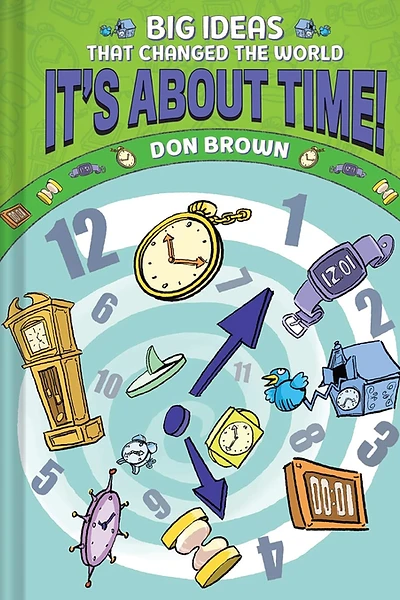
 3-7
3-7GN BROWN
It's About Time!
by Don Brown
Pacing MaterialA graphic novel history of timekeeping, from sundials and water clocks through mechanical clocks, pendulums, quartz crystals, and atomic clocks that measure time to the billionth of a second.
Big Idea
Our ability to measure time has shaped civilization, from agriculture to navigation to modern technology.
Discussion Questions
- 1.How did early civilizations measure time, and why was it important?
- 2.How did the invention of the pendulum clock improve timekeeping?
- 3.Why do we need atomic clocks, and what do they enable?
- 4.How would our lives be different if we couldn't measure time precisely?
Classroom Activity
Sundial Construction
Students build simple sundials and track shadows throughout the day to understand how early humans measured time.
Lesson Plan
Learning Goals
- Trace the evolution of timekeeping from sundials to atomic clocks
- Understand how Earth's rotation creates day and night
- Build and use a sundial to track time
- Connect historical timekeeping to modern precision
Activity Steps
- 1.Introduce early timekeeping methods: sundials, water clocks, hourglasses
- 2.Have students build simple sundials using paper plates and pencils
- 3.Take sundials outside and mark shadow positions at intervals
- 4.Discuss how the Earth's rotation affects the shadow's movement
- 5.Connect to modern timekeeping and why precision matters
Standards Connections
- ELA: RL.3.1 — Ask and answer questions about key details
- ELA: RL.3.2 — Retell stories, including key details
- ELA: RL.3.3 — Describe characters, setting, and events
- ELA: RL.7.6 — Acknowledge differences in characters' points of view
- ELA: SL.3.1 — Participate in collaborative conversations about the text
- ELA: W.3.3 — Write narratives recounting events with descriptive details
- SEL: Responsible Decision-Making
- Art: VA:Re7 — Perceive and analyze artistic work
Pace-Write-Read Study with Pace-Write It!
Focus question: How does an author speed up or slow down information so readers can understand a big idea like the history of time? In It's About Time! by Don Brown, readers move through the story of timekeeping from ancient sundials and water clocks to modern quartz and atomic clocks. Brown uses graphic-novel panels, short bursts of explanation, humor, and quick jumps across history to keep a complex science topic clear, lively, and well paced.
| Element | How to notice or teach it in the novel |
|---|---|
| Pace | Read: Notice how Don Brown moves quickly across centuries but slows down for major inventions like sundials, pendulum clocks, quartz clocks, and atomic clocks. The pacing helps readers feel the long history of discovery without getting stuck in one era too long. Classroom Activity: Write a 6-sentence mini-history of one invention, using 3 short sentences to speed up time and 3 longer sentences to slow down an important moment. |
| Plot | Read: Even though this is a biography/history graphic novel, the book has a plot-like progression: humans need to measure time, invent tools, improve them, and keep chasing greater accuracy. Each new clock solves a problem left by the one before it. Classroom Activity: Create a plot line with 5 steps showing how timekeeping changed from early methods to atomic clocks, then write a short paragraph explaining the biggest turning point. |
| Prosody | Read: Listen to how the short explanatory lines in It's About Time! sound when read aloud—some feel clipped and brisk, while others stretch out to explain scientific ideas. The changing sentence flow matches the changing speed of the book. Classroom Activity: Choose one page or spread and read it aloud two ways—fast and slow—then write 4 lines explaining which pace fits Brown's meaning best. |
| Word pause | Read: Notice places where a single important word or short phrase creates a pause, especially around words tied to precision, invention, or surprise. Brown uses brief wording to let key ideas land before moving on. Classroom Activity: Write 5 short lines about a new invention, putting one powerful science word alone in a sentence for emphasis. |
| Concept | Read: The central concept is that humans have always wanted better ways to measure time, and each discovery builds on earlier ones. Brown turns a huge science-and-history idea into a clear sequence readers can follow. Classroom Activity: Write a concept statement starting with 'People kept inventing better clocks because...' and support it with 3 examples from the book. |
| Voice & World View | Read: Don Brown's voice is informative, curious, and lightly humorous, showing admiration for human problem-solving and scientific discovery. The worldview of the book suggests that progress happens through observation, testing, and improvement over time. Classroom Activity: Write a short explanation of a modern tool in a voice that is both factual and playful, like Brown's tone in It's About Time!. |
| Setting & Place | Read: The book moves across many places and eras, showing that timekeeping developed in different parts of the world and in different historical settings. These shifts in place help readers see timekeeping as a global human challenge. Classroom Activity: Pick one historical setting from the book and write 5-6 sentences describing how that place affected the kind of clock people used there. |
| Point of View | Read: The book is told from an outside, knowledgeable point of view that explains inventions and their impact, rather than from one inventor's personal voice. This broad perspective helps Brown cover a long timeline efficiently. Classroom Activity: Rewrite one invention moment from the first-person point of view of an inventor, beginning with 'I needed a better way to measure time because...'. |
| Original Characters | Read: In this biography-style graphic novel, the 'characters' are often inventors, thinkers, and even the clocks themselves as visual personalities in the artwork. Brown makes historical figures and devices memorable through quick visual and textual sketches. Classroom Activity: Invent a character profile for one clock from the book, giving it traits, a problem, and a goal. |
| Dialogue | Read: Notice how any bits of speech or speech-bubble style moments can make technical history feel immediate and accessible. In a graphic novel, even brief dialogue can break up exposition and speed reader engagement. Classroom Activity: Write an 8-line dialogue between a sundial and an atomic clock arguing over which one is more important to history. |
| Details | Read: Brown selects just enough details about how each device works—like shadows, water flow, swinging pendulums, vibrations, or atomic measurement—to inform without overwhelming. These precise details control pacing by giving readers the essentials. Classroom Activity: Write 4 factual detail sentences about one timekeeping device, and make each detail help explain how it worked. |
| Descriptions | Read: The descriptions in It's About Time! are concise because the art carries part of the meaning. Brown does not over-describe; instead, he pairs visual clues with carefully chosen words. Classroom Activity: Describe one clock from the book in 3 vivid sentences, using one sensory detail, one shape detail, and one motion detail. |
| Strong First Lines | Read: Think about how a strong opening in a nonfiction graphic novel quickly introduces the big topic and hooks readers into wondering how humans measured time. Brown's beginning launches a large historical question without delay. Classroom Activity: Write 3 possible first lines for a nonfiction piece about an invention, and make one of them begin with a surprising fact or problem. |
| Immediacy & Engagement | Read: Brown keeps readers engaged by moving quickly, using humor, and showing how each invention mattered in real life. The graphic format makes distant history feel active and present. Classroom Activity: Write a short paragraph that makes an old invention feel urgent today by connecting it to something students use now. |
| Story Scenes & Summaries & Unique Structures | Read: The book blends summary across long stretches of history with scene-like moments that spotlight key inventions or breakthroughs. This structure lets Brown cover a vast topic while still giving readers memorable stops along the timeline. Classroom Activity: Write one 2-sentence summary of 100 years of change, then one 4-sentence scene showing a single important invention moment. |
| Flashback & Flash Forward & Cliffhangers | Read: Because the book traces history, readers are constantly aware of what came before and what will come next in the evolution of clocks. Brown can end a section with the feeling that a problem still remains, pushing readers forward to the next invention. Classroom Activity: End a paragraph about an early clock with a cliffhanger sentence such as 'But people still had one big problem...' and continue with the next invention. |
| Tension & Suspense & Surprise | Read: The tension in It's About Time! comes from the ongoing challenge of making clocks more accurate. Surprise comes when readers see how inventive people became, from using shadows and water to crystals and atoms. Classroom Activity: Write a 5-sentence paragraph that builds tension around a problem with measuring time and reveals a surprising solution in the last sentence. |
| Page Turns and Chapter Breaks | Read: In a graphic novel, page turns help reveal new inventions, time jumps, or new scientific ideas. Notice how readers are often set up to expect the next breakthrough. Classroom Activity: Plan a 4-panel or 2-page mini-comic about an invention, and write the last line of page 1 so readers want to turn the page. |
| Performance | Read: The visual storytelling invites performance because clocks, inventors, and ideas can be read with dramatic timing—slow for mystery, quick for discovery, sharp for humor. Brown's pacing works especially well when read aloud with expression. Classroom Activity: Perform a short section aloud using different voices for an inventor and a narrator, then write 3 notes about where you paused for effect. |
| Personality | Read: Brown gives personality to a serious topic through playful art, energetic pacing, and a sense of wonder about discovery. Even machines can seem stubborn, clever, or impressive through the way they are presented. Classroom Activity: Write a paragraph giving personality to one object from the book, such as a sundial, water clock, pendulum clock, quartz clock, or atomic clock. |
| Humor | Read: Notice the light humor in the graphic-novel style that keeps dense information from feeling too heavy. Brown uses playful visuals and brisk wording to make the long history of time enjoyable. Classroom Activity: Write 3 funny caption lines for a comic panel showing an old clock trying to compete with a modern atomic clock. |
| Pause | Read: Good pacing includes places where readers stop and think, especially after major leaps in accuracy or when the science becomes more complex. Brown balances movement with moments for understanding. Classroom Activity: Add 3 pause marks into your own informational paragraph by inserting a dash, colon, or short reflective sentence like 'That changed everything.'. |
| Poetry and Poetic Devices | Read: Even in nonfiction, Brown's language can use rhythm, sound, and image to make scientific history memorable. Repeated sounds or vivid comparisons can help readers feel motion, ticking, dripping, or swinging. Classroom Activity: Write 4 lines about time using personification or onomatopoeia, such as 'tick,' 'drip,' or 'hum,' inspired by devices in the book. |
| Repetition | Read: The book repeats a pattern: humans face a problem, invent a tool, discover its limits, and improve it. This repetition creates a steady structure that supports pacing and understanding. Classroom Activity: Write a repeating paragraph frame with 3 rounds: 'People needed..., so they made.... But.... Next....'. |
| Rhythm | Read: The rhythm of the book comes from short text blocks, visual breaks, and repeated leaps from one invention to the next. The stop-and-go rhythm matches the march of scientific progress. Classroom Activity: Write 6 sentences about an invention using this rhythm pattern: short, short, long, short, long, very short. |
| Punctuation | Read: Notice how punctuation in a graphic nonfiction text can speed up or slow down reading—dashes for emphasis, question marks for curiosity, exclamation points for surprise. Brown's punctuation helps shape tone without using many extra words. Classroom Activity: Rewrite 3 plain sentences about clocks using different punctuation to create excitement, suspense, and explanation. |
| Questions | Read: The topic naturally raises questions: How did people tell time before clocks? Why did they need more accurate clocks? How can a clock measure a billionth of a second? These questions drive readers forward. Classroom Activity: Write 5 inquiry questions you could investigate after reading It's About Time!, including at least one about sundials, one about pendulums, and one about atomic clocks. |
| Compare-Contrast | Read: The book is built on comparing older and newer methods of timekeeping, showing how each invention improved on earlier ones. Contrasts between simple natural methods and advanced scientific tools help pace the historical development. Classroom Activity: Make a compare-contrast chart for 2 devices from the book, then turn it into a paragraph using the words 'both,' 'however,' and 'unlike.' |
| Objects | Read: Objects drive this book: sundials, water clocks, mechanical gears, pendulums, quartz crystals, and atomic technology. Brown turns tools into the center of the story because each object represents a stage in human understanding. Classroom Activity: Choose one object from the book and write a museum label that explains what it is, how it works, and why it mattered. |
| Threes | Read: Look for places where ideas can be grouped in threes, such as problem, invention, improvement, or old, newer, newest. Grouping information in threes can make complex history easier to remember. Classroom Activity: Write 3 sentences comparing three timekeeping methods from the book, with one sentence for each method and a final phrase naming the best improvement. |
| Whitespace & Negative Space | Read: In a graphic novel, space on the page matters. Open space around panels or text can slow readers down, spotlight a key fact, or make a new invention stand out. Classroom Activity: Sketch a simple comic layout with 3 panels about a clock invention and leave one area of whitespace to emphasize the most important fact; then explain your choice in 2 sentences. |
| Art & Graphics | Read: Brown's illustrations do major pacing work by showing how devices looked, moved, and changed over time. The graphics help readers grasp scientific ideas quickly, so the text can stay concise. Classroom Activity: Create a labeled diagram or comic panel of one timekeeping device from the book and add 3 captions that explain its function. |
| Interactives & Gamification | Read: The book invites readers to test ideas mentally by asking them to notice patterns of improvement and imagine how each device solved a problem. Its sequence of inventions can easily become a game of matching problems to solutions. Classroom Activity: Design a simple class game with 6 cards—3 'problem' cards and 3 'invention' cards—from It's About Time!, and write one explanation sentence for each match. |
Pace-Write It!
20-Minute Classroom Flow\nRead (5 min): Read aloud a short section of It's About Time! by Don Brown that shows the shift from one timekeeping method to another, such as from sundials or water clocks to pendulum or quartz clocks. Ask students to listen for places where the book speeds up across history and slows down for an important invention.\nNotice (5 min): Students turn and talk: What details did Brown include? Where did the panels, short text, or humor make the reading move faster? Where did the explanation slow down so we could understand how a clock worked? Chart 3 craft moves: quick time jumps, key invention spotlight, and concise science detail.\nWrite (7 min): Students write a short informational paragraph or comic script about one invention from the book. Writing frame: 'At first, people used ____. This worked by ____. But there was a problem: ____. So people invented ____. This changed timekeeping because ____. The most important detail is ____.' Challenge students to include one short sentence for emphasis and one compare-contrast sentence.\nShare (3 min): Partners read their pieces aloud and identify one place where the writing speeds up and one place where it slows down. Invite 1-2 students to share how they used pacing to highlight an important science idea.\nExit ticket: In one or two sentences, answer: How did Don Brown's pacing in It's About Time! help you understand the history of clocks, and what is one pacing move you used in your own writing?