
 K-5
K-5R CUSOLITO
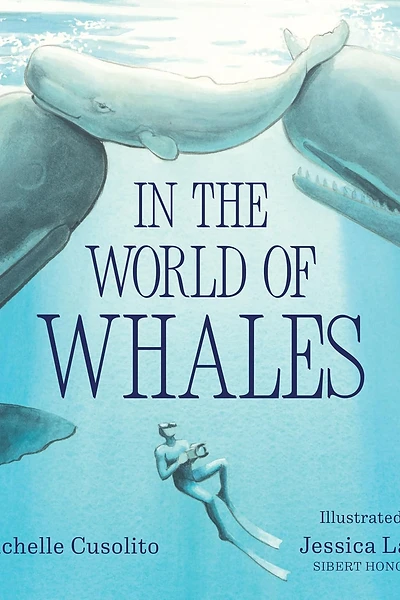
In the World of Whales
by Michelle Cusolito
Pacing MaterialAn immersive look at the underwater world of whales through the eyes of a diver.
Big Idea
Whales live in a world we can only visit, and understanding them helps us protect their home.
Discussion Questions
- 1.What do you think it feels like to be near a whale?
- 2.Why is it important to learn about ocean life?
Classroom Activity
Whale Research Dive
Students research a whale species and create an informational poster.
Lesson Plan
Learning Goals
- Research marine life
- Communicate scientific findings
Activity Steps
- 1.Read the story aloud
- 2.Choose a whale species
- 3.Research facts
- 4.Create and share a poster
Standards Connections
- ELA: RI.K.1 — Ask and answer questions about key details
- ELA: RI.K.2 — Identify main topic and retell key details
- ELA: RI.K.3 — Describe connection between events
- ELA: RI.5.6 — Acknowledge differences in characters' points of view
- ELA: SL.K.1 — Participate in collaborative conversations about the text
- ELA: W.K.3 — Write narratives recounting events with descriptive details
- SEL: Responsible Decision-Making
Pace-Write-Read Study with Pace-Write It!
Focus question: How does an author slow down and speed up a true story to help readers feel what it is like to meet whales underwater? In the World of Whales by Michelle Cusolito is a nonfiction narrative that invites readers into the ocean through the eyes of a diver observing whales up close. The book uses pacing by stretching important moments with vivid sensory details, quiet pauses, and page-by-page discoveries so readers can feel wonder, movement, and anticipation.
| Element | How to notice or teach it in the novel |
|---|---|
| Pace | Read: Notice how Michelle Cusolito slows the action when the diver closely watches whales underwater and speeds up when moving through information about whale behavior and the ocean environment. Classroom Activity: Write 4-6 sentences about seeing a sea animal, stretching the most important moment and moving quickly through the less important parts. |
| Plot | Read: Notice that this real story follows the diver’s experience of entering the whales’ world, observing what happens, and coming away with deeper understanding and awe. Classroom Activity: Map the beginning, middle, and end of a true nature encounter, then write a short paragraph following that order. |
| Prosody | Read: Listen to how the sentences in In the World of Whales sound calm, flowing, and full of wonder, matching the movement of the ocean and the whales. Classroom Activity: Read one page aloud, then write 3 sentences about ocean life using smooth, flowing sentence patterns. |
| Word pause | Read: Notice where individual words and short phrases create little pauses that make readers linger on the diver’s observations of the whales. Classroom Activity: Write a sentence about an underwater moment and add a one- or two-word line or phrase that makes the reader pause and picture it. |
| Concept | Read: Notice how the book builds the big idea that whales are powerful, intelligent animals and that humans can enter their world with respect and curiosity. Classroom Activity: Write 2-3 sentences explaining one big idea you learned about whales, then add a true scene that helps show that idea. |
| Voice & World View | Read: Notice the respectful, amazed voice that presents whales not as monsters or pets, but as living beings in their own ocean home. Classroom Activity: Write a short reflection in a voice of wonder about an animal, showing respect for its world. |
| Setting & Place | Read: Notice how the underwater ocean setting shapes the pacing, with silence, depth, light, and movement making each whale encounter feel immersive. Classroom Activity: Write a setting description of an ocean place using at least 3 sensory details that could slow readers down. |
| Point of View | Read: Notice that the story is shaped through the diver’s experience, helping readers feel close to the whales while still learning true information. Classroom Activity: Write a short scene from the point of view of a person observing marine life, using what that person sees, hears, and feels. |
| Original Characters | Read: Notice that even in this real story, the whales feel distinct through their size, movement, and behavior, while the diver acts as the human guide into their world. Classroom Activity: Write 3 sentences introducing a real animal as if it were a memorable character, using true details. |
| Dialogue | Read: Notice that the book relies more on observation and narration than on conversation, which helps keep the underwater focus strong and quiet. Classroom Activity: Write a whale-watching scene with little or no dialogue, using action and description to carry the moment. |
| Details | Read: Notice the specific details about whales, diving, and the ocean that make the encounter feel true and immediate. Classroom Activity: List 5 exact details about a real animal or habitat, then turn them into a descriptive paragraph. |
| Descriptions | Read: Notice how Michelle Cusolito describes the whales’ bodies, movement, and underwater world so readers can picture being beside them. Classroom Activity: Write 4 descriptive sentences about a whale or another sea creature using size, color, motion, and sound or silence. |
| Strong First Lines | Read: Notice how the opening quickly draws readers into the whale world with curiosity and immediacy. Classroom Activity: Write 3 possible first lines for a true ocean story that make readers want to keep reading. |
| Immediacy & Engagement | Read: Notice how close-up observations and present-feeling narration make readers feel almost face-to-face with the whales. Classroom Activity: Rewrite a plain sentence about seeing a whale so it feels immediate and exciting, as if it is happening right now. |
| Story Scenes & Summaries & Unique Structures | Read: Notice how the book balances scene-like close moments with broader explanatory parts about whales and their lives. Classroom Activity: Write one detailed scene of observing an animal, then add 2 summary sentences that teach facts about it. |
| Flashback & Flash Forward & Cliffhangers | Read: Notice that the book mostly stays in the unfolding encounter, using anticipation rather than dramatic cliffhangers to keep readers engaged. Classroom Activity: Write a paragraph about approaching an ocean animal and end with a line that makes the reader want to turn the page. |
| Tension & Suspense & Surprise | Read: Notice how suspense comes from not knowing when or how the whales will appear and what the diver will notice next. Classroom Activity: Write 5-6 sentences building suspense before an animal appears, then reveal it in the final sentence. |
| Page Turns and Chapter Breaks | Read: Notice how page turns help reveal new whale actions, new views underwater, or new facts, keeping the reading experience moving. Classroom Activity: Fold a paper into 3 parts and plan what detail or image would be revealed after each page turn in a short ocean piece. |
| Performance | Read: Notice that this book invites expressive oral reading with hushed, awed phrasing when the diver is near the whales. Classroom Activity: Choose 3 lines to perform aloud, marking where your voice should slow, soften, or pause. |
| Personality | Read: Notice how the narrator’s curiosity, patience, and sense of wonder shape the mood of the whale encounter. Classroom Activity: Write a first-person response to seeing a whale that shows your personality through word choice and reactions. |
| Humor | Read: Notice that the tone is mostly serious and wonder-filled, showing that pacing can be powerful without jokes. Classroom Activity: Write two versions of an ocean observation, one serious like In the World of Whales and one playful, then compare how the pacing changes. |
| Pause | Read: Notice how quiet moments and reflective pauses give readers time to absorb the beauty and scale of the whales. Classroom Activity: Add a pause to your own nature writing by inserting a short reflective sentence after an exciting moment. |
| Poetry and Poetic Devices | Read: Notice the lyrical language, vivid imagery, and gentle sound patterns that make the nonfiction feel poetic. Classroom Activity: Write a 4-line free-verse poem about whales using imagery and one comparison. |
| Repetition | Read: Notice how repeated ideas about whales, water, and watching can reinforce wonder and rhythm. Classroom Activity: Write 3-4 sentences about the ocean that repeat one key word or phrase for emphasis. |
| Rhythm | Read: Notice how sentence lengths change, with some flowing longer lines and some shorter lines, to echo underwater movement and attention. Classroom Activity: Write one long sentence and two short sentences about a whale encounter to create rhythm. |
| Punctuation | Read: Notice how punctuation helps control pacing, especially commas and periods that slow the reader and shape calm observation. Classroom Activity: Write a short paragraph about marine life, then revise the punctuation to make one part slower and one part faster. |
| Questions | Read: Notice how the book encourages readers to wonder about what whales do, how they move, and what it feels like to share their world. Classroom Activity: Write 3 research or wonder questions you have about whales, then choose one to answer in 2 sentences. |
| Compare-Contrast | Read: Notice how readers naturally compare the small human diver with the enormous whales and compare the human world with the whales’ underwater world. Classroom Activity: Write 4 sentences comparing a diver and a whale using words like both, unlike, and while. |
| Objects | Read: Notice how diving gear, the ocean itself, and the whales’ bodies act like important objects that shape the action and pacing. Classroom Activity: Choose one object from an ocean exploration, such as flippers, a mask, or a boat, and write how it helps tell the story. |
| Threes | Read: Notice places where three related details or images can help build rhythm and emphasis in descriptions of whales and sea life. Classroom Activity: Write a sentence that uses three details about the ocean, such as what the diver sees, hears, and feels. |
| Whitespace & Negative Space | Read: Notice how space on the page and the visual openness around text can mirror the vastness and quiet of the ocean. Classroom Activity: Create a short piece of whale writing and deliberately leave space between lines or ideas to create a feeling of calm and depth. |
| Art & Graphics | Read: Notice how the illustrations or visual elements support the pacing by revealing scale, movement, and mood in the whales’ underwater world. Classroom Activity: Sketch one scene from your own ocean writing and add labels showing the details your words describe. |
| Interactives & Gamification | Read: Notice that while In the World of Whales is not a game, readers can interact by tracking moments of slow pacing, surprise, and wonder across the book. Classroom Activity: Make a simple reading tracker with boxes labeled slow, fast, surprise, and wonder, then mark where those moments happen in a short nonfiction piece you read or write. |
Pace-Write It!
20-Minute Classroom Flow\nRead (5 min): Read aloud a section of In the World of Whales by Michelle Cusolito that describes the diver observing whales underwater. Ask students to listen for places where the story slows down so they can picture the whales and the ocean.\nNotice (5 min): Discuss: Where did the author slow the pacing? What words or details made the whale encounter feel close, quiet, or powerful? Chart student ideas such as sensory details, short pauses, descriptive language, and page-turn anticipation.\nWrite (7 min): Students write a short true-to-life ocean scene or animal encounter that uses slowed-down pacing in the most important moment. Writing frame: “I was ____. Then I noticed ____. Everything seemed to slow down as I saw ____, ____, and ____. I felt ____. In that moment, I understood ____.” Encourage students to add one pause sentence, one strong detail, and one line of wonder.\nShare (3 min): Partners read their favorite sentence aloud and explain how they slowed the pacing for readers. Invite 1-2 students to share with the class.\nExit ticket: Write one sentence answering: How did Michelle Cusolito use pacing in In the World of Whales to help readers feel close to the whales?