 2-5
2-5GN LAMBELET
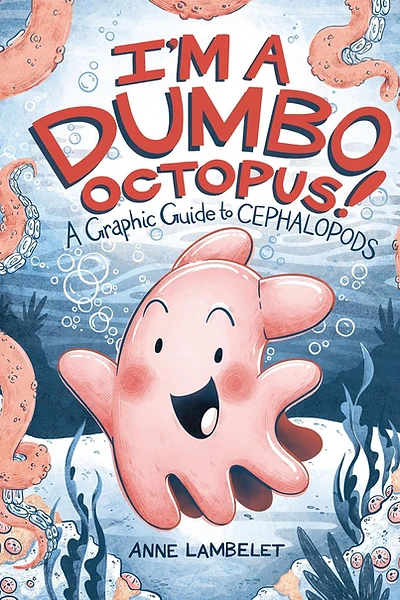
I'm a Dumbo Octopus!
by Anne Lambelet
Pacing MaterialBig Idea
Every creature has unique strengths, and embracing our own identity is just as important as learning about the diverse abilities of others.
Discussion Questions
- 1.Why does Grimpy feel like he doesn't have a special ability compared to the other cephalopods?
- 2.How do the other sea creatures help Grimpy change his perspective on being a dumbo octopus?
- 3.What are some of the 'superpowers' that different cephalopods have, and how do they use them?
- 4.How does the graphic novel format help us understand the science of marine life better than a textbook might?
- 5.If you were a cephalopod, which one would you want to be and why?
Classroom Activity
My Cephalopod Superpower Profile
Students will research a specific cephalopod from the book and create a 'superhero' profile card that highlights its unique biological adaptations as if they were special powers.
Lesson Plan
Learning Goals
- Identify and describe at least three unique adaptations of cephalopods.
- Analyze how the author uses humor and character perspective to convey scientific information.
- Practice synthesizing information from a graphic novel into a creative format.
- Reflect on the theme of self-acceptance and individual strengths.
Activity Steps
- 1.Review the book to select one cephalopod (e.g., cuttlefish, nautilus, squid) featured in the tour.
- 2.Use the book or library resources to list three 'special abilities' or adaptations of that creature.
- 3.Design a profile card that includes a drawing of the creature and a 'hero name' based on its ability.
- 4.Write a short blurb explaining why this creature's ability is important for its survival in the ocean.
- 5.Share profiles in small groups to compare the diverse 'powers' of the cephalopod class.
Standards Connections
- CCSS.ELA-LITERACY.RI.3.3: Describe the relationship between a series of scientific ideas.
- CCSS.ELA-LITERACY.RL.3.1: Ask and answer questions to demonstrate understanding of a text.
- SEL Goal: Demonstrate self-awareness and appreciation for individual differences.
- National Core Arts Standard: Create artistic works that express personal meaning.
Pace-Write-Read Study with Pace-Write It!
The Pace-Write-Read study of 'I'm a Dumbo Octopus!' focuses on how Anne Lambelet balances the rapid-fire delivery of scientific facts with the slower, emotional arc of Grimpy’s self-discovery. By examining the graphic novel's structure, students learn how visual pacing—the size of panels and the density of text—dictates the reader's experience of both the 'tour' and the character's internal journey. This study encourages students to notice how the 'edutainment' style relies on rhythmic page turns to keep the reader engaged. We will explore how the author uses the graphic novel medium to pause for emotional beats, allowing the reader to absorb complex biological concepts before moving to the next humorous interaction.
| Element | How to notice or teach it in the novel |
|---|---|
| Pace | Notice how the author speeds up during fact-heavy tour segments and slows down during Grimpy's moments of self-doubt. |
| Plot | The plot follows a dual track: a scientific tour of cephalopods and an emotional arc about self-acceptance. |
| Prosody | Encourage students to read dialogue aloud, emphasizing the enthusiastic tone of the tour guide versus the somber tone of Grimpy. |
| Word Pause | Look for ellipses or isolated text bubbles that force the reader to stop and reflect on Grimpy's feelings. |
| Concept | The core concept is the diversity of the cephalopod class, taught through a relatable character-driven narrative. |
| Voice & World View | Grimpy’s voice is humble and slightly insecure, which contrasts with the confident, 'show-off' nature of the other creatures. |
| Setting & Place | The deep-sea setting is established through color palettes and background details that ground the scientific facts. |
| Point of View | The story is told from Grimpy’s perspective, making the scientific information feel like a personal conversation. |
| Original Characters | Grimpy is an original character who serves as a proxy for the reader's own curiosity and insecurities. |
| Dialogue | Dialogue is used to deliver facts naturally, making the 'edutainment' feel like a friendly chat rather than a lecture. |
| Details | Pay attention to the small visual details in the background that show how different cephalopods interact with their environment. |
| Descriptions | Visual descriptions of anatomy are integrated into the art, reducing the need for long, dense paragraphs of text. |
| Strong First Lines | The opening establishes the narrator immediately, inviting the reader into the tour. |
| Immediacy & Engagement | The direct address to the reader ('Meet Grimpy!') creates an immediate bond and sense of participation. |
| Story Scenes & Summaries & Unique Structures | The book uses a tour-guide structure to organize the summary of different species into distinct, manageable scenes. |
| Flashback & Flash Forward & Cliffhangers | The book relies on 'mini-cliffhangers' at the end of each species introduction to keep the reader moving to the next page. |
| Tension & Suspense & Surprise | Tension arises from Grimpy’s internal conflict, which is resolved through the surprise of his friends' support. |
| Page Turns and Chapter Breaks | Use page turns to reveal new creatures, creating a sense of discovery and anticipation. |
| Performance | The characters' facial expressions act as a performance, conveying emotion that words alone might miss. |
| Personality | Each cephalopod is given a distinct personality, making the scientific facts easier to remember. |
| Humor | Humor is used to lighten the scientific load, particularly in the interactions between the different species. |
| Pause | Identify panels where there is no text; these are moments for the reader to look at the art and breathe. |
| Poetry and Poetic Devices | Look for alliteration in the descriptions of the creatures' abilities. |
| Repetition | The repetition of the tour-guide format helps structure the reader's expectations. |
| Rhythm | The rhythm is established by the alternating pattern of 'fact' and 'reaction' panels. |
| Punctuation | Notice how exclamation points are used to convey the excitement of the tour guide. |
| Questions | The book frequently asks questions to the reader, keeping them actively involved in the tour. |
| Compare-Contrast | The entire book is a compare-contrast exercise between the dumbo octopus and other cephalopods. |
| Objects | Objects like tools used by the coconut octopus are highlighted as key visual elements. |
| Threes | Look for groupings of three creatures or three facts that help organize the information. |
| Whitespace & Negative Space | Whitespace is used to isolate characters, emphasizing their individuality against the vast ocean background. |
| Art & Graphics | The art style is essential for showing the anatomy of the creatures, which would be difficult to describe in text alone. |
| Interactives & Gamification | The book acts as an interactive tour, inviting the reader to 'join' the journey. |
Pace-Write It!
In 20 minutes, have students pick a two-page spread. They must identify one 'fast' panel (lots of info) and one 'slow' panel (emotional or visual focus). They will then write a one-sentence caption for each that explains why the author chose that specific pacing for that moment.