 3-7
3-7GN DONKIN
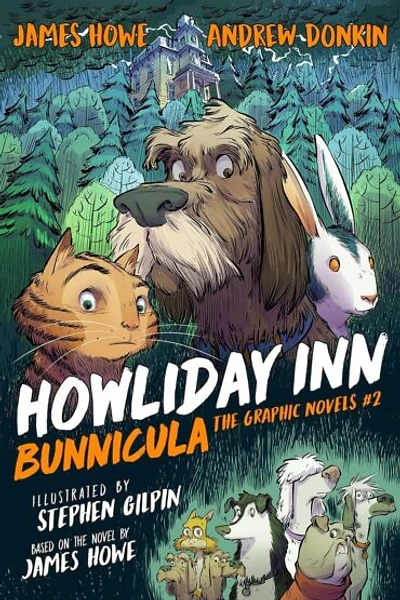
Howliday Inn: Bunnicula the Graphic Novels #2
by James Howe and Andrew Donkin
Pacing MaterialHarold, Chester, and Howie are left at a creepy boarding kennel called Howliday Inn — where strange howls, mysterious shadows, and spooky happenings test their courage and friendship.
Big Idea
Bravery doesn't mean not being scared — it means sticking together even when things feel spooky.
Discussion Questions
- 1.What scares the animals at Howliday Inn?
- 2.How do the characters support each other when they're afraid?
- 3.What mysteries do they uncover at the kennel?
- 4.What's a time you were brave even though you were scared?
Classroom Activity
Mystery Kennel
Write a short mystery story set in a spooky place. Include at least one clue, one suspect, and a surprising ending.
Lesson Plan
Learning Goals
- Explain how Harold, Chester, and Howie respond to spooky events at Howliday Inn, using details from words and illustrations.
- Identify how graphic novel panels, shadows, expressions, and sound effects create suspense.
- Plan and write a short mystery with a spooky setting, at least one clue, one suspect, and a surprising ending that connects to the clue.
- Show through characters’ actions how friendship helps them act bravely even when they feel afraid.
Activity Steps
- 1.Read or revisit a suspenseful scene at Howliday Inn. Discuss: What makes the kennel seem creepy? How do the characters react? What do the pictures reveal that the words do not?
- 2.Create a class 'Mystery Kennel' chart with four headings: Spooky Setting, Clues, Suspects, and Possible Explanations. Add observations from the selected scene, distinguishing what characters know from what they suspect.
- 3.Plan an original mystery set in a boarding kennel or another spooky place. Choose two friends as main characters, a strange event, at least one clue, and one suspect. Decide on a surprising explanation that makes sense of the clue.
- 4.Write the mystery as a short prose story or a six-to-eight-panel comic. Include suspenseful details and a moment when the friends support each other despite feeling scared. Offer a beginning–middle–end organizer for younger writers; challenge older writers to add a misleading clue.
- 5.Exchange drafts with a partner. Ask the partner to identify the clue, suspect, and act of bravery, then check whether the ending explains the mystery. Revise unclear details and share selected stories.
Standards Connections
- ELA: CCSS RL.3.3 / RL.4.3 / RL.5.3 / RL.6.3 / RL.7.3 — Analyze characters, their responses, and how events develop.
- ELA: CCSS RL.3.7 / RL.4.7 / RL.5.7 — Examine how illustrations and visual elements contribute to meaning, tone, and the reading experience.
- ELA: CCSS W.3.3–W.7.3 — Write narratives using descriptive details, sequenced events, and an effective conclusion.
- ELA: CCSS W.3.5–W.7.5 — Strengthen writing through planning, peer feedback, revision, and editing.
- SEL: Self-awareness and relationship skills — Recognize fear and explore how supportive friendships help characters practice bravery.
Pace-Write-Read Study with Pace-Write It!
Focus question: How do writers and artists control pacing to make readers feel suspense, laughter, and courage at just the right moments? In Howliday Inn: Bunnicula the Graphic Novels #2 by James Howe and Andrew Donkin, Harold, Chester, and Howie face eerie sounds, dark shadows, and spooky surprises at a boarding kennel. The graphic novel uses quick dialogue, page turns, visual pauses, and cliffhangers to speed up scary moments, slow down tense ones, and show how resilience and courage grow through friendship.
| Element | How to notice or teach it in the novel |
|---|---|
| Pace | Read: Notice how the story speeds up when Harold, Chester, and Howie react to strange noises at Howliday Inn, then slows down when they study clues or worry about what might happen next. Classroom Activity: Write a short scene in which a character hears a mysterious sound; use 3 fast sentences for panic and 2 slower sentences for thinking bravely. |
| Plot | Read: Track how the plot moves from being dropped off at the kennel, to noticing creepy signs, to facing danger and solving the mystery through teamwork. Classroom Activity: Make a 5-step plot ladder for Harold, Chester, Chester's suspicions, Howie's reactions, and the final brave choice, then write one new middle event that raises the danger. |
| Prosody | Read: Listen to how the dialogue would sound aloud—Harold often sounds steady, Chester sounds dramatic and nervous, and Howie adds playful energy that changes the beat of scenes. Classroom Activity: Write 6 lines of dialogue among Harold, Chester, and Howie, giving each character a different sound and mood. |
| Word pause | Read: Notice where short words, ellipses, or broken speech make readers pause before the next spooky reveal at the inn. Classroom Activity: Write a 4-line suspense moment using at least 2 pauses such as ellipses or dashes before the frightening detail appears. |
| Concept | Read: Think about the big idea that courage does not mean feeling unafraid; in this story, the pets keep going even when the kennel feels unsafe and strange. Classroom Activity: Write 3-4 sentences explaining how one character in Howliday Inn shows resilience, then invent a new challenge that would test that courage again. |
| Voice & World View | Read: Notice the humorous, slightly nervous world view of animal characters trying to understand a human-run place that seems full of danger. Classroom Activity: Write a paragraph in the voice of a pet who thinks an ordinary boarding kennel object is suspicious and scary. |
| Setting & Place | Read: Study how Howliday Inn feels creepy because of dark halls, closed spaces, nighttime sounds, and unfamiliar rooms that keep the pets uneasy. Classroom Activity: Describe a new room in Howliday Inn using 5 sensory details that make it feel both ordinary and spooky. |
| Point of View | Read: Notice how the story lets readers experience events through the pets' fears, guesses, and misunderstandings, which increases suspense and humor. Classroom Activity: Rewrite one tense kennel moment from Chester's point of view and then from Harold's point of view to show how pacing changes. |
| Original Characters | Read: Pay attention to how Harold's calmness, Chester's dramatic suspicion, and Howie's playful energy create a lively team during scary events. Classroom Activity: Invent an original animal guest at Howliday Inn and write a character card showing how that character would help or complicate the mystery. |
| Dialogue | Read: Watch how quick back-and-forth dialogue keeps scenes moving, especially when Chester panics, Harold reasons things out, and Howie reacts in a surprising way. Classroom Activity: Write a dialogue-only scene where the three friends argue about whether to investigate a shadowy hallway. |
| Details | Read: Notice the small clues—sounds, shadows, expressions, and kennel details—that help build mystery before the truth is fully revealed. Classroom Activity: List 6 tiny details from an imagined spooky pet hotel scene, then use them in a paragraph that hints something is wrong. |
| Descriptions | Read: See how descriptions in the words and pictures make ordinary kennel spaces seem eerie and uncertain. Classroom Activity: Write a description of nighttime at Howliday Inn that begins safe, then gradually becomes unsettling. |
| Strong First Lines | Read: Think about how a strong opening in an adventure-mystery needs to quickly place characters in trouble or hint that something odd is ahead. Classroom Activity: Write 3 possible opening lines for a new Bunnicula-style graphic novel adventure starring Harold, Chester, and Howie. |
| Immediacy & Engagement | Read: Notice how the book quickly puts the pets into confusing, risky situations so readers want to know what the next howl or shadow means. Classroom Activity: Write 5 sentences that begin with a problem happening right now, using present-tense feeling words to create urgency. |
| Story Scenes & Summaries & Unique Structures | Read: Observe how some parts feel like full scenes with action and dialogue while other parts move quickly to the next important event, helping the mystery stay tight. Classroom Activity: Write one full scene of 8-10 lines at the kennel, then add a 2-sentence summary that skips ahead to the next scare. |
| Flashback & Flash Forward & Cliffhangers | Read: Notice how cliffhanger endings make readers turn the page when Harold, Chester, and Howie hear or see something alarming before the answer is given. Classroom Activity: End a short scene with a cliffhanger in which Chester discovers something in the dark but the reader does not yet know what it is. |
| Tension & Suspense & Surprise | Read: Track how suspense grows when the pets suspect danger, tension rises as clues pile up, and surprise comes when events are not exactly what they expected. Classroom Activity: Write a paragraph with 3 stages labeled suspect, fear, surprise to show how a mystery unfolds. |
| Page Turns and Chapter Breaks | Read: In a graphic novel, page turns matter because a frightening reveal, a joke, or a sudden clue often appears only after the reader turns the page. Classroom Activity: Plan a 4-panel mini-comic and mark where the page turn should happen to create the biggest surprise. |
| Performance | Read: Notice how the characters' faces, poses, and reactions make the story feel performative, almost like actors on a stage during a spooky comedy. Classroom Activity: Script a dramatic read-aloud of one scary-funny kennel moment and add stage directions for Harold, Chester, and Howie. |
| Personality | Read: Pay attention to how pacing is shaped by personality—Chester's overreactions can speed things up, while Harold's thoughtful nature can slow the moment down. Classroom Activity: Write 2 versions of the same event, one led by Chester's personality and one led by Harold's personality. |
| Humor | Read: Notice how humor keeps the scary parts from becoming too overwhelming, especially through Chester's dramatic ideas and the contrast between fear and silly misunderstandings. Classroom Activity: Write a scary-but-funny exchange in which a character mistakes an ordinary kennel object for something dangerous. |
| Pause | Read: Study how a pause before a reveal can make a bark, creak, or shadow seem more important than if it happened instantly. Classroom Activity: Write a suspense beat in 5 lines, with line 4 as a pause before the final reveal on line 5. |
| Poetry and Poetic Devices | Read: Even in a graphic novel, sound devices such as repetition, onomatopoeia, and vivid comparisons can shape pacing during eerie kennel scenes. Classroom Activity: Write 4 lines about a nighttime hallway at Howliday Inn using onomatopoeia and one simile. |
| Repetition | Read: Notice how repeated sounds, repeated worries, or repeated warnings can make readers feel the pets' growing anxiety. Classroom Activity: Write a short paragraph that repeats one phrase 3 times to build suspense about a mysterious howl. |
| Rhythm | Read: Feel the rhythm created by short bursts of dialogue, action beats, and image-to-image movement as the mystery unfolds. Classroom Activity: Write 6 sentences that alternate short-long-short-long to create a chase-like rhythm. |
| Punctuation | Read: Watch how question marks, exclamation points, ellipses, and dashes shape the tone of Chester's panic, Harold's caution, and the spooky timing of reveals. Classroom Activity: Rewrite the same 3-line kennel scene using different punctuation each time to change the pacing. |
| Questions | Read: Notice how characters' questions—What was that? Who is there? Is the inn safe?—pull readers deeper into the mystery and keep pages turning. Classroom Activity: Write 5 questions Harold, Chester, and Howie might ask while investigating a locked room at Howliday Inn, then answer only 2 of them. |
| Compare-Contrast | Read: Compare Harold's resilience with Chester's fear, or compare the kennel's ordinary purpose with its spooky feeling, to see how contrasts build interest. Classroom Activity: Write a compare-contrast paragraph about how Harold and Chester respond differently to the same frightening event. |
| Objects | Read: Notice how everyday objects in the kennel can become important clues, jokes, or sources of fear depending on how the story presents them. Classroom Activity: Choose 3 objects from a boarding kennel and write how each could seem harmless, suspicious, or helpful in a mystery. |
| Threes | Read: Look for patterns of three in reactions, clues, or events, because triples often make pacing feel complete and memorable in adventure stories. Classroom Activity: Create a rule of three by writing 3 strange sounds the pets hear before they decide to investigate. |
| Whitespace & Negative Space | Read: In a graphic novel, empty space around a panel or speech bubble can slow readers down and make a lonely or tense moment feel bigger. Classroom Activity: Sketch or describe a panel with lots of empty space around Chester or Harold, then write 2 sentences explaining how that space increases suspense. |
| Art & Graphics | Read: Notice how shadows, panel size, expressions, and visual motion in the art help control fear, comedy, and action in Howliday Inn. Classroom Activity: Design 3 comic panels showing a spooky hallway scene, and note where the art should zoom in or pull back to change pacing. |
| Interactives & Gamification | Read: Think about how readers can act like detectives by collecting clues from both words and pictures as Harold, Chester, and Howie explore the inn. Classroom Activity: Create a clue hunt with 5 hidden details from an imagined Howliday Inn scene and challenge a partner to solve the mystery from your clues. |
Pace-Write It!
20-Minute Classroom Flow\nRead (5 min): Read a suspenseful section from Howliday Inn: Bunnicula the Graphic Novels #2 by James Howe and Andrew Donkin in which Harold, Chester, and Howie hear or see something strange at the kennel. Ask students to notice where the scene speeds up, where it slows down, and how the pictures help.\nNotice (5 min): Discuss: What creates suspense—the dialogue, facial expressions, shadows, sound effects, or page turn? Chart student observations under Fast Pace, Slow Pause, and Courage Moment.\nWrite (7 min): Students write their own short spooky scene set in a pet boarding place. They should include one mysterious sound, one pause, one quick burst of dialogue, and one brave action. Writing frame: 'At ________, I heard ________. First, I felt ________. "Did you hear that?" said ________. We moved ________ down the hall. Then we saw ________. Even though I was ________, I ________.'\nShare (3 min): Students read one favorite line to a partner or small group and explain where they used pacing to create suspense or show resilience.\nExit ticket: In 1-2 sentences, answer: How did you use pacing to help your character seem brave even when the setting felt scary?