
 1-4
1-4P GIBSON
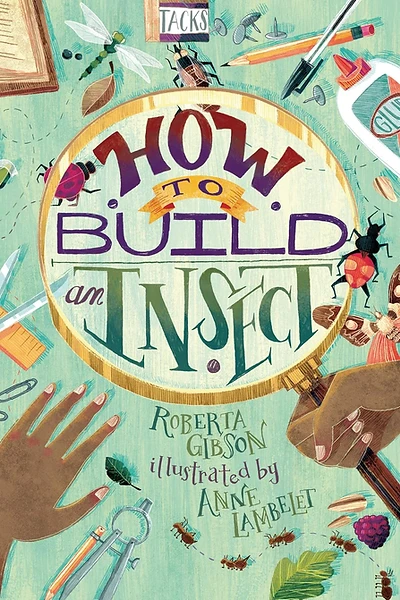
How to Build an Insect
by Roberta Gibson, Illustrated by Anne Lambelet
Pacing MaterialBig Idea
Insects are defined by specific anatomical features, including three body segments, an exoskeleton, and specialized appendages, which allow them to thrive in diverse environments.
Discussion Questions
- 1.What are the three main body parts that every insect must have?
- 2.Why do you think insects have their skeletons on the outside of their bodies instead of the inside?
- 3.How do the antennae and eyes on an insect's head help it survive in the wild?
- 4.If you were to design your own insect, what special features would you give it to help it live in your backyard?
- 5.How does the author use the idea of 'building' an insect to help us understand its anatomy?
Classroom Activity
Build-a-Bug Workshop
Students will apply their knowledge of insect anatomy by constructing a 3D model of an insect using recycled materials, ensuring they include the head, thorax, abdomen, six legs, and antennae.
Lesson Plan
Learning Goals
- Identify the three main body segments of an insect: head, thorax, and abdomen.
- Explain the function of an exoskeleton.
- Differentiate between insects and other arthropods based on physical characteristics.
- Apply scientific knowledge to create a model that represents biological structures.
Activity Steps
- 1.Review the three main body segments and the placement of legs and antennae using the book as a guide.
- 2.Provide students with various recycled materials like cardboard tubes, bottle caps, pipe cleaners, and clay.
- 3.Instruct students to construct their insect, ensuring the legs are attached to the thorax and the antennae are on the head.
- 4.Have students label the parts of their model using small paper flags.
- 5.Allow students to present their 'inventions' to the class, explaining how their insect's features help it survive.
Standards Connections
- NGSS 1-LS1-1: Use materials to solve a human problem by mimicking how animals use their external parts.
- CCSS.ELA-LITERACY.RI.1.1: Ask and answer questions about key details in a text.
- National Core Arts Standard VA:Cr1.1.1a: Engage collaboratively in exploration and imaginative play with materials.
Pace-Write-Read Study with Pace-Write It!
The pacing of 'How to Build an Insect' is deliberate and instructional, mirroring the step-by-step process of assembly. By breaking down complex biological concepts into manageable, sequential 'construction' steps, the book allows young readers to internalize anatomical facts without feeling overwhelmed by scientific jargon. Teachers can use this pacing to model scientific inquiry. By reading at a measured pace that aligns with the 'building' process, educators can encourage students to visualize the insect coming together, turning a static anatomy lesson into an active, imaginative experience.
| Element | How to notice or teach it in the novel |
|---|---|
| Pace | The book uses a steady, instructional pace that mimics a step-by-step guide. |
| Plot | The plot is a procedural narrative where the 'action' is the assembly of an insect. |
| Prosody | Read with a clear, enthusiastic tone to emphasize the excitement of discovery. |
| Word Pause | Pause after each new body part is introduced to allow students to visualize the addition. |
| Concept | The core concept is the structural anatomy of insects. |
| Voice & World View | The voice is encouraging and accessible, treating science as a creative project. |
| Setting & Place | The setting is an abstract, creative space where the 'building' occurs. |
| Point of View | The book uses a second-person perspective, inviting the reader to be the builder. |
| Original Characters | The 'character' is the insect being built, which gains personality through its features. |
| Dialogue | The text functions as a direct dialogue between the author and the reader. |
| Details | Focus on the specific placement of legs on the thorax versus the head. |
| Descriptions | The descriptions are functional, explaining why an insect needs specific parts. |
| Strong First Lines | The opening invites the reader to participate immediately in the construction. |
| Immediacy & Engagement | The direct address keeps the reader engaged as an active participant. |
| Story Scenes & Summaries & Unique Structures | The structure is a unique 'how-to' manual disguised as a picture book. |
| Flashback & Flash Forward & Cliffhangers | The book avoids these, focusing on a linear, logical progression. |
| Tension & Suspense & Surprise | Tension is created by the anticipation of what part will be added next. |
| Page Turns and Chapter Breaks | Page turns act as the 'next step' in the assembly process. |
| Performance | Use hand gestures to indicate where parts are being 'attached' during reading. |
| Personality | The insect's personality is defined by the choices the reader makes in its design. |
| Humor | The humor lies in the playful premise of 'building' a living creature. |
| Pause | Pause to let students point to their own bodies to compare human parts to insect parts. |
| Poetry and Poetic Devices | The language is rhythmic and precise, bordering on poetic in its clarity. |
| Repetition | Repetition of the 'building' theme reinforces the anatomical sequence. |
| Rhythm | The rhythm is steady and predictable, like a set of instructions. |
| Punctuation | Use exclamation points to emphasize the excitement of completing a section. |
| Questions | The text poses implicit questions about how parts function. |
| Compare-Contrast | Compare the insect's exoskeleton to human skin or bones. |
| Objects | The objects are the anatomical parts being assembled. |
| Threes | The three body segments are the central 'three' of the book. |
| Whitespace & Negative Space | Whitespace is used to isolate the insect parts for clarity. |
| Art & Graphics | The illustrations are clean and diagrammatic, supporting the text's instructional nature. |
| Interactives & Gamification | The book is inherently gamified by framing science as a construction challenge. |
Pace-Write It!
In 20 minutes, have students draw a 'blueprint' of an insect on a piece of paper. They must label the head, thorax, and abdomen, and draw six legs attached to the thorax. Then, they must add one 'superpower' feature (like wings or camouflage) and explain in one sentence why that feature helps the insect survive.