 3-7
3-7M HISTORY SMASHERS
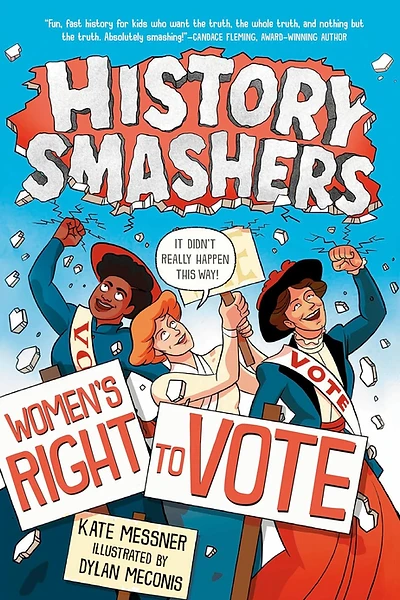
History Smashers: Women's Right to Vote
by Kate Messner
Pacing MaterialBig Idea
History is often shaped by myths and oversimplifications, and critical thinking allows us to uncover the complex, often hidden truths behind historical events.
Discussion Questions
- 1.Why do you think certain myths about historical events, like the Titanic or the Underground Railroad, become more popular than the actual facts?
- 2.How does the author use 'smashing' myths to change the way we view historical figures or events?
- 3.In what ways do the illustrations, sidebars, and photos help you understand the history better than text alone?
- 4.Why is it important to look for multiple perspectives when learning about history, such as the Taino people's experience with Columbus?
- 5.How can we become 'history detectives' in our own lives to make sure we are finding the truth instead of just accepting a story?
Classroom Activity
The Myth-Buster Investigation
Students act as historical investigators to identify a common myth about a historical event, research the actual facts, and create a 'Smash Card' that contrasts the myth with the reality.
Lesson Plan
Learning Goals
- Distinguish between historical myths and verified facts.
- Analyze how visual and textual evidence supports historical claims.
- Synthesize information from multiple sources to construct a more accurate historical narrative.
- Develop critical thinking skills by questioning popular historical narratives.
Activity Steps
- 1.Select a historical event covered in the History Smashers series.
- 2.Identify a common myth associated with that event using the book as a primary source.
- 3.Research or extract the 'smashed' truth provided by the author.
- 4.Create a two-sided 'Smash Card' with the myth on one side and the reality on the other.
- 5.Present the findings to the class, explaining why the myth was incorrect and why the truth matters.
Standards Connections
- CCSS.ELA-LITERACY.RI.4.3: Explain events, procedures, ideas, or concepts in a historical text.
- CCSS.ELA-LITERACY.RI.4.7: Interpret information presented visually, orally, or quantitatively.
- CCSS.ELA-LITERACY.W.4.7: Conduct short research projects that build knowledge about a topic.
- NCSS D2.His.1.3-5: Create and use artifacts to study history.
Pace-Write-Read Study with Pace-Write It!
The History Smashers series by Kate Messner is a masterclass in non-fiction pacing, utilizing a hybrid structure that blends traditional narrative with graphic elements. By alternating between fast-paced debunking of myths and deep-dive informational sidebars, Messner teaches students that writing history is not just about relaying facts, but about managing the reader's curiosity and engagement. This book demonstrates how to use 'interruptions'—such as graphic panels, photos, and sidebars—to control the speed of information delivery. Students learn that pacing is not just about word count, but about the strategic placement of visual breaks that allow the reader to process complex historical truths without feeling overwhelmed.
| Element | How to notice or teach it in the novel |
|---|---|
| Pace | Messner uses short, punchy sentences to build excitement before 'smashing' a myth, creating a fast-paced rhythm. |
| Plot | The plot follows a 'Myth vs. Reality' structure, moving from a common misconception to the historical truth. |
| Prosody | The text uses bold, emphatic language to mimic the tone of a detective uncovering a secret. |
| Word Pause | The author uses short, one-word sentences like 'WRONG!' to force a dramatic pause in the reader's mind. |
| Concept | The core concept is historical inquiry, teaching students to question what they think they know. |
| Voice & World View | The voice is conversational and authoritative, positioning the author as a guide rather than a lecturer. |
| Setting & Place | Setting is treated as a historical site to be investigated, focusing on the reality of the location versus the myth. |
| Point of View | The narrative shifts between the popular historical perspective and the voices of those often left out, like the Taino people. |
| Original Characters | While non-fiction, the author creates a 'detective' persona that acts as a character guiding the reader. |
| Dialogue | Dialogue is used sparingly to highlight historical quotes or to simulate a debate between myth and fact. |
| Details | Specific, gritty details are used to replace romanticized versions of history. |
| Descriptions | Descriptions are vivid and grounded in primary source evidence, avoiding flowery language. |
| Strong First Lines | The books often start with a bold, provocative question or a direct challenge to a common belief. |
| Immediacy & Engagement | The use of direct address ('You might think...') keeps the reader personally involved in the investigation. |
| Story Scenes & Summaries & Unique Structures | The book uses a unique structure of alternating text blocks and graphic panels to keep the reader moving. |
| Flashback & Flash Forward & Cliffhangers | Cliffhangers are used at the end of sections to encourage the reader to turn the page to find the 'truth'. |
| Tension & Suspense & Surprise | Tension is built by setting up a myth and then 'smashing' it with a surprising, evidence-based reveal. |
| Page Turns and Chapter Breaks | Page turns are used to reveal the 'truth' after a myth is presented on the previous page. |
| Performance | The text is written to be read aloud with high energy, perfect for a dramatic classroom performance. |
| Personality | The author's personality shines through as an enthusiastic, truth-seeking educator. |
| Humor | Humor is used to lighten the weight of serious historical topics, making them more accessible to young readers. |
| Pause | Graphic panels act as visual pauses, allowing the reader to digest the information before moving on. |
| Poetry and Poetic Devices | The series uses alliteration and rhythmic repetition to make historical facts memorable. |
| Repetition | The phrase 'Right? WRONG!' is a recurring motif that anchors the series' structure. |
| Rhythm | The rhythm is staccato and energetic, mirroring the pace of a fast-moving investigation. |
| Punctuation | Exclamation points are used frequently to emphasize the 'smashing' of myths. |
| Questions | Questions are the engine of the book, driving the reader to seek answers alongside the author. |
| Compare-Contrast | This is the primary structural device, comparing the myth to the historical reality. |
| Objects | Historical objects, like quilts or ships, are used as focal points for uncovering the truth. |
| Threes | The author often lists three myths before smashing them, creating a satisfying pattern. |
| Whitespace & Negative Space | Whitespace is used effectively to separate the 'myth' text from the 'truth' sidebars. |
| Art & Graphics | Illustrations are essential, providing visual evidence that contradicts the romanticized myths. |
| Interactives & Gamification | The book feels like a game, with the reader acting as a player trying to solve the mystery of history. |
Pace-Write It!
Students will spend 20 minutes writing a 'Myth-Buster' paragraph about a common school-day misconception (e.g., 'We have to go outside for recess even if it rains'). They must use the 'Right? WRONG!' structure, include one piece of 'evidence' (a fact), and use a graphic element (a drawing or sidebar) to support their argument.