 3-7
3-7M HISTORY SMASHERS
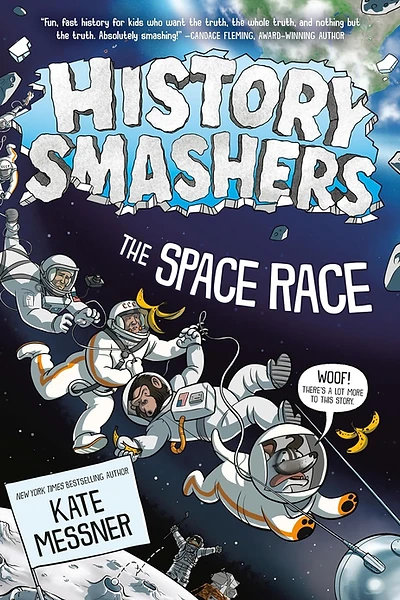
History Smashers: The Space Race
by Kate Messner, Dylan Meconis
Pacing MaterialHistory Smashers: The Space Race busts common myths about the Cold War competition to explore the cosmos. Kate Messner highlights the unsung heroes, including the women and animals, who were instrumental in reaching the moon while correcting popular misconceptions about the timeline and technology.
Big Idea
Historical narratives are often simplified; true scientific and political progress relies on diverse, often overlooked contributors and complex, iterative failure.
Discussion Questions
- 1.Why does history often focus on the most famous astronauts while ignoring the thousands of workers behind the scenes?
- 2.How does the author use humor and graphic novel elements to change the way we think about the Cold War?
- 3.What is the difference between a historical 'fact' and a 'myth' in the context of the Space Race?
- 4.How did the political rivalry between the US and the USSR influence the speed and safety of their space programs?
- 5.Why is it important to learn about the animals that were sent into space before humans?
Classroom Activity
The Myth-Buster Research Lab
Students work in teams to identify a commonly held belief about the Space Race and use the text to 'bust' it. They will create a 'Fact vs. Myth' infographic to present their findings to the class.
Lesson Plan
Learning Goals
- Analyze how historical myths are constructed and perpetuated.
- Evaluate the role of diversity in scientific discovery.
- Practice evidence-based reading by citing specific sections of the text.
- Develop collaborative research and presentation skills.
Activity Steps
- 1.Assign small groups a specific chapter of the book.
- 2.Have groups identify one 'myth' mentioned by the author.
- 3.Task groups with finding the supporting evidence that 'smashes' that myth.
- 4.Students design a simple poster or digital infographic illustrating the truth.
- 5.Groups give a two-minute lightning presentation on their discovery.
Standards Connections
- CCSS.ELA-LITERACY.RI.6.1: Cite textual evidence to support analysis of informational text.
- CCSS.ELA-LITERACY.RI.6.7: Integrate information presented in different media or formats.
- SEL.CASEL.Self-Awareness: Recognizing personal biases and challenging them through inquiry.
- SEL.CASEL.Relationship Skills: Collaborative problem solving in group activities.
Pace-Write-Read Study with Pace-Write It!
The pacing of this book utilizes a modular, 'burst' style that mirrors the rapid-fire nature of the Space Race itself. By alternating between narrative history, graphic panels, and 'myth-buster' callouts, the text keeps readers engaged through constant shifts in visual and cognitive tempo.
| Element | How to notice or teach it in the novel |
|---|---|
| Graphic Panels | Notice how these panels provide a humorous pause to digest dense historical information. |
| Callout Boxes | Teach these as 'fast facts' that break the rhythm of the main paragraph flow. |
| Transition Paragraphs | Identify how the author bridges the gap between Cold War politics and scientific milestones. |
| Image Captions | Point out how captions move the reader's eye and control the reading speed. |
| Chapter Openers | Discuss how chapter titles set the stakes for the upcoming historical investigation. |
| Interviews | Look for shifts in pacing when the narrative voice switches to a first-person perspective. |
| Bold Text | Use bolding to teach students how to identify the main idea quickly. |
| Question Headings | Analyze how asking a question at the start of a section forces the reader to slow down to find the answer. |
| Historical Timelines | Observe how these compress time to show a sequence of fast-paced failures and successes. |
| Maps | Use maps to ground the reader's pace in geographical reality. |
| Myth-Buster Icons | Explain these as rhythmic triggers for the reader to pay extra attention. |
| Dialogue Bubbles | Discuss how dialogue accelerates the pace of the narrative. |
| Biographical Sidebars | Show how these act as 'brakes' to highlight individual human stories. |
| Technical Explanations | Notice the change in vocabulary density that requires a slower, more careful read. |
| Humorous Annotations | Identify these as a stylistic choice to keep the reader's tone lighthearted. |
| Glossary Terms | Teach students to pause when encountering new, emphasized vocabulary. |
| Primary Source Quotes | Notice how these shift the weight of the narrative back to history as it happened. |
| Conclusion Summaries | Examine how the end of chapters provides a rhythmic 'cool down' period. |
| Author Notes | Teach these as an extra layer of pacing that explains the meta-process of writing. |
| References to Pop Culture | Highlight how these bridge the past to the reader's modern experience. |
| Sentence Length Variation | Show students how short sentences increase the intensity of the Space Race atmosphere. |
| Pacing of Failure | Analyze how failures are described quickly to match the 'try, fail, repeat' cycle of space tech. |
| Pacing of Success | Notice the descriptive, slow-motion language used during major landing events. |
| Paragraph Breaks | Explain that frequent breaks are designed for shorter attention spans. |
| Recurring Icons | Help students recognize icons as pacing markers for different content types. |
| Interactive Prompts | Point out where the author forces the reader to stop and think. |
| Comparison Tables | Use these to compare US and Soviet progress in a single glance. |
| Footnotes | Explain their function as 'extra credit' information for curious readers. |
| Chapter Subheadings | Treat these as rhythmic beats that guide the reader through sections. |
| Pacing of Conflict | Look for how political tension is paced through rapid listing of events. |
| Visual Analogies | Analyze how illustrations explain complex concepts without slowing down the reading speed. |
| Emotional Anchors | Teach students to slow down when the text shifts to the human cost of the race. |
| The 'Smash' Factor | Examine the dramatic irony used to pivot from a myth to the truth. |
Pace-Write It!
Students choose a 2-page spread and map the pacing using a 'Traffic Light' system: Red for slow/complex text, Yellow for medium-density facts, and Green for fast-paced graphic sections or action sequences.