 3-7
3-7M HISTORY SMASHERS
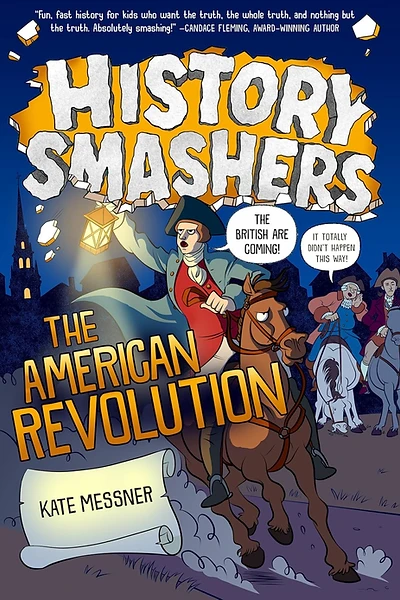
History Smashers: The American Revolution
by Kate Messner, Dylan Meconis
Pacing MaterialHistory Smashers: The American Revolution challenges the sanitized versions of the war for independence, replacing national myths with documented historical realities. Kate Messner weaves together the experiences of diverse populations, including women, enslaved people, and Native Americans, to provide a multifaceted look at the birth of the United States.
Big Idea
History is not a static list of dates and heroes but an evolving investigation where questioning popular myths is essential to uncovering the truth. Students must learn to evaluate historical accounts by looking for diverse perspectives and evidence.
Discussion Questions
- 1.Why does our culture often simplify history into legends like Paul Revere's ride?
- 2.How does including the stories of enslaved people and women change our understanding of 'liberty' in 1776?
- 3.What criteria should we use to decide if a historical source is reliable?
- 4.Why might some people prefer historical myths over the complicated truth?
- 5.How does the format of this book—using sidebars, graphics, and humor—help the reader engage with the facts?
Classroom Activity
The Myth-Buster Investigative Report
Students will select one popular 'myth' from the Revolutionary War era and conduct a mini-investigation using primary and secondary sources. They will then create an infographic that outlines both the myth and the historical reality they uncovered.
Lesson Plan
Learning Goals
- Distinguish between commonly held historical myths and verifiable evidence.
- Evaluate the role of diverse perspectives in shaping historical events.
- Practice synthesizing complex historical information into visual formats.
- Develop critical thinking skills regarding bias in historical narratives.
Activity Steps
- 1.Select a historical myth mentioned in the book, such as the Boston Tea Party or the signing of the Declaration of Independence.
- 2.Consult the book and at least one other provided source to identify the 'smashed' myth vs. the historical record.
- 3.Create a draft of a 'True vs. Myth' infographic including key names, dates, and evidence.
- 4.Add visual elements like sketches, timelines, or speech bubbles to make the historical reality clear.
- 5.Present the infographics to the class to debunk their chosen myths together.
Standards Connections
- CCSS.ELA-LITERACY.RI.5.1: Quote accurately from a text when explaining what the text says.
- CCSS.ELA-LITERACY.RI.5.9: Integrate information from two texts on the same topic.
- SEL.CASEL: Self-awareness by recognizing personal biases in learning historical content.
- SEL.CASEL: Social awareness by acknowledging the contributions of marginalized groups in American history.
Pace-Write-Read Study with Pace-Write It!
The pacing in History Smashers is intentionally fragmented, using short chapters, graphic callouts, and 'Smash Alert' sidebars to mimic the rapid-fire style of digital media. This approach keeps young readers engaged while constantly signaling shifts in tone from educational narrative to critical inquiry.
| Element | How to notice or teach it in the novel |
|---|---|
| Smash Alerts | Teach students to treat these as 'stop-and-think' points where the narrative interrupts itself to correct a bias. |
| Short Chapters | Encourage students to use these breaks to summarize the previous event before moving on. |
| Graphic Sidebars | Show students how to integrate these visual breaks without losing the flow of the main text. |
| Primary Source Insets | Guide students to pause the narrative flow to analyze the actual language of original documents. |
| Dialogue Bubbles | Use these to teach how historical characters speak and react, emphasizing personality over myth. |
| Humorous Annotations | Discuss how levity is used to keep the reader's pace from stalling during heavy historical details. |
| Maps and Diagrams | Direct students to trace spatial relationships between battlefields to visualize the war's scope. |
| Vocabulary Pop-ups | Highlight these as speed-bumps for understanding context-specific terminology. |
| Narrative Asides | Point out how these break the fourth wall, keeping the reader connected to the author's voice. |
| Timeline Intervals | Teach students to use these to pace their mental reconstruction of sequential events. |
| Chapter Headings | Ask students to predict the focus before reading, helping them manage their expectations of speed. |
| Illustrative Metaphors | Analyze how art helps explain complex political motives without slowing down the read. |
| Sidebar Quotes | Explain that these function as pauses for reflection on primary source perspectives. |
| Question Prompts | Use these to regulate pacing by forcing a stop for self-inquiry. |
| Biography Snippets | Treat these as rhythmic deviations that provide human context for the war. |
| Comparison Tables | Guide readers to slow down when analyzing data points across multiple columns. |
| Author Notes | Teach these as end-of-section reflections on the research process. |
| Iconography | Use icons to help students scan for specific types of information at different speeds. |
| Humor Shifts | Monitor how the reader's emotional pacing fluctuates with the author's dry wit. |
| Historical Myths | Identify these as central anchors that slow down the narrative to allow for debunking. |
| Call-out Boxes | Use these as high-intensity, short-duration information bursts. |
| Action Sequences | Highlight how sentence structure becomes faster when describing military maneuvers. |
| Political Context Blocks | Instruct students to read these slower to ensure comprehension of complex motivation. |
| Diverse Perspective Insets | Emphasize these as deliberate rhythm changes to include underrepresented voices. |
| Document Analysis | Show how slowing down here rewards the reader with deeper understanding. |
| Checkpoints | Encourage students to use these for self-monitoring their own pacing. |
| Character Sketches | Use these to provide depth to fast-moving historical events. |
| Myth-vs-Fact Tables | Teach students to compare these horizontally to speed up data synthesis. |
| Footnotes | Explain that these are optional deep-dives that change the reading pace. |
| Concluding Summaries | Use these to wrap up the narrative velocity at the end of every chapter. |
| Visual Pacing | Observe how the layout designs force the eye to move in non-linear ways. |
| Interactive Questions | Force a pause to connect past events to modern life. |
| Concluding Reflection | Slow the reader down to synthesize the chapter's main argument. |
Pace-Write It!
Provide students with a 2-page excerpt and ask them to map the 'rhythm' of the page by highlighting text in blue for narrative flow and yellow for informational breaks or sidebars; students then discuss how this visual variety aids their focus.