 3-7
3-7M HISTORY SMASHERS
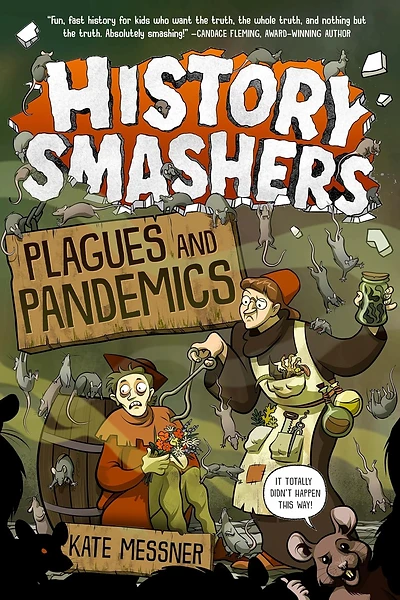
History Smashers: Plagues and Pandemics
by Kate Messner, Dylan Meconis
Pacing MaterialBig Idea
History is not just a collection of static facts, but a dynamic process of investigation where we must actively question myths and uncover hidden truths to understand the past accurately.
Discussion Questions
- 1.Why do you think some historical myths, like mummy curses or alien-built pyramids, become more popular than the actual historical facts?
- 2.How does the author use the 'History Smasher' persona to change the way we look at traditional history textbooks?
- 3.What is the difference between a primary source and a myth, and why is it important to check our sources?
- 4.How do the illustrations and graphic panels in the book help us understand complex historical events better than text alone?
- 5.If you were to 'smash' a common myth about your own school or town, what would it be and how would you prove the truth?
Classroom Activity
The Myth-Buster Investigation
Students act as historical detectives to identify a common misconception, research the actual facts using multiple sources, and create a 'Smashed Myth' graphic panel.
Lesson Plan
Learning Goals
- Distinguish between historical fact and popular myth.
- Analyze how visual elements and text work together to convey information.
- Practice critical thinking by evaluating the credibility of historical claims.
- Synthesize research into a concise, persuasive visual format.
Activity Steps
- 1.Select a common historical myth or a 'secret' from the book to investigate.
- 2.Use classroom resources or library books to find two reliable sources that explain the reality behind the myth.
- 3.Draft a 'Smashed' statement that clearly identifies the myth and provides the corrected fact.
- 4.Design a graphic panel that includes a 'Myth' bubble and a 'Truth' bubble, incorporating a sketch or diagram.
- 5.Present the findings to the class, explaining why the myth was believed and how the truth was uncovered.
Standards Connections
- CCSS.ELA-LITERACY.RI.4.7: Interpret information presented visually.
- CCSS.ELA-LITERACY.RI.4.9: Integrate information from two texts on the same topic.
- CCSS.ELA-LITERACY.W.4.7: Conduct short research projects.
- SEL: Responsible Decision-Making
Pace-Write-Read Study with Pace-Write It!
The 'History Smashers' series by Kate Messner and Dylan Meconis serves as a masterclass in non-fiction pacing, demonstrating how to balance dense historical information with the high-energy engagement of a graphic novel. By utilizing a 'stop-and-go' rhythm, the authors prevent reader fatigue, ensuring that complex topics like the Titanic or the American Revolution remain accessible and exciting for young readers. This book teaches the craft of writing by showing how to interweave narrative inquiry with factual evidence. Students learn that pacing isn't just about speed; it is about the strategic placement of 'smash' moments—where a myth is debunked—to create a sense of discovery that keeps the reader turning pages.
| Element | How to notice or teach it in the novel |
|---|---|
| Pace | The pace is intentionally fast, using short, punchy sentences to mirror the excitement of a detective uncovering a secret. |
| Plot | The plot follows an investigative arc: identify a myth, present the evidence, and reveal the truth. |
| Prosody | Encourage students to read the 'Myth' sections with a questioning tone and the 'Truth' sections with a confident, authoritative voice. |
| Word Pause | Use the bolded 'SMASH' headers as natural pauses to allow the reader to process the shift from fiction to fact. |
| Concept | The core concept is 'historical inquiry,' teaching students that history is a process of questioning. |
| Voice & World View | The voice is conversational and peer-to-peer, positioning the reader as a fellow investigator rather than a student being lectured. |
| Setting & Place | Setting is treated as a crime scene; the authors describe historical locations with specific, gritty details to ground the reader. |
| Point of View | The POV is second-person, directly addressing the reader to make them feel like an active participant in the investigation. |
| Original Characters | The 'History Smasher' persona acts as a guide, providing a consistent personality that anchors the reader through diverse topics. |
| Dialogue | Dialogue is used sparingly in graphic panels to provide quick, punchy reactions to historical revelations. |
| Details | Details are chosen for their 'shock value' to challenge preconceived notions, such as specific dates or overlooked figures. |
| Descriptions | Descriptions are visual and immediate, focusing on what was actually found in the archaeological or historical record. |
| Strong First Lines | The books often start with a bold, provocative question that immediately challenges a common belief. |
| Immediacy & Engagement | The use of direct address and rhetorical questions keeps the reader engaged in the 'now' of the investigation. |
| Story Scenes & Summaries & Unique Structures | The structure alternates between narrative summaries and graphic 'smash' panels to keep the reading experience dynamic. |
| Flashback & Flash Forward & Cliffhangers | Cliffhangers are used at the end of sections to tease the next 'smash' revelation. |
| Tension & Suspense & Surprise | Tension is built by presenting a popular myth as fact before 'smashing' it with evidence. |
| Page Turns and Chapter Breaks | Page turns are used to reveal the 'truth' after a myth is presented on the previous page. |
| Performance | The text is written to be read aloud, with clear shifts in tone that invite dramatic performance. |
| Personality | The authorial personality is curious, skeptical, and respectful of the reader's intelligence. |
| Humor | Humor is used to lighten the weight of serious historical events, making the learning process enjoyable. |
| Pause | The layout provides visual 'white space' that acts as a pause for the reader to reflect on the new information. |
| Poetry and Poetic Devices | The authors use alliteration and rhythmic repetition in their 'smash' headers to create a memorable cadence. |
| Repetition | The repetition of the 'Myths! Lies! Secrets!' hook creates a familiar, comforting rhythm for the series. |
| Rhythm | The rhythm is syncopated, alternating between long paragraphs of context and short, sharp bursts of graphic information. |
| Punctuation | Exclamation points are used frequently to emphasize the 'smashing' of myths and the excitement of discovery. |
| Questions | Questions are the engine of the book, driving the reader to seek answers alongside the author. |
| Compare-Contrast | The entire book is a compare-contrast exercise between 'what we thought' and 'what we know.' |
| Objects | Historical objects (like a mummy's tomb or a ship's artifact) are used as focal points for the investigation. |
| Threes | The 'Myths! Lies! Secrets!' trio is a classic use of the rule of three to establish the book's mission. |
| Whitespace & Negative Space | Whitespace is used to isolate graphic panels, ensuring the reader focuses on one 'smash' at a time. |
| Art & Graphics | The art is not just decorative; it is a primary source of information that clarifies the text. |
| Interactives & Gamification | The book feels like a game, with the reader 'collecting' facts to win the argument against the myth. |
Pace-Write It!
In 20 minutes, have students write a 'Myth vs. Truth' paragraph. They must start with a common misconception (e.g., 'Everyone thinks...'), use a transition word like 'However,' and end with a 'Smash' sentence that reveals the truth with an exclamation point.