 3-7
3-7M HISTORY SMASHERS
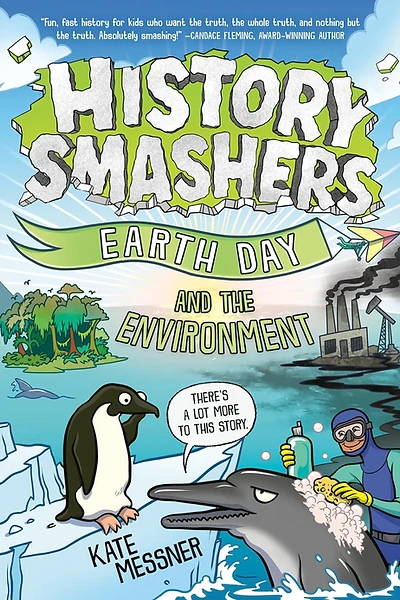
History Smashers: Earth Day and the Environment
by Kate Messner
Pacing MaterialA middle-grade nonfiction book exploring the true history of the environmental movement and Earth Day, separating fact from myth.
Big Idea
The history of the environmental movement is a complex, ongoing process of activism and policy changes that requires us to look past popular myths to understand how real change happens. By analyzing historical narratives, students learn to distinguish between symbolic gestures and impactful environmental action.
Discussion Questions
- 1.How does Kate Messner’s 'myth-busting' approach change how you view famous stories about the start of Earth Day?
- 2.Why is it important to learn about the people whose contributions to the environmental movement might have been left out of history books?
- 3.What is the difference between individual action and systemic policy change, and why do we need both?
- 4.How do the graphics and sidebars in this book help you better understand the 'smashing' of common historical misconceptions?
- 5.If you were to document a current environmental issue, what facts would you investigate to ensure you aren't just repeating a popular myth?
Classroom Activity
The Environmental Myth-Buster Gallery Walk
Students work in groups to research a common environmental 'myth' presented in the book and create a 'Smash-the-Myth' infographic that presents the researched truth alongside visual evidence.
Lesson Plan
Learning Goals
- Identify common misconceptions regarding the history of the environmental movement.
- Evaluate the reliability of historical narratives by comparing popular stories to factual evidence.
- Practice synthesizing complex historical information into a concise, visual format.
- Demonstrate an understanding of the impact of grassroots versus political activism.
Activity Steps
- 1.Divide students into groups and assign each a specific myth discussed in the book, such as the origins of the first Earth Day or the impact of individual littering campaigns.
- 2.Students revisit the relevant chapter to identify the 'myth' and the 'truth' as explained by Messner.
- 3.Groups create a two-sided poster: one side titled 'The Myth' (with common misconceptions) and the other 'The Reality' (with evidence-based facts from the text).
- 4.Encourage students to incorporate graphic elements similar to the book's style to explain their findings.
- 5.Host a gallery walk where students present their posters and peer-review the accuracy of the myth-busting information.
Standards Connections
- CCSS.ELA-LITERACY.RI.4.8: Explain how an author uses reasons and evidence to support particular points in a text.
- CCSS.ELA-LITERACY.W.4.7: Conduct short research projects that build knowledge through investigation of different aspects of a topic.
- C3 Framework D2.His.1.3-5: Create and use a chronological sequence of related events to compare developments that happened at the same time.
Pace-Write-Read Study with Pace-Write It!
In 'History Smashers: Earth Day and the Environment,' Kate Messner demonstrates that nonfiction writing does not have to be dry or encyclopedic to be informative. Through a deliberate blend of narrative investigation and investigative journalism, she models how to hook readers by challenging what they think they already know. This book is an excellent masterclass for students on how to layer information without overwhelming the reader. By utilizing a conversational yet rigorous tone, Messner shows how writers can establish authority while remaining approachable, guiding young writers to see that history is a dynamic, evolving dialogue rather than a fixed set of facts. The text illustrates that the 'pace' of a nonfiction book relies on the strategic alternation between summarizing broad historical eras and zooming in on specific, punchy details that reveal the truth.
| Element | How to notice or teach it in the novel |
|---|---|
| Pace | Messner controls pace by alternating between short, myth-busting chapters and longer narrative dives, keeping the reader moving quickly through dense topics. |
| Plot | The plot is structured around the evolution of environmental awareness, treating the movement itself as the protagonist encountering obstacles and conflicts. |
| Prosody | The text uses a consistent, urgent rhythm that mimics a detective uncovering clues, which helps maintain reader engagement throughout technical explanations. |
| Word Pause | Messner uses single-word subheadings or bolded exclamations to create intentional pauses that allow the reader to digest a shocking new fact. |
| Concept | The central concept is that 'history is a story,' and the book teaches students to interrogate the narrator of that story. |
| Voice & World View | The voice is that of a skeptical, curious mentor who encourages the reader to question sources rather than accepting them at face value. |
| Setting & Place | Setting is used to contrast the smog-filled, industrial landscapes of the 1960s with the cleaner environments we strive for today. |
| Point of View | The book utilizes a 'detective' point of view, where the author and reader are partners investigating the truth behind historical myths. |
| Original Characters | While historical figures are real, Messner gives them character-like depth by highlighting their contradictions and human failings. |
| Dialogue | Dialogue is used sparingly to quote primary sources, allowing historical figures to speak for themselves against the backdrop of the author's analysis. |
| Details | The book excels at using 'smash' details—surprising, specific facts that directly contradict a widely held misconception. |
| Descriptions | Descriptions of environmental disasters are vivid and sensory, intended to evoke a visceral reaction rather than just a factual understanding. |
| Strong First Lines | Each chapter opens with a hook that sets up a myth immediately, forcing the reader to want to learn why that myth is wrong. |
| Immediacy & Engagement | Direct address (e.g., 'Do you really think...?') brings the reader into the room, creating a sense of immediate collaboration. |
| Story Scenes & Summaries & Unique Structures | The book structures history through 'Myth' vs. 'Truth' segments, providing a reliable, recurring structure for the reader to follow. |
| Flashback & Flash Forward & Cliffhangers | Cliffhangers are used at the end of sections to leave a lingering question about a historical figure’s true motivations. |
| Tension & Suspense & Surprise | Tension is created by the conflict between what we were taught in school versus what the evidence reveals. |
| Page Turns and Chapter Breaks | Chapter breaks are timed to coincide with the conclusion of one myth, setting the stage for the next mystery. |
| Performance | The writing encourages a performative read, with bolded text and exclamation points that invite excitement. |
| Personality | The author’s personality shines through her humor and witty asides, making the history feel personal. |
| Humor | Humor is used to lighten the mood of serious topics, preventing the reader from becoming overwhelmed by environmental crises. |
| Pause | Messner uses graphical 'stop' signs or 'smash' bubbles to force a pause, emphasizing a critical takeaway. |
| Poetry and Poetic Devices | While prose-heavy, the book uses alliteration and strong rhythmic phrasing to make historical facts memorable. |
| Repetition | The repetition of the 'History Smasher' branding builds a predictable rhythm that rewards the reader for recognizing the pattern. |
| Rhythm | Short, choppy sentences are used during moments of realization to create a rapid, heartbeat-like rhythm. |
| Punctuation | Exclamation points and em-dashes are used frequently to show the author’s excitement and urgency about revealing the truth. |
| Questions | The book is built entirely on inquiry, using questions to prompt critical thinking before providing the historical answers. |
| Compare-Contrast | The entire book is built on the compare-contrast of 'Myth' vs 'Truth' which serves as the core engine of the text. |
| Objects | Objects like trash, posters, and protest signs are described as symbols that have evolved over time. |
| Threes | Facts are often presented in groups of three to provide a clear, balanced overview of a complex event. |
| Whitespace & Negative Space | The layout uses ample whitespace, call-out boxes, and graphics to prevent the text from feeling like a wall of data. |
| Art & Graphics | Art isn't just decoration; it functions as a visual shorthand that summarizes data or highlights a contrast in evidence. |
| Interactives & Gamification | The 'Myth' labels act as game-like triggers that gamify the process of learning by challenging the reader to solve the history puzzle. |
Pace-Write It!
Students spend 20 minutes picking a topic they feel they 'know' well and drafting a two-paragraph myth-buster entry. Paragraph 1: State the myth as a 'fact.' Paragraph 2: 'Smash' that myth using a specific, researched detail, mirroring Messner's investigative voice.