
 K-5
K-5C HENRY
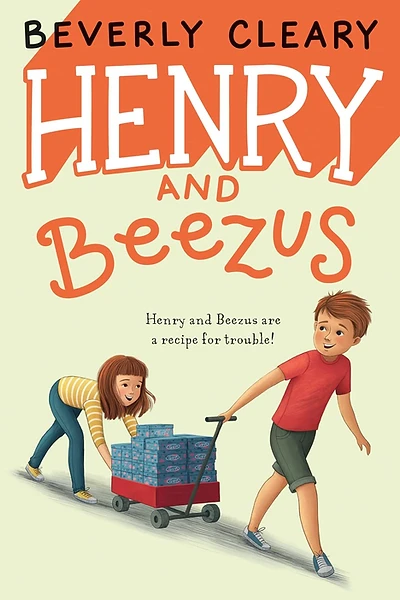
Henry and Beezus
by Beverly Cleary
Pacing MaterialHenry and Beezus is the second book in the Henry Huggins series. This humorous children's novel was written by Beverly Cleary and published in 1952. Henry comes up with many ways to earn money for the new red bicycle he wants, but they all seem to end up with him in trouble. Finally his friend Beezus gives him an idea that actually works.
Big Idea
Persistence and creative problem-solving are essential when pursuing a goal, especially when initial attempts lead to unexpected challenges. Henry Huggins learns that success often requires the support of friends and the ability to pivot when plans go awry.
Discussion Questions
- 1.Why is Henry so determined to get a red bicycle, and what does this tell us about his character?
- 2.How do Henry's failed attempts to earn money change his perspective on hard work?
- 3.In what ways does Beezus act as a supportive friend, and why is her idea more successful than Henry's previous ones?
- 4.How does the presence of characters like Ramona Quimby and Ribsy the dog complicate Henry's plans?
- 5.What does the book suggest about the difference between wanting something and earning it?
Classroom Activity
The Klickitat Street Entrepreneur Challenge
Students will brainstorm and map out a 'business plan' for a goal they want to achieve, identifying potential obstacles and creating a 'Plan B' for when things don't go as expected, mirroring Henry's journey.
Lesson Plan
Learning Goals
- Analyze character motivation and development throughout a narrative.
- Identify the cause-and-effect relationships between character actions and plot outcomes.
- Practice creative problem-solving by developing contingency plans for real-world scenarios.
- Understand the theme of perseverance in the face of repeated failure.
Activity Steps
- 1.Discuss Henry's various money-making schemes and why they failed.
- 2.Have students identify a personal goal they would like to achieve.
- 3.Students create a 'Goal Map' listing their primary plan and two potential obstacles they might face.
- 4.Students write a 'Pivot Plan' for each obstacle, explaining how they would adjust their strategy.
- 5.Share plans in small groups to receive feedback on the feasibility of their ideas.
Standards Connections
- ELA: RL.3.3 (Describe characters in a story and explain how their actions contribute to the sequence of events)
- SEL: Responsible Decision-Making
- ELA: W.3.2 (Write informative/explanatory texts to examine a topic)
Pace-Write-Read Study with Pace-Write It!
Beverly Cleary’s 'Henry and Beezus' is a masterclass in pacing through episodic structure. By focusing on Henry’s repeated, failed attempts to earn money, Cleary creates a rhythmic narrative that builds anticipation and humor, teaching students how to use 'failure cycles' to keep readers engaged. This book demonstrates how to balance fast-paced, chaotic scenes—like the bubble gum incident—with slower, reflective moments where characters learn from their mistakes. Students can study how Cleary uses chapter breaks to reset the tension, allowing the reader to breathe before diving into the next humorous disaster.
| Element | How to notice or teach it in the novel |
|---|---|
| Pace | Cleary uses a brisk, episodic pace where each chapter introduces a new scheme that quickly spirals into chaos. |
| Plot | The plot follows a clear 'try-fail' cycle that keeps the reader invested in Henry's ultimate success. |
| Prosody | The dialogue should be read with a natural, conversational rhythm that reflects the everyday speech of children in the 1950s. |
| Word Pause | Use pauses before the reveal of a disaster to heighten the comedic effect of Henry's mishaps. |
| Concept | The central concept is the universal desire for independence and the value of hard-earned rewards. |
| Voice & World View | The voice is grounded in the perspective of a middle-class boy, making his frustrations feel authentic and relatable. |
| Setting & Place | Klickitat Street serves as a character itself, providing a familiar, contained world where Henry's adventures occur. |
| Point of View | The third-person limited perspective allows us to see Henry's earnest intentions while recognizing the humor in his mistakes. |
| Original Characters | Characters like Ramona are introduced as agents of chaos, providing necessary friction to Henry's plans. |
| Dialogue | Dialogue is used to show the dynamic between Henry and Beezus, highlighting their friendship and differing approaches. |
| Details | Specific details about the cost of the bike and the mechanics of his jobs make the stakes feel real. |
| Descriptions | Cleary uses simple, vivid descriptions to paint the picture of a shiny red bike that represents Henry's dream. |
| Strong First Lines | The opening establishes the goal immediately, pulling the reader into Henry's singular focus. |
| Immediacy & Engagement | The immediate consequences of Henry's actions keep the reader engaged in the 'what happens next' factor. |
| Story Scenes & Summaries & Unique Structures | The book uses a series of self-contained scenes that build toward a larger narrative arc. |
| Flashback & Flash Forward & Cliffhangers | Chapter endings often act as mini-cliffhangers, teasing the next attempt at earning money. |
| Tension & Suspense & Surprise | Tension is built through the anticipation of whether a scheme will succeed or fail. |
| Page Turns and Chapter Breaks | Chapter breaks are used to transition between different money-making attempts, providing a natural pause. |
| Performance | The text invites expressive reading, especially during scenes involving the mischievous Ribsy. |
| Personality | Henry's personality is defined by his well-meaning but often misguided determination. |
| Humor | Humor is derived from the irony of Henry's plans backfiring in increasingly ridiculous ways. |
| Pause | Use pauses to emphasize the 'oops' moments when Henry realizes he is in trouble. |
| Poetry and Poetic Devices | While prose, the repetition of the 'bike' motif acts as a rhythmic anchor for the story. |
| Repetition | The repetition of failed attempts reinforces the theme of persistence. |
| Rhythm | The narrative rhythm mimics the cycle of hope and disappointment. |
| Punctuation | Exclamation points are used to convey Henry's excitement and the suddenness of his mishaps. |
| Questions | The story constantly poses the question: 'Will this be the time Henry finally succeeds?' |
| Compare-Contrast | Compare Henry's approach to earning money with Beezus's more thoughtful strategy. |
| Objects | The red bicycle is the central object that drives all character motivation. |
| Threes | The rule of three is often applied to the escalation of Henry's problems. |
| Whitespace & Negative Space | The simple, clean prose leaves room for the reader to imagine the neighborhood setting. |
| Art & Graphics | Illustrations help visualize the era and the specific antics of Ribsy and Ramona. |
| Interactives & Gamification | The book's structure invites readers to 'guess' the outcome of each new scheme. |
Pace-Write It!
Students have 20 minutes to write a 'One-Page Disaster' scene. They must describe a character attempting a simple task (like making a sandwich or cleaning a room) that goes hilariously wrong, focusing on using short, punchy sentences to increase the pace as the disaster unfolds.