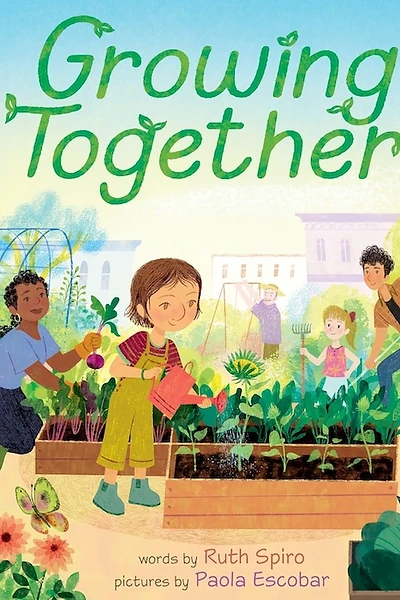
 K-2
K-2P ESCOBAR
Growing Together
by Ruth Spiro, pictures by Paola Escobar
Pacing MaterialA community garden brings neighbors together across generations — a celebration of growth, cooperation, and the joy of getting your hands dirty.
Big Idea
Things grow when we care for them together — patience, teamwork, and nurturing help gardens and communities thrive.
Discussion Questions
- 1.How do the people in the garden help each other?
- 2.What does a garden need to grow?
- 3.How is a garden like a community?
- 4.What would you grow in your own garden?
Classroom Activity
Garden Journal
Students create a 'garden journal' — planning a classroom garden with labeled plants and care instructions.
Lesson Plan
Learning Goals
- Identify what plants need to grow.
- Explain how teamwork helps a community.
- Design a simple garden plan.
- Write clear care instructions.
Activity Steps
- 1.Read the book, noting how the community works together in the garden.
- 2.Discuss what a garden needs to grow — soil, water, sun, care.
- 3.Students design a garden plan with at least 3 plants.
- 4.Write one care instruction for each plant.
Standards Connections
- ELA: RL.K.1 — Ask and answer questions about key details
- ELA: RL.K.2 — Retell stories, including key details
- ELA: RL.K.3 — Describe characters, setting, and events
- ELA: RL.2.6 — Acknowledge differences in characters' points of view
- ELA: SL.K.1 — Participate in collaborative conversations about the text
- ELA: W.K.3 — Write narratives recounting events with descriptive details
- SEL: Relationship Skills
- SEL: Social Awareness
- Art: VA:Re7 — Perceive and analyze artistic work
Pace-Write-Read Study with Pace-Write It!
Focus question: How does a story about a garden grow slowly and joyfully while still keeping readers turning the pages? In Growing Together by Ruth Spiro, illustrated by Paola Escobar, a community garden becomes a place where children, adults, and elders work side by side. The pacing feels warm and steady, using repeated garden actions, lively page turns, and bright visual details to show how growth in a garden and growth in a community happen bit by bit.
| Element | How to notice or teach it in the novel |
|---|---|
| Pace | Read: Notice how Growing Together moves at a gentle, growing pace, like planting, watering, waiting, and blooming. The story does not rush; it lets readers feel that community is built little by little. Classroom Activity: Write 3 short sentences that show something growing step by step, using first, next, and finally. |
| Plot | Read: Notice the simple plot arc in Growing Together: neighbors come to the garden, work together, and create something beautiful as they grow connections across generations. The garden gives the story a clear beginning, middle, and end. Classroom Activity: Draw and label the beginning, middle, and end of a class garden story. |
| Prosody | Read: Listen to how the language in Growing Together sounds smooth and welcoming when read aloud, matching the calm teamwork of the neighbors. The flow of the words supports the cozy, hopeful feeling of the story. Classroom Activity: Echo-read a favorite page with a partner, then write one sentence that sounds good when read aloud. |
| Word pause | Read: Notice where you naturally pause in Growing Together to look closely at the garden, the people, and the changing plants. These little pauses help readers savor growth and cooperation. Classroom Activity: Choose one sentence idea about planting and add a slash where a reader should pause when reading it aloud. |
| Concept | Read: The big concept in Growing Together is that gardens and communities both need care, patience, and many helping hands. Ruth Spiro shows growth as both physical and emotional. Classroom Activity: Write one sentence that tells what can grow in a garden and one sentence that tells what can grow in a neighborhood. |
| Voice & World View | Read: Notice the warm, inclusive voice of Growing Together and its world view that everyone has something valuable to contribute. The story celebrates cooperation across ages and backgrounds. Classroom Activity: Write 2 sentences in a kind, welcoming voice inviting neighbors to help in a garden. |
| Setting & Place | Read: Notice how the community garden is more than a backdrop in Growing Together; it is the heart of the story where people meet, dig, plant, and connect. The setting shapes the action and the theme. Classroom Activity: Describe a special outdoor place in 3 sentences and tell how people could work together there. |
| Point of View | Read: Notice that Growing Together presents the garden community from an inviting outside view so readers can watch many neighbors participate. This broad point of view helps the whole community feel important. Classroom Activity: Rewrite one garden moment from the point of view of a child, an older neighbor, or even a seed. |
| Original Characters | Read: Notice how the people in Growing Together feel distinct because they are shown as different ages and members of one shared neighborhood. The mix of generations makes the garden community memorable. Classroom Activity: Invent a new neighbor who joins the garden and write 3 details about what that person brings. |
| Dialogue | Read: Notice how any spoken moments or implied talk in Growing Together would sound encouraging, helpful, and community-building. The story’s social energy comes from people working together and likely sharing ideas. Classroom Activity: Write 4 lines of dialogue between a child and an elder deciding what to plant. |
| Details | Read: Notice the small details in Growing Together—soil, tools, plants, hands at work, and neighbors side by side—that make the garden feel alive. These details slow the pace in a good way and help readers notice growth. Classroom Activity: Make a list of 5 garden details, then use 3 of them in one sentence. |
| Descriptions | Read: Notice how Growing Together uses clear, inviting description to help readers picture dirt, plants, and people caring for the garden together. Description helps the steady pacing feel rich instead of slow. Classroom Activity: Write a describing sentence about a seed, a sprout, or muddy hands using at least 2 adjectives. |
| Strong First Lines | Read: Notice how the opening of Growing Together quickly introduces the book’s warm garden world and invites readers into a story of shared work. A strong start makes readers ready to join in. Classroom Activity: Write an opening line for a story about a class garden that makes readers want to keep reading. |
| Immediacy & Engagement | Read: Notice how Growing Together keeps readers engaged by showing hands-on actions like digging, planting, and tending, which make the experience feel close and active. Readers can imagine themselves right in the garden. Classroom Activity: Write 2 action sentences that begin with -ing verbs or strong action verbs, such as Digging, watering, or patting. |
| Story Scenes & Summaries & Unique Structures | Read: Notice how Growing Together likely balances scene-like moments of neighbors working together with broader summary moments that show time passing and plants growing. This structure helps the story move through a whole season of change. Classroom Activity: Write one sentence that zooms in on one garden moment and one sentence that summarizes many days of growing. |
| Flashback & Flash Forward & Cliffhangers | Read: Notice that Growing Together is mostly rooted in the present, but readers can imagine what came before the garden and what will happen after the plants bloom. The story does not need big cliffhangers because the gentle suspense comes from waiting for growth. Classroom Activity: Write one flash forward sentence beginning with Soon... to tell what the garden will look like later. |
| Tension & Suspense & Surprise | Read: Notice that the tension in Growing Together is soft and hopeful: Will the garden grow? Will the neighbors’ hard work pay off? The surprise comes from seeing how much can bloom when people cooperate. Classroom Activity: Write 2 sentences that build gentle suspense about a tiny seed before it sprouts. |
| Page Turns and Chapter Breaks | Read: Notice how page turns in Growing Together can reveal new growth, new neighbors joining in, or a fuller garden. In a picture book, the page turn helps pacing by creating a moment of waiting and discovery. Classroom Activity: Plan a 2-page mini-book idea and write what happens before the page turn and what is revealed after it. |
| Performance | Read: Notice that Growing Together invites expressive read-aloud performance with warm tone, slower pacing, and emphasis on action words about planting and growing. The performance should sound caring and communal. Classroom Activity: Practice reading one line in a soft, hopeful voice, then write a note telling how your voice should sound. |
| Personality | Read: Notice the personality of Growing Together: gentle, joyful, hardworking, and welcoming. The book’s personality shapes its pacing because it lingers on cooperation instead of rushing to a problem. Classroom Activity: Write 3 words that match the personality of the garden, then use one in a sentence. |
| Humor | Read: Notice that any humor in Growing Together is likely light and playful, coming from garden messiness, muddy hands, or cheerful moments of working together. This kind of humor keeps the story bright. Classroom Activity: Write a funny but kind sentence about getting dirty while helping in a garden. |
| Pause | Read: Notice where Growing Together invites a pause to admire a sprout, a flower, or a moment of neighbors connecting. These pauses help readers feel appreciation and wonder. Classroom Activity: Write one short sentence of wonder, such as Look! or It grew!, and decide where it belongs in a garden story. |
| Poetry and Poetic Devices | Read: Notice how Growing Together may use poetic language, image patterns, or gentle comparisons to make gardening feel beautiful and meaningful. The story’s theme of growth is naturally lyrical. Classroom Activity: Write a simile about the garden, such as The leaves opened like... . |
| Repetition | Read: Notice any repeated garden actions, words, or ideas in Growing Together, such as planting, watering, waiting, and growing. Repetition supports the rhythm and reinforces the theme that community care happens again and again. Classroom Activity: Write a 3-line piece that repeats the same starter, such as We dig... We plant... We grow... . |
| Rhythm | Read: Notice the steady rhythm of Growing Together, which echoes the repeated motions of gardening and the dependable return of neighbors to the shared space. This rhythm makes the story feel comforting. Classroom Activity: Clap the beat of a sentence from your own writing, then revise it so it sounds smooth and steady. |
| Punctuation | Read: Notice how punctuation in Growing Together helps control pacing by slowing readers down with commas or adding excitement with exclamation points at moments of discovery. Small marks shape big feelings. Classroom Activity: Write one garden sentence with a comma and one with an exclamation point. |
| Questions | Read: Notice the questions readers may ask while reading Growing Together: What will grow first? Who will help next? How will the garden change the neighborhood? Questions keep readers engaged. Classroom Activity: Write 2 questions a child in the garden might ask while planting seeds. |
| Compare-Contrast | Read: Notice the contrasts in Growing Together between before and after, tiny seed and full plant, working alone and working together, young and old. These comparisons help show change over time. Classroom Activity: Write 2 sentences comparing the garden at the start and at the end. |
| Objects | Read: Notice how objects in Growing Together—seeds, watering cans, shovels, gloves, baskets, and plants—help tell the story of labor and care. Ordinary objects become important story tools. Classroom Activity: Choose one garden object and write 2 sentences showing how it helps the community. |
| Threes | Read: Notice how ideas in Growing Together can be grouped in threes for satisfying rhythm, such as dig, plant, water or seed, sprout, bloom. Groups of three help writing sound complete. Classroom Activity: Write a sentence that uses three garden actions or three things seen in the garden. |
| Whitespace & Negative Space | Read: Notice how the open space on pages in Growing Together can give readers room to look closely at the illustrations and feel the calm pace of the story. Whitespace can make important images and words stand out. Classroom Activity: Create a one-page picture-book layout with one short sentence and lots of blank space around your garden drawing. |
| Art & Graphics | Read: Notice how Paola Escobar’s illustrations help pace Growing Together by showing the changing garden, the emotions of neighbors, and the warmth of the community. The art carries part of the story, especially the feeling of growth over time. Classroom Activity: Draw a before-and-after garden picture and write one caption for each part. |
| Interactives & Gamification | Read: Notice that Growing Together naturally invites interactive reading because students can spot changes in the garden, track who is helping, and predict what will grow next. These playful noticing tasks keep readers involved. Classroom Activity: Make a garden growth checklist with 4 boxes, such as seed, sprout, leaf, flower, and write one sentence for one stage. |
Pace-Write It!
20-Minute Classroom Flow\nRead (5 min): Read Growing Together by Ruth Spiro aloud, pausing to show Paola Escobar’s illustrations. Ask students to listen for places where the story slows down to show planting, waiting, and growing together.\nNotice (5 min): Chart what students notice about pacing: repeated garden actions, page turns that reveal change, and the steady movement from seed to community celebration. Ask: How does the book show that growth takes time? How do the pictures help the story feel calm and alive?\nWrite (7 min): Students write a tiny garden scene that shows slow, joyful growth. Writing frame: First, we ________. Next, we ________. Then, we wait and ________. Finally, we see ________. Encourage students to include one garden detail, one action, and one feeling word.\nShare (3 min): Partners read their pieces aloud with gentle, expressive pacing. Listeners name one part where the writer helped them feel the growth happening step by step.\nExit ticket: Complete this sentence: The pacing in Growing Together feels ________ because ________.