
 2-6
2-6GN HIRSCH
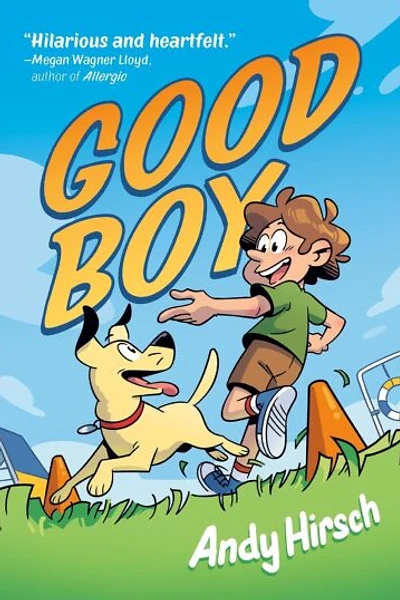
Good Boy
by Andy Hirsch
Pacing MaterialA boy and his new puppy navigate the ups and downs of training, friendship, and growing up together in this heartfelt graphic novel.
Big Idea
Training a dog teaches us about patience, trust, and the kind of love that grows through effort.
Discussion Questions
- 1.What does the boy learn from training his puppy?
- 2.Why is patience important when teaching someone something new?
- 3.How does the puppy change the boy's life?
- 4.What's something you've had to be patient about?
Classroom Activity
Train a Friend
Write step-by-step instructions for teaching a dog (or a friend!) a new trick. Draw each step as a comic panel.
Lesson Plan
Learning Goals
- Explain how the boy and puppy’s experiences in Good Boy connect patience, trust, and friendship.
- Write clear, sequenced instructions for teaching a simple trick or skill, using words such as first, next, then, and finally.
- Combine pictures, captions, and speech bubbles to show each teaching step in a comic.
- Revise instructions after a partner checks whether the steps are easy to follow.
- Identify encouraging responses to mistakes that help a learner feel safe and supported.
Activity Steps
- 1.Read or revisit a scene from Good Boy involving training or a challenge between the boy and puppy. Discuss: What does each character need? How can patience and encouragement build trust? Identify how panels and expressions help tell the story.
- 2.Introduce Train a Friend. Choose a simple dog trick, such as sitting on cue, or a skill a classmate can voluntarily try, such as folding a paper hat. Explain that classmates are learning partners, not pets; all practice must be respectful and optional. No live animals are needed.
- 3.Plan 4–6 teaching steps with a clear starting point, a small action for each step, and an encouraging response. For a dog trick, include a gentle cue and a reward for progress; avoid force or punishment. Younger students may dictate or use sentence starters, while older students add troubleshooting advice.
- 4.Draw one comic panel per step. Add numbered captions with sequence words, speech bubbles for cues or encouragement, and expressions that show how the teacher and learner feel. Include a moment when patience helps after a mistake.
- 5.Exchange comics with a partner. Have partners explain the sequence or voluntarily test a classroom-safe skill. Ask them to flag missing steps or unclear wording, then revise the comic.
- 6.Share finished comics and connect them to Good Boy: How does your teaching plan show that trust and friendship grow through effort? Finish with one sentence about what a patient teacher does.
Standards Connections
- ELA: RL.2.3 — Describe how characters respond to major events and challenges; extend in grades 3–6 to analyzing character actions and development.
- ELA: W.2.2 — Write explanatory text that introduces a topic and develops it with facts; extend in grades 3–6 to clearly organized procedural explanations.
- ELA: W.3.5 — Strengthen writing through planning, revising, and editing with peer and adult support; adapt support to grades 2–6.
- ELA: SL.2.1 — Participate in collaborative conversations, build on others’ ideas, and ask for clarification; extend discussion expectations in grades 3–6.
- SEL: Relationship skills and self-management — Practice encouragement, respectful collaboration, patience, and constructive responses to mistakes.
Pace-Write-Read Study with Pace-Write It!
Focus question: How does pacing help readers feel the growing friendship between a boy and his puppy? In Good Boy by Andy Hirsch, a boy and his new dog learn how to live, play, and train together through funny, warm, and sometimes challenging moments. The graphic novel format helps Hirsch control pacing with panels, page turns, dialogue, and quiet pauses so readers can feel both the excitement and the heart of their friendship.
| Element | How to notice or teach it in the novel |
|---|---|
| Pace | Read: Notice how Good Boy moves quickly during playful puppy chaos and slows down during tender training and friendship moments between the boy and his dog. Classroom Activity: Write a short scene about a pet or friend that starts fast with action and then slows down for a caring moment. |
| Plot | Read: Follow how the story grows from getting a new puppy to learning responsibility, trust, and kindness as the boy and dog face small everyday ups and downs. Classroom Activity: Make a 5-part plot ladder for a friendship story: beginning, problem, try, change, and ending. |
| Prosody | Read: Listen to how the dialogue and sound effects in Good Boy create a lively reading voice, especially in energetic dog scenes and calmer emotional scenes. Classroom Activity: Choose one moment and script it with expressive read-aloud lines and sound words that match the mood. |
| Word pause | Read: Notice where short phrases, speech bubbles, and panel breaks make you pause before the next action or feeling in the boy-and-puppy relationship. Classroom Activity: Write 6 lines of dialogue between a child and a pet, using line breaks to create pauses. |
| Concept | Read: Think about the big idea that friendship and kindness take patience, practice, and understanding, especially when someone is still learning. Classroom Activity: Write a paragraph explaining what a puppy can teach a person about kindness. |
| Voice & World View | Read: Notice how the story presents the world with warmth, humor, and empathy, showing that mistakes are part of learning and growing together. Classroom Activity: Write about a frustrating moment from a kind and forgiving point of view. |
| Setting & Place | Read: Watch how home, neighborhood, and everyday spaces become important places for training, playing, and building trust in Good Boy. Classroom Activity: Describe a familiar place where a friendship grows, and show how the place affects what happens. |
| Point of View | Read: Notice how readers understand both the boy’s responsibilities and the puppy’s feelings through the graphic novel’s visual storytelling and scene choices. Classroom Activity: Rewrite one training moment twice—once from the boy’s point of view and once from the dog’s point of view. |
| Original Characters | Read: Pay attention to how Andy Hirsch makes the boy and his puppy feel distinct and memorable through their reactions, habits, and growing bond. Classroom Activity: Invent an original child-and-animal pair and list 3 traits for each character. |
| Dialogue | Read: Notice how dialogue helps show training, encouragement, confusion, and affection between the boy, the puppy, and the people around them. Classroom Activity: Write a dialogue scene in which a child tries to teach a pet or friend one important rule. |
| Details | Read: Look closely at the small details that show puppy behavior, care routines, and the little moments that build friendship in Good Boy. Classroom Activity: Write a list of 8 specific details from a pet-care or friendship moment, then use them in a scene. |
| Descriptions | Read: Notice how the art and words together describe energy, mess, excitement, and tenderness without needing long paragraphs. Classroom Activity: Describe a busy scene and a quiet scene using only 3 sentences for each. |
| Strong First Lines | Read: Think about how the opening quickly pulls readers into the world of a new puppy and the changes that come with him. Classroom Activity: Write 3 possible first lines for a story about a surprising first day with a pet or new friend. |
| Immediacy & Engagement | Read: Notice how the panels make readers feel close to the action when the puppy is learning, making mistakes, or sharing a sweet moment with the boy. Classroom Activity: Write a scene in present tense so the reader feels right inside the moment. |
| Story Scenes & Summaries & Unique Structures | Read: Watch how Good Boy balances full scenes of important moments with quicker transitions that move time forward in the boy and puppy’s growth. Classroom Activity: Write one full scene about a training problem, then add a 2-sentence summary of what happens over the next week. |
| Flashback & Flash Forward & Cliffhangers | Read: Notice where readers may think back to earlier mistakes or successes and how page endings can make you want to know whether the puppy will improve. Classroom Activity: End a scene with a mini-cliffhanger about whether a pet or friend will finally get something right. |
| Tension & Suspense & Surprise | Read: Look for moments when the puppy’s unpredictability creates tension, and notice how surprises can be funny, stressful, or heartwarming. Classroom Activity: Write a short scene where something goes wrong during practice, but the ending reveals a sweet surprise. |
| Page Turns and Chapter Breaks | Read: Notice how page turns in the graphic novel can reveal a joke, a mess, a new problem, or a meaningful emotional beat in the friendship. Classroom Activity: Plan a 4-panel comic and mark where the page turn should happen for the biggest effect. |
| Performance | Read: Pay attention to how characters’ body language, facial expressions, and movement perform feelings like excitement, guilt, patience, and love. Classroom Activity: Write a scene with only action and dialogue tags that show emotion without naming the emotion. |
| Personality | Read: Notice how the puppy’s playful personality and the boy’s developing responsibility shape the pacing and mood of the story. Classroom Activity: Write a character sketch showing how a lively personality changes a normal day. |
| Humor | Read: Look for the funny misunderstandings, dog behavior, and visual jokes that keep Good Boy light even when training is hard. Classroom Activity: Write a humorous scene in which a pet or child misunderstands what is supposed to happen. |
| Pause | Read: Notice the quiet pauses that let readers feel affection, disappointment, or pride after a big or silly moment in Good Boy. Classroom Activity: Add one silent beat to a scene by writing a line that shows a character stopping, looking, or thinking. |
| Poetry and Poetic Devices | Read: Notice how repetition, sound, and image in the graphic novel can feel poetic, especially in scenes of movement, barking, running, or cuddling. Classroom Activity: Write a 6-line poem about a puppy using sound words and repeated beginnings. |
| Repetition | Read: Watch how repeated training attempts, repeated commands, and repeated caring actions show that friendship grows through practice. Classroom Activity: Write a scene that repeats one phrase 3 times, with the meaning changing each time. |
| Rhythm | Read: Notice the rhythm created by short panels, quick dialogue, and bursts of action followed by slower emotional beats. Classroom Activity: Write 8 sentences that alternate between short, quick action and longer reflective lines. |
| Punctuation | Read: Look at how exclamation points, question marks, ellipses, and bold comic-style emphasis help control energy and feeling in Good Boy. Classroom Activity: Rewrite the same line of dialogue 4 times using different punctuation to change its meaning. |
| Questions | Read: Notice the questions readers and characters may ask: Will the puppy listen? Will the boy stay patient? How will their friendship grow? Classroom Activity: Write 5 story questions before drafting a friendship scene, then answer them in your writing. |
| Compare-Contrast | Read: Compare the puppy at the beginning of Good Boy with the puppy later in the story, and compare the boy’s early expectations with what he learns. Classroom Activity: Make a T-chart comparing ‘At first’ and ‘Later’ for a character relationship, then write a paragraph using both sides. |
| Objects | Read: Pay attention to important objects like toys, leashes, bowls, treats, or training tools that help tell the story of care and connection. Classroom Activity: Choose one object from a pet or friendship story and write how it appears in the beginning, middle, and end. |
| Threes | Read: Notice how events, attempts, or jokes can feel satisfying when they come in threes, especially in training and comic moments. Classroom Activity: Write a scene where a character tries 3 times to solve a problem, and the third try changes the relationship. |
| Whitespace & Negative Space | Read: Notice how open space in panels can slow the reading and highlight a feeling, a reaction, or a meaningful pause between the boy and his dog. Classroom Activity: Create a mini-comic plan with one panel that uses empty space to show waiting, wondering, or calm. |
| Art & Graphics | Read: Study how Andy Hirsch uses expressions, panel size, movement, and visual humor to pace the story and deepen the theme of friendship and kindness. Classroom Activity: Storyboard a 3-panel scene showing a problem, a reaction, and a gentle solution. |
| Interactives & Gamification | Read: Think about how readers could track the puppy’s progress like levels in a game—learning rules, building trust, and becoming a better companion. Classroom Activity: Design a ‘Good Boy Training Tracker’ with 4 levels and write one scene for each level. |
Pace-Write It!
20-Minute Classroom Flow\nRead (5 min): Read a short excerpt from Good Boy by Andy Hirsch that shows the boy and puppy in a training or friendship moment. Ask students to notice where the scene speeds up, where it slows down, and how the panels help them feel the relationship.\nNotice (5 min): Discuss: What makes this moment feel fast? What makes it feel calm or meaningful? Chart student observations such as short dialogue, repeated commands, funny reactions, page turns, and quiet facial-expression panels.\nWrite (7 min): Students write their own short friendship scene between a child and a pet, or between two friends, using pacing on purpose. Writing frame: ‘At first, _____ was full of energy. “_____!” said _____. Everything happened fast: _____, _____, _____. Then the moment slowed. _____ looked at _____. “_____,” said _____. In that quiet second, they both learned _____.’ Encourage students to include one fast part, one pause, and one kind ending.\nShare (3 min): Partners read their scenes aloud and point to one sentence that feels fast and one sentence that feels slow. Invite 1-2 students to share how they used pacing to show friendship or kindness.\nExit ticket: Write one sentence answering: How can slowing down a scene help readers understand a friendship better?