 K-5
K-5C GOLDIE BLOX
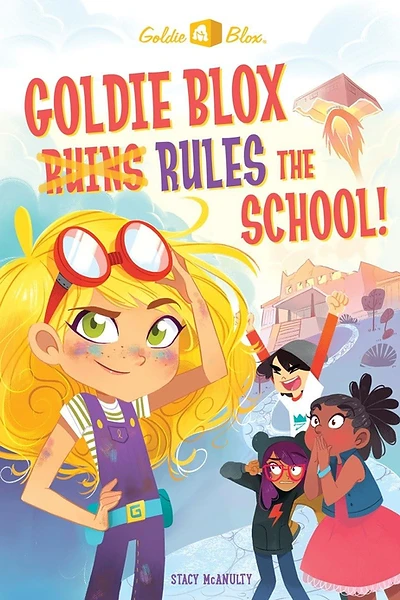
Goldie Blox Rules the School!
by Stacy McAnulty
Pacing MaterialWhen Goldie Blox accidentally blows off the roof of her school, she and her friends Val, Ruby, and Li have to work together and use their creative know-how to rebuild the school.
Big Idea
Innovation and problem-solving are collaborative processes where mistakes are simply opportunities to engineer a better solution. By working together, Goldie and her friends demonstrate that creativity and persistence can overcome any obstacle.
Discussion Questions
- 1.How did Goldie’s mistake of blowing off the school roof lead to a new opportunity for her and her friends?
- 2.Why is it important for Goldie to work with Val, Ruby, and Li instead of trying to fix the school by herself?
- 3.What does it mean to have 'creative know-how,' and how do the characters show this trait throughout the story?
- 4.How do the different skills of Goldie’s friends help the group succeed in their mission?
- 5.Can you think of a time you made a mistake that turned into a learning experience? How did you handle it?
Classroom Activity
The Great Classroom Rebuild Challenge
Students work in small 'engineering teams' to design and build a stable structure using limited materials after being presented with a 'disaster' scenario, mirroring Goldie's experience in the book.
Lesson Plan
Learning Goals
- Apply the engineering design process to solve a structural problem.
- Demonstrate effective collaboration and communication within a team.
- Identify how individual strengths contribute to a group goal.
- Practice resilience by iterating on designs after initial failures.
Activity Steps
- 1.Present the 'disaster' scenario: A pretend storm has damaged a section of the classroom, and teams must build a support structure to hold a 'roof' (a piece of cardboard).
- 2.Teams brainstorm and sketch their designs, assigning roles like 'Lead Engineer' or 'Materials Manager'.
- 3.Teams build their structures using the provided materials within a set time limit.
- 4.Test the structures for stability and weight-bearing capacity.
- 5.Reflect as a group on what worked, what failed, and how they adjusted their plans during the process.
Standards Connections
- NGSS: K-2-ETS1-1 Engineering Design
- ELA: SL.3.1 Collaborative discussion
- SEL: Relationship Skills
- Math: Measurement and Data
Pace-Write-Read Study with Pace-Write It!
Stacy McAnulty uses a fast-paced, energetic narrative style that mirrors the 'maker' mindset of her protagonist. By utilizing short, punchy sentences and frequent dialogue, she keeps the reader engaged in the high-stakes action of the school rebuild, teaching students that writing about complex processes can be both accessible and exciting. This book serves as an excellent mentor text for teaching 'immediacy' in writing. McAnulty demonstrates how to drop the reader directly into the middle of the action, using the 'inciting incident' of the roof blowing off to establish the tone and urgency of the story immediately.
| Element | How to notice or teach it in the novel |
|---|---|
| Pace | The story moves quickly, using short chapters to maintain the momentum of the engineering challenges. |
| Plot | The plot follows a clear problem-solution structure: accident, challenge, collaboration, and success. |
| Prosody | Encourage students to read with excitement during the 'building' scenes to match the characters' enthusiasm. |
| Word Pause | Use pauses after Goldie's 'oops' moments to let the gravity of the situation sink in before the solution begins. |
| Concept | The core concept is 'STEM-based problem solving' woven into a narrative framework. |
| Voice & World View | Goldie’s voice is optimistic, curious, and inherently scientific. |
| Setting & Place | The school is treated as a character itself, shifting from a place of learning to a construction site. |
| Point of View | The story is told from a close third-person perspective that focuses on Goldie’s internal engineering logic. |
| Original Characters | Each friend (Val, Ruby, Li) represents a different archetype of a maker, showing diversity in problem-solving styles. |
| Dialogue | Dialogue is used to show the brainstorming process rather than just moving the plot forward. |
| Details | McAnulty includes specific technical details about tools and materials to ground the fiction in reality. |
| Descriptions | Focus on how the author describes the 'mess' of the accident versus the 'order' of the finished repair. |
| Strong First Lines | The opening immediately establishes the stakes, pulling the reader into the chaos of the accident. |
| Immediacy & Engagement | The book uses present-tense urgency to make the reader feel like they are part of the build team. |
| Story Scenes & Summaries & Unique Structures | The book alternates between 'action scenes' of building and 'summary scenes' of planning. |
| Flashback & Flash Forward & Cliffhangers | Chapters often end on small cliffhangers regarding whether a specific invention will hold. |
| Tension & Suspense & Surprise | Tension is built through the 'will it work?' moments during the construction phases. |
| Page Turns and Chapter Breaks | Chapter breaks are used to transition between different stages of the engineering project. |
| Performance | The text invites readers to act out the 'tinkering' sounds and movements. |
| Personality | Goldie’s personality is defined by her refusal to give up when things break. |
| Humor | The humor comes from the absurdity of the accident and the characters' reactions to it. |
| Pause | Use pauses to emphasize the 'Aha!' moments when a character has a breakthrough idea. |
| Poetry and Poetic Devices | The book uses alliteration in character names and tool descriptions to create a rhythmic flow. |
| Repetition | The repetition of the 'we can fix this' mantra reinforces the theme of persistence. |
| Rhythm | The rhythm of the prose speeds up during the building sequences and slows down during planning. |
| Punctuation | Exclamation points are used frequently to convey the high energy of the characters. |
| Questions | Goldie constantly asks herself 'What if?' questions, modeling the scientific method. |
| Compare-Contrast | Compare the school before the accident to the school after the creative repairs. |
| Objects | Tools and building materials are treated as essential 'characters' in the story. |
| Threes | The group of friends often works in trios or sequences of three steps to solve problems. |
| Whitespace & Negative Space | The layout uses whitespace to emphasize the scale of the building projects. |
| Art & Graphics | The illustrations provide visual blueprints that help the reader understand the engineering concepts. |
| Interactives & Gamification | The book encourages the reader to think like a gamer/engineer by presenting 'levels' of difficulty. |
Pace-Write It!
Students have 20 minutes to write a 'How-To' guide for a simple invention. They must use at least three 'action verbs' and one 'what if' question, mimicking Goldie’s engineering thought process.