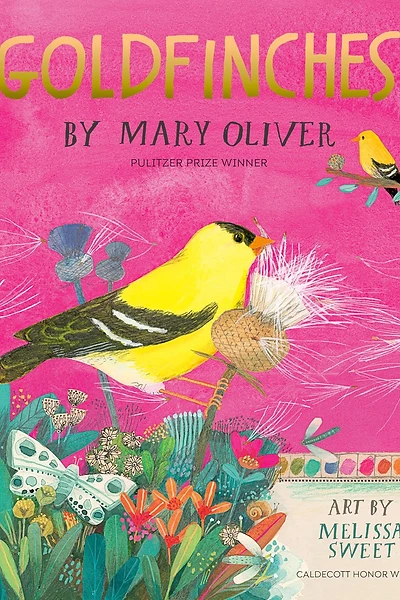
 2-6
2-6R OLIVER
Goldfinches
by Mary Oliver
Pacing MaterialMary Oliver's beloved poem about goldfinches, brought to life as a picture book that invites readers to see the world with a poet's eyes.
Big Idea
Poetry helps us see the everyday world as extraordinary, and paying attention is a form of love.
Discussion Questions
- 1.How does the poet describe the goldfinches?
- 2.What words surprise you?
- 3.How do the illustrations match the poem?
- 4.What would you write a poem about?
- 5.How does poetry change how we see nature?
Classroom Activity
Poem About a Bird
Choose a bird you've seen and write a short poem about it. Use one surprising word, the way Mary Oliver does.
Lesson Plan
Learning Goals
- Describe how Mary Oliver’s words and the picture-book illustrations invite readers to notice goldfinches closely.
- Identify a vivid or surprising word in the poem and explain what it helps readers imagine.
- Write a short poem about a familiar bird using specific sensory details and at least one surprising word.
- Explain how careful attention to an ordinary bird can express appreciation for the natural world.
Activity Steps
- 1.Read Goldfinches aloud while students view the illustrations. Ask: What do you notice about the birds? What makes these everyday creatures seem extraordinary?
- 2.Reread a brief passage and invite students to identify a vivid or unexpected word. Discuss what that word makes them picture, hear, or feel and why Oliver might have chosen it.
- 3.Have students choose a bird they have seen, such as a robin, pigeon, sparrow, or goldfinch. Using memory, a bird photograph, or a quiet look outdoors, list details about its colors, movements, sounds, and surroundings.
- 4.Model turning an observation into a poetic line, such as 'The pigeon struts in its silver slippers.' Students draft a 4–8-line poem that includes two specific observations and one surprising word or comparison. Grades 2–3 may dictate or use sentence starters; grades 4–6 can experiment with line breaks and figurative language.
- 5.Partners read their poems aloud and point out a detail that helps them imagine the bird. Writers revise one word to make it more precise or surprising, then illustrate their poems.
- 6.Share selected poems and ask: How did paying attention change the way you saw your bird? Display the poems under the title 'Everyday Birds, Extraordinary Words.'
Standards Connections
- ELA: CCSS.RL.2.4 — Describe how words and phrases supply rhythm and meaning in a poem.
- ELA: CCSS.RL.3.7 — Explain how illustrations contribute to a text’s meaning or mood.
- ELA: CCSS.RL.4.4, RL.5.4, RL.6.4 — Determine the meaning of words and phrases, including figurative language, in literary texts.
- ELA: CCSS.W.2.5–W.6.5 — Strengthen writing through developmentally appropriate planning, revising, and editing with support.
- ELA: CCSS.SL.2.1–SL.6.1 — Participate in collaborative discussions, building on others’ ideas and expressing observations clearly.
Pace-Write-Read Study with Pace-Write It!
Focus question: How does a poet slow us down so we can notice small moments in nature? Goldfinches by Mary Oliver is a picture-book version of a poem that invites readers to watch birds closely and think about beauty, attention, and the natural world. Its pacing is gentle and reflective, using short poetic lines, pauses, images, and page turns to help readers linger over each movement of the goldfinches.
| Element | How to notice or teach it in the novel |
|---|---|
| Pace | Read: Notice how Goldfinches by Mary Oliver moves slowly, asking readers to pause and watch the birds instead of rushing to a big event. Classroom Activity: Write 4-6 short lines about one small nature moment, using slow pacing so each line reveals just one new detail. |
| Plot | Read: This real story-poem does not follow a problem-and-solution plot; instead, the experience is the speaker noticing goldfinches and discovering meaning in their presence. Classroom Activity: Write a tiny plot of observation with a beginning (I noticed), middle (I watched closely), and end (I realized). |
| Prosody | Read: Listen to the musical flow of Mary Oliver’s lines and how the poem sounds gentle, thoughtful, and full of wonder. Classroom Activity: Read one page aloud, then write 3 lines that sound smooth and lyrical when spoken. |
| Word pause | Read: Notice where line breaks and punctuation make you stop for a moment to think about the goldfinches or the speaker’s feelings. Classroom Activity: Write a sentence about a bird or flower, then break it into lines to create meaningful pauses. |
| Concept | Read: The big idea in Goldfinches is that careful attention to nature can lead to joy, reflection, and deeper seeing. Classroom Activity: Write a one-sentence theme statement, then add 3 lines that show that idea through a nature image. |
| Voice & World View | Read: Mary Oliver’s voice is calm, observant, and full of reverence for the natural world, showing a worldview that nature is worth noticing and learning from. Classroom Activity: Write in a voice that sounds amazed and respectful as you describe something alive outdoors. |
| Setting & Place | Read: The outdoor setting matters because the goldfinches are seen in their natural place, where light, air, plants, and space shape the poem’s mood. Classroom Activity: Create a 5-senses list for an outdoor setting, then use it to write 4 lines of a poem. |
| Point of View | Read: The poem is told from the speaker’s point of view, so readers experience the goldfinches through one person’s close observation and thinking. Classroom Activity: Rewrite one nature moment from first person using the frame 'I saw..., I wondered..., I felt...'. |
| Original Characters | Read: The goldfinches are the central living presence in the book, and although they are real birds, Mary Oliver makes them memorable through careful noticing rather than made-up traits. Classroom Activity: Choose one real animal and make it vivid by listing 5 true details instead of inventing a fantasy character. |
| Dialogue | Read: Goldfinches does not depend on spoken dialogue; the silence helps keep attention on the birds, the speaker’s thoughts, and the stillness of nature. Classroom Activity: Write a poem with no dialogue at all, letting images and observations carry the meaning. |
| Details | Read: Notice the precise details Mary Oliver uses to help readers truly see the goldfinches instead of just naming them. Classroom Activity: Observe a natural object and write 6 exact details about color, movement, shape, or sound. |
| Descriptions | Read: The descriptions in Goldfinches create beauty by showing what the birds look like and how they move, rather than using many extra words. Classroom Activity: Write 3 descriptive lines about an animal using strong nouns and verbs. |
| Strong First Lines | Read: Notice how the opening invites immediate attention and draws readers into a moment of looking closely. Classroom Activity: Write 3 possible first lines for a nature poem, each beginning with a surprising observation. |
| Immediacy & Engagement | Read: The poem feels immediate because readers are placed right into the act of noticing, as if standing beside the speaker watching the goldfinches. Classroom Activity: Write in present tense about something happening outside right now. |
| Story Scenes & Summaries & Unique Structures | Read: Goldfinches blends scene-like moments of observation with reflective summary, and its poem structure makes the reading experience different from a regular narrative. Classroom Activity: Write one line that shows a scene you can picture and one line that explains what that moment means to you. |
| Flashback & Flash Forward & Cliffhangers | Read: This book mostly stays in the present moment, which helps the pacing remain focused and meditative instead of suspenseful. Classroom Activity: Write 2 versions of a short nature poem—one fully in the present, and one with a quick memory of another time. |
| Tension & Suspense & Surprise | Read: The surprise in Goldfinches comes from insight and beauty rather than danger, as the speaker’s noticing leads to a fresh way of seeing the birds. Classroom Activity: Write a poem in which the last line reveals a new thought or feeling about what you observed. |
| Page Turns and Chapter Breaks | Read: In the picture-book format, page turns help stretch out the poem and give readers time to pause with each image of the goldfinches. Classroom Activity: Fold a paper into 4 parts and place one short line or image idea on each part so the reader turns from one moment to the next. |
| Performance | Read: This poem is powerful when performed aloud slowly, with pauses that let the images of the birds and the speaker’s wonder settle in. Classroom Activity: Practice reading 4 lines aloud, marking where your voice should soften, pause, or lift. |
| Personality | Read: The speaker’s personality comes through as patient, curious, and deeply appreciative of nature. Classroom Activity: Write 5 lines that reveal your own personality while you describe something outdoors. |
| Humor | Read: Goldfinches is not built around jokes; its tone is more thoughtful and delighted, showing that poems can engage readers through wonder instead of humor. Classroom Activity: Write two nature lines—one serious and one playful—and compare how the tone changes. |
| Pause | Read: Long pauses between ideas help readers sit with the goldfinches and think about what the speaker is discovering. Classroom Activity: Add dashes, commas, or line breaks to a draft so the reader pauses at important moments. |
| Poetry and Poetic Devices | Read: Notice how imagery, line breaks, sound, and figurative language work together in Mary Oliver’s poem to deepen the theme of noticing nature. Classroom Activity: Write a 4-line poem that includes one image, one comparison, and one line break for emphasis. |
| Repetition | Read: Repeated sounds, ideas, or sentence patterns can make the poem feel calm and unified, echoing the steady act of watching goldfinches. Classroom Activity: Write 3 lines that begin with the same words, such as 'I notice...' or 'In the field...'. |
| Rhythm | Read: The rhythm of Goldfinches feels unhurried and flowing, matching the reflective mood of watching birds. Classroom Activity: Clap the beat of one line, then write your own line with a similarly smooth rhythm. |
| Punctuation | Read: Punctuation in the poem helps shape breathing, emphasis, and pace, telling readers when to glide on and when to stop. Classroom Activity: Write one line three ways—with a comma, a dash, and no punctuation—and discuss how the pace changes. |
| Questions | Read: The poem invites wondering, even when it does not rely on many direct questions, because the speaker is thinking deeply about what the goldfinches mean. Classroom Activity: Write 3 wondering questions about something in nature, then choose one to answer in a poem line. |
| Compare-Contrast | Read: Readers can compare the bright, lively goldfinches with the quieter human act of watching, which helps highlight the poem’s theme of connection. Classroom Activity: Write 2 lines comparing a bird to something else, and 2 lines contrasting motion and stillness. |
| Objects | Read: Natural objects and living things in the environment help ground the poem, giving the goldfinches a real world to move through. Classroom Activity: Make a list of 5 objects or living things from an outdoor scene and include at least 3 in a poem. |
| Threes | Read: Grouping images or ideas in sets of three can make poetic writing feel balanced and memorable, fitting the graceful pacing of Goldfinches. Classroom Activity: Write a line that names three things the speaker sees, hears, or feels in nature. |
| Whitespace & Negative Space | Read: The open space around poem lines and around picture-book illustrations helps slow readers down and gives the goldfinches room to shine. Classroom Activity: Arrange a 4-line poem on the page with extra space between lines to create a quiet feeling. |
| Art & Graphics | Read: The picture-book art supports Mary Oliver’s words by helping readers visualize the goldfinches, their movement, and the peaceful natural setting. Classroom Activity: Sketch a simple scene from your poem and revise one line so the words and picture work together. |
| Interactives & Gamification | Read: Although Goldfinches is not a game-based text, readers can interact by hunting for pauses, strong images, and feeling words as they read. Classroom Activity: Create a 'poetry scavenger hunt' by finding one image, one pause, one repeated idea, and one line that shows wonder, then use them as models for your own writing. |
Pace-Write It!
20-Minute Classroom Flow\nRead (5 min): Read Goldfinches by Mary Oliver aloud twice. The first time, students just listen. The second time, students track where the poem slows them down and where they picture the goldfinches most clearly.\nNotice (5 min): Ask: 'What helps this poem feel slow, calm, and full of wonder?' Chart student observations such as short lines, page turns, careful details, quiet tone, repetition, and pauses. Revisit one page and notice how Mary Oliver focuses on the goldfinches and the speaker’s thinking instead of a fast-moving plot.\nWrite (7 min): Students write a short nature poem about one real thing they observe or remember from outdoors. Encourage them to use slow pacing, one precise detail per line, and at least one intentional pause. Writing frame: 'I notice ____________. / It moves like ____________. / I pause when ____________. / I wonder ____________. / For a moment, ____________.'\nShare (3 min): Partners read their poems aloud slowly. Listeners name one line where the pacing helped them picture the moment clearly.\nExit ticket: Write one sentence answering: 'What is one craft move Mary Oliver uses in Goldfinches that you used in your own writing today?'
Pace-Write-Read Connection
Teach this book using the Pace-Write-Read method — Tool 25: Poetry & Poetic Devices.
Open the Mastery Manual