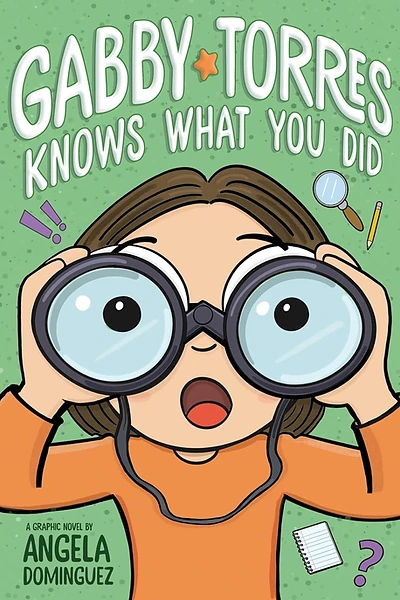
 2-5
2-5GN GABBY-TORRES
Gabby Torres Knows What You Did
by Angela Dominguez
Pacing MaterialGabby Torres turns detective with binoculars and notepad in hand, determined to crack a mysterious case in her neighborhood and discover what really happened.
Big Idea
Curiosity and observation are powerful tools for understanding our world, but we must be careful not to let our imaginations jump to conclusions before we have all the facts.
Discussion Questions
- 1.Why does Gabby immediately assume the worst when she sees the mysterious packages at her neighbor's house?
- 2.How do Gabby's tools, like her binoculars and notepad, help her feel more like a detective?
- 3.Have you ever misunderstood a situation because you didn't have all the information? What happened?
- 4.How does the author use Gabby's facial expressions in the illustrations to show us how she is feeling?
- 5.What is the difference between being a 'detective' and being a 'nosy neighbor'?
Classroom Activity
The Neighborhood Mystery Log
Students will create their own 'Detective Log' to practice the scientific method of observation, hypothesis, and evidence-gathering, mirroring Gabby's investigative process in the book.
Lesson Plan
Learning Goals
- Identify the difference between an observation (fact) and an inference (guess).
- Analyze how visual cues in graphic novels contribute to character development.
- Practice creative writing by documenting a 'case' from a first-person perspective.
- Understand the importance of gathering evidence before reaching a conclusion.
Activity Steps
- 1.Provide students with a 'Detective Log' template featuring space for a drawing and a written observation.
- 2.Have students observe a 'mystery object' or a 'mystery scene' (a staged area in the classroom) for three minutes without talking.
- 3.Ask students to write down three facts they observed and one 'theory' about what the object is or what happened.
- 4.Facilitate a class discussion where students share their theories and identify which parts were facts versus guesses.
- 5.Students will then draw a comic panel depicting their 'case' using speech bubbles to show their internal monologue.
Standards Connections
- CCSS.ELA-LITERACY.RL.2.7: Use information gained from the illustrations and words in a print or digital text to demonstrate understanding.
- CCSS.ELA-LITERACY.W.2.3: Write narratives in which they recount a well-elaborated event.
- SEL: Responsible Decision-Making: Identifying problems and analyzing situations.
- Art: Visual Literacy: Interpreting visual symbols and composition.
Pace-Write-Read Study with Pace-Write It!
In 'Gabby Torres Knows What You Did,' Angela Dominguez masterfully uses the graphic novel format to teach the craft of pacing through visual rhythm. By alternating between wide establishing shots of the neighborhood and tight, zoomed-in panels of Gabby’s intense expressions, the book controls exactly how fast the reader moves through the mystery. This study helps students understand that writing is not just about words, but about the deliberate control of time and focus. Students will learn that 'pacing' in a graphic novel is dictated by the size and sequence of panels. When Gabby is spying, the panels become smaller and more frequent, creating a sense of urgency and suspense. When she is reflecting, the panels widen, allowing the reader to slow down and process her thoughts. This book serves as a perfect mentor text for teaching students how to manipulate the 'speed' of their own stories through structural choices.
| Element | How to notice or teach it in the novel |
|---|---|
| Pace | Notice how the panel density increases during Gabby's stakeout scenes to speed up the reader's heart rate. |
| Plot | The plot follows a classic mystery structure: the inciting incident (new neighbors), the investigation, and the resolution. |
| Prosody | Encourage students to read the dialogue aloud, matching their tone to Gabby's dramatic, detective-like voice. |
| Word Pause | Look for ellipses in dialogue that show Gabby hesitating or thinking before she speaks. |
| Concept | The core concept is the 'detective' trope applied to a relatable, everyday neighborhood setting. |
| Voice & World View | Gabby's voice is bold and imaginative; she views her mundane street as a place of high-stakes mystery. |
| Setting & Place | The neighborhood is a character itself, with the 'For Sale' sign acting as the catalyst for the story's setting. |
| Point of View | The story is told through Gabby's eyes, making the reader feel as suspicious and curious as she is. |
| Original Characters | Gabby is a unique, tenacious protagonist who stands out for her proactive, 'do-it-yourself' attitude. |
| Dialogue | Dialogue is used to show Gabby's internal monologue and her interactions with the world around her. |
| Details | Focus on the small details in the art, like the white plastic wrapping, which serve as clues for the reader. |
| Descriptions | The illustrations provide the descriptions, allowing the text to focus on Gabby's reactions and thoughts. |
| Strong First Lines | The book starts with the excitement of a new neighbor, immediately establishing the mystery. |
| Immediacy & Engagement | The graphic format pulls the reader into the action immediately through visual storytelling. |
| Story Scenes & Summaries & Unique Structures | The book uses a sequence of 'stakeout' scenes to build the narrative arc. |
| Flashback & Flash Forward & Cliffhangers | Chapter breaks often end on cliffhangers, such as the 'howling' sound, to keep the reader turning pages. |
| Tension & Suspense & Surprise | Tension is built by contrasting Gabby's wild theories with the mundane reality of the neighbors. |
| Page Turns and Chapter Breaks | Use the page turns to predict what Gabby will find next in her investigation. |
| Performance | Gabby's physical performance—crouching, peering, and note-taking—is key to her character. |
| Personality | Gabby's personality is defined by her tenacity and her tendency to jump to conclusions. |
| Humor | The humor comes from the gap between Gabby's dramatic detective persona and the reality of her situation. |
| Pause | Identify panels where there is no text; these are moments for the reader to pause and observe the art. |
| Poetry and Poetic Devices | Look for onomatopoeia (like 'howling' sounds) that adds a rhythmic, poetic quality to the action. |
| Repetition | Gabby's repeated use of her binoculars reinforces her role as an observer. |
| Rhythm | The rhythm of the book is set by the alternating pattern of 'spy' panels and 'thought' panels. |
| Punctuation | Exclamation points are used frequently to show Gabby's high energy and excitement. |
| Questions | The book is driven by questions: 'Is that a couch... or a coffin?' |
| Compare-Contrast | Compare Gabby's initial theory about the packages to the final reveal. |
| Objects | Objects like the binoculars and the notepad are essential props that define Gabby's identity. |
| Threes | Look for sequences of three panels that show a progression of an action or a thought. |
| Whitespace & Negative Space | Notice how the background is often simplified to keep the focus on Gabby's expressions. |
| Art & Graphics | The art style is expressive and clean, making it easy for young readers to follow the narrative flow. |
| Interactives & Gamification | The book invites the reader to play along as a detective, trying to solve the mystery alongside Gabby. |
Pace-Write It!
In 20 minutes, have students draw a three-panel comic strip where a character sees something mysterious. Panel 1: The character sees the object. Panel 2: The character has a wild, imaginative theory (use a thought bubble). Panel 3: The character discovers the boring, real-life truth. This teaches them how to use pacing to build and then release tension.