 2-5
2-5GN GABBY-TORRES
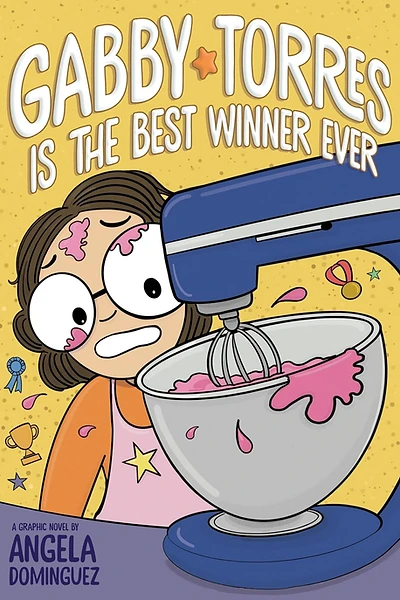
Gabby Torres is the Best Winner Ever
by Angela Dominguez
Pacing MaterialGabby enters a baking competition, but when everything goes hilariously wrong with a stand mixer and pink frosting, she learns that being the best winner is about how you handle the mess.
Big Idea
True success is not defined by winning a competition, but by how one handles mistakes, manages resources, and maintains relationships during the process.
Discussion Questions
- 1.Why does Gabby feel it is so important to be the 'best winner' in the baking competition?
- 2.How do Gabby's actions—like buying excessive supplies—affect her relationship with her parents?
- 3.When the stand mixer disaster happens, how does Gabby's reaction change from the beginning of the story to the end?
- 4.What does the book suggest about the difference between being 'winner material' and being a good friend or family member?
- 5.How does Gabby's father's hobby of birdwatching contrast with her own high-energy goals, and what can they learn from each other?
Classroom Activity
The 'Best Winner' Reflection Journal
Students create a two-sided reflection journal where they map out a time they faced a 'baking disaster' (a mistake or failure) and rewrite the ending to focus on resilience and learning rather than just the outcome.
Lesson Plan
Learning Goals
- Identify the character's internal motivation and how it shifts throughout the narrative.
- Analyze how graphic novel visual cues (facial expressions, panel size) convey emotional growth.
- Practice self-reflection by connecting personal experiences of failure to the theme of resilience.
- Demonstrate understanding of narrative structure by creating a 'growth-mindset' alternative ending.
Activity Steps
- 1.Discuss the 'stand mixer disaster' scene in the book and identify the specific emotions Gabby feels.
- 2.Have students brainstorm a personal 'mess' or mistake they have made recently.
- 3.Students draw a comic-style panel showing the 'mess' on one side of their paper.
- 4.On the other side, students write or draw how they could handle that situation with the grace of a 'best winner'.
- 5.Share reflections in small groups to discuss how changing one's perspective changes the outcome of a failure.
Standards Connections
- ELA: RL.2.3 (Describe how characters in a story respond to major events and challenges)
- SEL: Self-Management (Demonstrating personal and collective agency)
- Art: Visual Literacy (Interpreting how images convey character emotion)
- ELA: W.3.3 (Write narratives to develop real or imagined experiences)
Pace-Write-Read Study with Pace-Write It!
In 'Gabby Torres is the Best Winner Ever,' Angela Dominguez utilizes the graphic novel format to masterfully control the pacing of a comedic disaster. By alternating between high-energy, chaotic panels during the baking mishaps and slower, contemplative moments when Gabby interacts with her family, Dominguez teaches students that pacing is not just about speed, but about emotional weight. This book serves as an excellent mentor text for young writers to understand how to use 'visual silence' and panel density to manipulate the reader's experience. Students can observe how Dominguez stretches out a moment of failure to build humor, then compresses the resolution to emphasize the character's growth, providing a blueprint for their own narrative pacing.
| Element | How to notice or teach it in the novel |
|---|---|
| Pace | Notice how the action speeds up during the baking scenes and slows down during quiet family moments. |
| Plot | The plot follows a classic 'over-ambitious protagonist' arc where the goal is challenged by reality. |
| Prosody | Encourage students to read the dialogue bubbles with the frantic, high-energy tone Gabby uses when she is excited. |
| Word Pause | Look for ellipses or isolated words in bubbles that force the reader to stop and process the disaster. |
| Concept | The core concept is the irony of trying to be the 'best' while making the biggest mess. |
| Voice & World View | Gabby’s voice is relatable and tenacious, reflecting a child's desire to prove themselves. |
| Setting & Place | The kitchen serves as the primary setting, acting as a character itself through the chaos of the stand mixer. |
| Point of View | The story is told through Gabby’s perspective, making her internal pressure feel immediate to the reader. |
| Original Characters | Gabby is a distinct, bold character who fits the archetype of the 'relatable disaster' protagonist. |
| Dialogue | Dialogue is punchy and often humorous, highlighting Gabby's impulsivity. |
| Details | Focus on the visual details of the frosting and batter splatters to show the scale of the mess. |
| Descriptions | Dominguez uses visual descriptions in the art to show what Gabby is feeling without needing extra text. |
| Strong First Lines | The opening establishes Gabby's goal immediately, setting the stakes for the rest of the book. |
| Immediacy & Engagement | The graphic novel format pulls the reader directly into the action of the baking competition. |
| Story Scenes & Summaries & Unique Structures | The book uses a mix of dialogue-heavy scenes and summary panels to move the story forward. |
| Flashback & Flash Forward & Cliffhangers | Use the cliffhangers at the end of chapters to discuss how they keep the reader turning pages. |
| Tension & Suspense & Surprise | The tension builds as Gabby spends more money and the kitchen gets messier. |
| Page Turns and Chapter Breaks | Analyze how the page turns are used to reveal the 'big mess' for comedic effect. |
| Performance | The characters' body language in the art acts as a performance of their internal state. |
| Personality | Gabby’s personality is shown through her 'can-do' attitude that often leads to trouble. |
| Humor | The humor is derived from the contrast between Gabby's high expectations and the reality of the kitchen disaster. |
| Pause | Identify panels with no text where the character is just reacting to the mess. |
| Poetry and Poetic Devices | Look for onomatopoeia (e.g., 'SPLAT!') used to emphasize the action. |
| Repetition | Gabby’s repeated attempts to succeed show her persistence. |
| Rhythm | The rhythm of the book is dictated by the back-and-forth between Gabby’s plans and the resulting chaos. |
| Punctuation | Exclamation points are used frequently to show Gabby's high energy and excitement. |
| Questions | Gabby often asks herself questions that reveal her internal conflict. |
| Compare-Contrast | Compare Gabby’s high-energy baking with her father’s quiet birdwatching. |
| Objects | The stand mixer is a central object that symbolizes Gabby's ambition and her eventual mess. |
| Threes | Look for the 'rule of three' in the baking steps or the escalating disasters. |
| Whitespace & Negative Space | Notice how the background drops away when Gabby is focused on her goal. |
| Art & Graphics | The art style is essential for conveying the humor of the physical comedy. |
| Interactives & Gamification | The book invites readers to 'root' for Gabby, making the reading experience feel like a game. |
Pace-Write It!
Students have 20 minutes to draw a 3-panel comic strip where a character attempts a simple task (like making a sandwich) that goes hilariously wrong, focusing on using one panel for the 'disaster' and one for the 'recovery' to practice pacing.