 K-3
K-3R P SHUMAKER
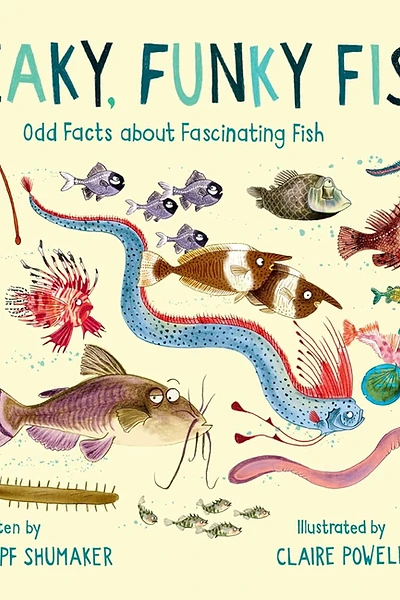
Freaky, Funky Fish
by Debra Kempf Shumaker
Pacing MaterialThis vibrant nonfiction book takes readers deep into the ocean to meet its most peculiar inhabitants. From the glowing anglerfish to the hopping mudskipper, children discover the incredible diversity of marine life.
Big Idea
The natural world is full of strange and wonderful adaptations that allow creatures to survive in unique environments.
Discussion Questions
- 1.Which fish was the most unusual to you and why?
- 2.What kind of special body parts help these fish survive?
- 3.Where would you look to find these creatures in real life?
- 4.Why is it important to learn about different types of animals?
- 5.How did the illustrations help you understand these fish better?
Classroom Activity
Adaptation Invention
Students will invent their own 'freaky' fish and describe the unique adaptations it uses to survive in a made-up underwater habitat.
Lesson Plan
Learning Goals
- Understand the concept of biological adaptations
- Practice non-fiction observational skills
- Develop descriptive writing vocabulary
Activity Steps
- 1.Review the fish adaptations found in the book
- 2.Choose a unique environment like an underwater volcano or a deep trench
- 3.Design a fish with specific traits that help it live in that environment
- 4.Write a brief description of the fish's traits
- 5.Present the 'new discovery' to the class
Standards Connections
- NGSS.LS1.A
- CCSS.ELA-LITERACY.RI.2.7
- VA.2.CR1.1
Pace-Write-Read Study with Pace-Write It!
Workshop question: How can a few rhyming words make us turn a page quickly, while a picture and fact box make us stop and investigate? This nonfiction picture book introduces unusual fish adaptations through brief rhyming text, illustrations, added facts, and back matter. Shumaker says she placed a nighttime sequence near the end to give the sequence of facts a subtle story arc.
| Element | How to notice or teach it in the novel |
|---|---|
| Pace, plot & concept | Follow the order of the fish. This nonfiction book builds momentum through a sequence of discoveries rather than a character-driven plot. Classroom Activity: Arrange three verified fish facts so each one increases curiosity. Explain the order. |
| Prosody, word pause, performance & rhythm | Read the main rhyme aloud first. Read it again, pausing so classmates can examine each pictured fish. What changes? Classroom Activity: Write two original, factual rhyming lines. Mark one place for a deliberate pause. |
| Voice, worldview & point of view | Listen for the narrator's playful curiosity. Separate that lively presentation from the facts supplied about real animals. Classroom Activity: Present one researched fact in a playful line and then in a plain science sentence. |
| Setting, place, details & descriptions | Look at the water and habitat details around a fish. Which help you understand it, and which invite a closer look? Classroom Activity: Write a precise caption with one visible detail and one verified fact. |
| Original characters, personality, dialogue & humor | These fish are real animals, not fictional characters. Notice how Powell's art gives them visual personality. Check whether a page contains actual speech before calling it dialogue. Classroom Activity: Give a fish fact card a funny heading, followed by an accurate explanation. |
| Strong first lines, immediacy & engagement | Examine how the opening establishes the rhyme and the promise of surprising facts. Classroom Activity: Draft two openings for an animal book: one starts with a question; one starts with a verified surprise. |
| Scenes, summaries & unique structures | Compare the quick main text with a fact box and the fuller back matter. Each gives readers a different amount of information and a different reading speed. Classroom Activity: Explain the same fact in one lively line and three clear sentences. |
| Flashback, flash forward & cliffhangers | A prediction about the next page is not a flash forward. Instead, look for a line or image that withholds a reveal until the page turn. Classroom Activity: Put an animal question on one page and its researched answer on the next. |
| Tension, suspense, surprise, page turns & breaks | Before turning a page, predict the next unusual adaptation. How does the illustration affect the surprise? Classroom Activity: Design a two-page reveal: clue first, verified fish fact second. |
| Poetry, poetic devices, repetition & punctuation | Listen for rhyme, meter, repeated patterns, and punctuation. Shumaker has described rhyme as the structure that holds these nonfiction facts together. Kaitlyn Leann Sanchez Classroom Activity: Repeat an opening phrase across three factual lines. Change the final line's rhythm to draw attention to the last fact. |
| Questions, compare–contrast & threes | Compare three fish using feature, behavior, and habitat. Use the book's added information to check your conclusions. Classroom Activity: Make a three-column comparison chart and add one question for further research. |
| Objects | Choose a visible body feature. What can you observe in the picture, and what must you read or research to understand? Classroom Activity: Draw and label the feature. Add an observation and a sourced explanation. |
| Whitespace, negative space, art & graphics | Notice how little main text appears on some pages and how much work the pictures do. Inspect any fact boxes, ratings, and endpapers in your copy. Kirkus Reviews Classroom Activity: Lay out one original fact with a large illustration area, a short rhyme, and a small fact box. Show where the eye should go first. |
| Interactives & gamification | Use the book's visual features as prompts to investigate; treat playful ratings as opinions, not scientific measurements. Classroom Activity: Play See, Read, Verify: sort statements into visible in the art, stated in the book, or needs another source. |
Pace-Write It!
20-minute workshop flow: 1. Read (5 minutes): Read two spreads aloud without stopping. Reread them with pauses for the illustrations and fact boxes. 2. Notice (5 minutes): Partners identify one place they sped up, one place they paused, and the text or picture that caused each response. 3. Write (7 minutes): Each student creates a two-page, fact-checked fish reveal with an original rhyme, illustration plan, and explanatory caption. 4. Share (3 minutes): Partners read their pages aloud and test whether the planned pause and page turn work. Exit ticket: "I read quickly when ______. I stopped to investigate ______. The rhyme, picture, or fact box caused that change by ______." The author provides Freaky, Funky Fish teacher resources for additional activities at https://debrashumaker.com/books/freaky_funky_fish/