
 K-3
K-3P CHIEN
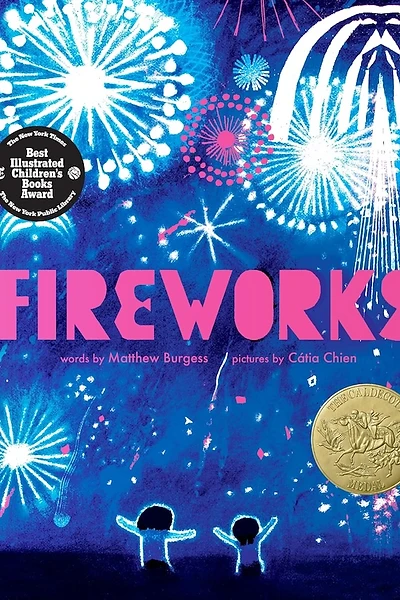
Fireworks
by Matthew Burgess, pictures by Cátia Chien
Pacing MaterialA poetic celebration of a summer night, fireworks, and the wonder they bring to two children experiencing them together.
Big Idea
Celebration is something we feel together — light, sound, and emotion combine to create memories that stay with us.
Discussion Questions
- 1.How do the fireworks make the characters feel?
- 2.What sounds do you associate with celebrations?
- 3.Have you ever seen fireworks? What was it like?
- 4.How can a moment be both loud and beautiful?
Classroom Activity
Sound Map
Students create a 'sound map' — sitting quietly outside or by a window, drawing symbols for each sound they hear.
Lesson Plan
Learning Goals
- Identify sensory details in a story.
- Practice mindful listening.
- Create a visual representation of sound.
- Share personal experiences of celebration.
Activity Steps
- 1.Read the book, noting how the characters experience the fireworks.
- 2.Discuss how sounds can be felt, seen, and shared.
- 3.Sit quietly for 3 minutes and map the sounds you hear.
- 4.Share your sound map with a partner.
Standards Connections
- ELA: RL.K.1 — Ask and answer questions about key details
- ELA: RL.K.2 — Retell stories, including key details
- ELA: RL.K.3 — Describe characters, setting, and events
- ELA: RL.3.6 — Acknowledge differences in characters' points of view
- ELA: SL.K.1 — Participate in collaborative conversations about the text
- ELA: W.K.3 — Write narratives recounting events with descriptive details
- SEL: Social Awareness
- SEL: Relationship Skills
- Art: VA:Re7 — Perceive and analyze artistic work
Pace-Write-Read Study with Pace-Write It!
Focus question: How does an author slow down a small moment so readers can feel wonder growing page by page? In Fireworks by Matthew Burgess, illustrated by Cátia Chien, two children move through a summer evening toward a fireworks show, and the text stretches time so the waiting, watching, and celebrating feel full of excitement. The book uses poetic language, page turns, and carefully placed pauses to make the night feel both intimate and grand.
| Element | How to notice or teach it in the novel |
|---|---|
| Pace | Read: Notice how Fireworks moves at the pace of a real summer night—slowly at first as the children wait and travel, then bursting wider and brighter as the fireworks begin. Classroom Activity: Write 3 short parts called before, during, and after a celebration, and make the middle part feel longest and brightest. |
| Plot | Read: Notice the simple plot in Fireworks: two children head out at night, join a crowd, watch fireworks, and carry the feeling of wonder home. Classroom Activity: Make a 4-box plot map for a small exciting event in your life and label each box with one action. |
| Prosody | Read: Listen to how the words in Fireworks sound when read aloud; the lines rise and fall like footsteps, breath, and bursts in the sky. Classroom Activity: Read one page aloud with a partner, then write 2 lines about a sound-filled moment using words that are smooth in one line and explosive in the next. |
| Word pause | Read: Notice the places in Fireworks where a word or short phrase feels like a pause, helping readers stop and take in the children’s awe. Classroom Activity: Write 3 short lines about seeing something amazing, and place one single-word line in the middle to create a pause. |
| Concept | Read: Notice that Fireworks is about more than a show in the sky; it is about shared wonder, celebration, summer, and being together in a city at night. Classroom Activity: Finish this sentence three ways: A celebration is not just loud—it is also ________. |
| Voice & World View | Read: Notice how Fireworks has a warm, observant, child-centered voice that sees the world as full of color, motion, and possibility. Classroom Activity: Write about an ordinary night as if it is magical, using a voice that notices tiny and beautiful details. |
| Setting & Place | Read: Notice how Fireworks creates a summer city setting with streets, buildings, people gathering, and the night sky opening above them. Classroom Activity: Write 4 setting details to show a neighborhood getting ready for a special night event. |
| Point of View | Read: Notice that Fireworks stays close to the children’s experience, so readers feel the anticipation and surprise right alongside them. Classroom Activity: Write 5 sentences about watching fireworks or another event from a child’s point of view using I or we. |
| Original Characters | Read: Notice that the two children in Fireworks are not described through long backstory; instead, their actions, closeness, and reactions make them memorable and real. Classroom Activity: Create two child characters going to see something exciting together and list 3 ways they react differently. |
| Dialogue | Read: Notice how Fireworks relies more on poetic narration and shared experience than on long stretches of dialogue, which keeps the focus on feeling and movement. Classroom Activity: Write a tiny dialogue of only 2 lines between two children waiting for the first firework. |
| Details | Read: Notice the precise sensory details in Fireworks—night air, crowd energy, bright flashes, and the children’s movement through the city. Classroom Activity: Make a 5-senses chart for a celebration and use at least 3 details in a short paragraph. |
| Descriptions | Read: Notice how Fireworks uses vivid description to make the fireworks feel alive, not just seen but felt in the body and heart. Classroom Activity: Describe lights in the sky without using the word fireworks. |
| Strong First Lines | Read: Notice how the opening of Fireworks invites readers right into a special night and builds curiosity about what is coming. Classroom Activity: Write 3 different first lines for a story about going somewhere exciting after dark. |
| Immediacy & Engagement | Read: Notice how Fireworks makes readers feel present in the moment through close observation, active verbs, and the children’s building anticipation. Classroom Activity: Rewrite a plain sentence like We went outside into a more immediate sentence that helps readers feel they are there. |
| Story Scenes & Summaries & Unique Structures | Read: Notice that Fireworks stretches the most important scenes—the waiting, the gathering, the bursts of light—while moving quickly through smaller transitions. Classroom Activity: Write one sentence to summarize getting to an event, then write three sentences that zoom in on the most exciting moment. |
| Flashback & Flash Forward & Cliffhangers | Read: Notice that Fireworks mostly stays in the present moment, which helps the wonder feel immediate instead of interrupted by past or future events. Classroom Activity: Write a present-moment scene about waiting for something exciting and end with a cliffhanger line just before it begins. |
| Tension & Suspense & Surprise | Read: Notice how Fireworks builds gentle suspense through waiting, crowd energy, darkness, and the question of when the sky will finally burst into color. Classroom Activity: Write 4 lines that build suspense before a surprise in the sky, ending with the moment just before everyone gasps. |
| Page Turns and Chapter Breaks | Read: Notice how page turns in Fireworks act like beats in music, making readers wait one more moment before seeing the next movement or burst. Classroom Activity: Plan a 4-page picture-book dummy and decide what surprise or image should come right after each page turn. |
| Performance | Read: Notice that Fireworks is ideal for expressive read-aloud performance, with chances to whisper the waiting parts and boom the fireworks parts. Classroom Activity: Mark one excerpt with performance notes such as whisper, pause, louder, and stretch this word. |
| Personality | Read: Notice how the personality of Fireworks is joyful, tender, and amazed, matching the children’s experience of celebration. Classroom Activity: Write a short scene about a night event using a personality for the narrator that is either excited, calm, or amazed. |
| Humor | Read: Notice that Fireworks is not mainly a funny book; instead, it finds delight and playfulness in movement, crowd moments, and the children’s shared excitement. Classroom Activity: Add one playful or light moment to a celebration scene without changing the overall feeling of wonder. |
| Pause | Read: Notice how Fireworks uses pauses between actions and images so readers can sit with the beauty of each moment before moving on. Classroom Activity: Write a 6-line poem about a celebration and place ellipses or a line break where you want readers to pause and look. |
| Poetry and Poetic Devices | Read: Notice how Fireworks uses poetic devices such as imagery, sound play, and metaphor-like comparisons to turn a city night into a song of celebration. Classroom Activity: Write 3 poetic lines about lights in the sky using one comparison, one sound word, and one feeling word. |
| Repetition | Read: Notice how repeated sounds, ideas, or structures in Fireworks help build rhythm and make the experience feel ceremonial and shared. Classroom Activity: Write a short piece that repeats the same starter words in 3 lines, such as We wait or In the sky. |
| Rhythm | Read: Notice the rhythm in Fireworks—some lines feel soft and slow like walking, while others feel quick and bursting like the fireworks themselves. Classroom Activity: Write one slow sentence and one fast sentence about the same moment and read both aloud. |
| Punctuation | Read: Notice how punctuation in Fireworks helps control breath, excitement, and stopping points, shaping how the book sounds in a reader’s mouth. Classroom Activity: Take one sentence about a celebration and rewrite it two ways, once with commas for a slow pace and once with exclamation marks for excitement. |
| Questions | Read: Notice the wondering spirit in Fireworks, where readers may naturally ask what will happen next and how the children are feeling as the night unfolds. Classroom Activity: Write 3 questions a child might think while waiting for a fireworks show to begin. |
| Compare-Contrast | Read: Notice the contrasts in Fireworks between quiet and loud, dark sky and bright color, waiting and bursting, individual feeling and shared crowd experience. Classroom Activity: Make a T-chart comparing before the fireworks and during the fireworks, then turn it into 4 sentences. |
| Objects | Read: Notice how ordinary objects and city features in Fireworks become part of the celebration as the children move through the night toward the sky show. Classroom Activity: Choose one object from a nighttime outing, such as a blanket, shoe, hand, window, or streetlight, and describe how it becomes special during a celebration. |
| Threes | Read: Notice how groups of three details can make images in Fireworks feel full and satisfying, like three sounds, three colors, or three actions in a row. Classroom Activity: Write one sentence with three details about a summer night, such as what you see, hear, and feel. |
| Whitespace & Negative Space | Read: Notice how Fireworks leaves room for readers to feel the sky, the pause, and the openness around the bursts of light; the spaces matter as much as the words. Classroom Activity: Create a short 4-line page with only a few words on each line so the empty space helps show wonder. |
| Art & Graphics | Read: Notice how Cátia Chien’s illustrations work with Burgess’s text in Fireworks to show motion, glow, crowd feeling, and the huge emotional scale of the night. Classroom Activity: Sketch a quick scene from your own celebration writing and add labels showing where the art would slow readers down or make them look closely. |
| Interactives & Gamification | Read: Notice that Fireworks invites participation through prediction, sound imitation, and movement, even though it is not a game book. Classroom Activity: Create a call-and-response read-aloud for your writing where the class says a repeated line such as Look up! each time the celebration grows bigger. |
Pace-Write It!
20-Minute Classroom Flow\nRead (5 min): Read Fireworks aloud, stopping once before the fireworks begin and once during the brightest spread. Ask students to listen for places where the story slows down so they can really feel the wonder.\nNotice (5 min): Chart what students notice about pacing: waiting, walking, gathering, looking up, bursting color, and quiet after. Highlight how Matthew Burgess uses short poetic lines, repetition, page turns, and pauses to stretch important moments for the two children.\nWrite (7 min): Students write their own small-moment celebration piece about seeing something amazing. Writing frame: First, we ________. Then we ________. We waited as ________. Then—______! In the sky/in the room/in the night, ________, ________, and ________. I felt ________ because ________. Encourage students to use one pause, one repeated phrase, and at least three sensory details.\nShare (3 min): Partners read their pieces aloud twice: first softly and slowly, then with expression on the most exciting part. Invite 2-3 students to share a line where they purposely slowed the pace.\nExit ticket: Write one sentence answering: How did you slow down your writing to help readers feel wonder?