
 K-2
K-2P FINISON
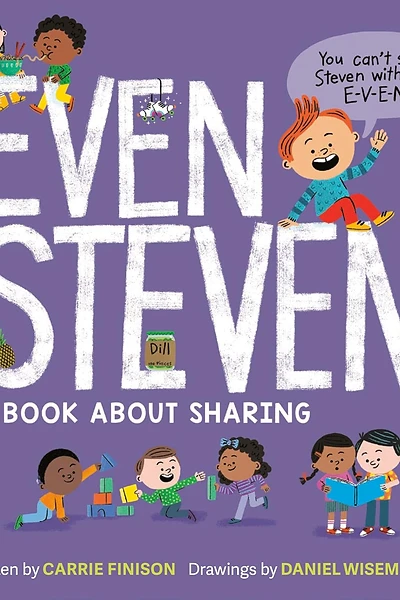
Even Steven: A Book About Sharing
by Carrie Finison
Pacing MaterialSteven likes everything to be even — but when sharing with friends gets complicated, he discovers that fair isn't always fifty-fifty.
Big Idea
Sharing isn't always even — it's about finding balance and fairness together.
Discussion Questions
- 1.What does 'even' mean to Steven? Is being even always fair?
- 2.What happens when one person feels they aren't getting an equal share?
- 3.How do the characters solve their sharing problem?
- 4.What is something you find hard to share, and why?
Classroom Activity
Even Steven Flip Book
Draw a four-panel comic of two characters learning to share something they both want.
Lesson Plan
Learning Goals
- Understand fairness and sharing
- Identify feelings when things feel unfair
- Practice compromise
Standards Connections
- ELA: RL.K.1 — Ask and answer questions about key details
- ELA: RL.K.2 — Retell stories, including key details
- ELA: RL.K.3 — Describe characters, setting, and events
- ELA: RL.2.6 — Acknowledge differences in characters' points of view
- ELA: SL.K.1 — Participate in collaborative conversations about the text
- ELA: W.K.3 — Write narratives recounting events with descriptive details
- SEL: Social Awareness
- SEL: Relationship Skills
- Art: VA:Re7 — Perceive and analyze artistic work
Pace-Write-Read Study with Pace-Write It!
Focus question: How does an author slow down and speed up a story to help readers understand what is fair? In Even Steven: A Book About Sharing by Carrie Finison, Steven loves when everything is exactly even, but sharing with others shows him that fairness can be more complicated than splitting things into equal parts. The pacing helps readers pause on Steven’s careful thinking, then move quickly through social problems and page turns as he learns that fair is not always fifty-fifty.
| Element | How to notice or teach it in the novel |
|---|---|
| Pace | Read: Notice how the story moves at Steven’s careful, measured pace when he is trying to make things equal, then speeds up when sharing with friends becomes tricky. Classroom Activity: Write 3 sentences about a time a character tries to make something fair—make sentence 1 slow and careful, sentence 2 faster as a problem starts, and sentence 3 show the solution. |
| Plot | Read: Track the plot from Steven wanting things even, to a sharing problem with friends, to learning that fairness and sameness are not always the same. Classroom Activity: Write a beginning-middle-end plan for a short story where a character learns that fair does not always mean equal. |
| Prosody | Read: Listen to how the read-aloud voice can sound steady and precise when reading Steven’s ideas, then more expressive when the sharing problem grows. Classroom Activity: Write 2 lines of dialogue for Steven and 2 lines for a friend, then mark where your voice should sound calm, worried, or relieved. |
| Word pause | Read: Notice where readers may naturally pause on words about evenness, fairness, and sharing to think about Steven’s feelings. Classroom Activity: Write a 4-sentence mini-scene and underline 3 words where a reader should pause for meaning. |
| Concept | Read: The big concept in this book is that fair is not always fifty-fifty, especially when people have different needs or situations. Classroom Activity: Write one sentence that tells the difference between equal and fair, then add an example from recess, snack, or home. |
| Voice & World View | Read: Notice how the story is shaped by Steven’s world view—he sees order, balance, and exactness as very important. Classroom Activity: Write 3 sentences in the voice of a character who likes things a certain way, using that character’s strong opinion to describe a problem. |
| Setting & Place | Read: Think about how everyday kid spaces where friends share toys, snacks, or materials make the fairness problem feel familiar and real. Classroom Activity: Choose a classroom, playground, or kitchen setting and write 4 sentences showing how that place creates a sharing problem. |
| Point of View | Read: Notice that readers stay close to Steven’s experience, helping us understand why evenness matters so much to him before he grows. Classroom Activity: Rewrite one sharing moment from the point of view of Steven’s friend and explain why the friend thinks a different solution is fair. |
| Original Characters | Read: Steven stands out as an original character because his love of exact evenness shapes the whole story problem and makes his lesson memorable. Classroom Activity: Invent a character with one strong habit, like always sorting, counting, or lining things up, and write how that habit causes a friendship problem. |
| Dialogue | Read: Notice how dialogue can show different ideas about sharing—Steven may think equal numbers matter, while others may focus on feelings or needs. Classroom Activity: Write a short conversation between Steven and a friend using 4 speech lines that show two different ideas about what is fair. |
| Details | Read: Pay attention to small details that show Steven’s need for things to match, balance, or come out evenly. Classroom Activity: Write 5 specific details about objects being shared so readers can picture the fairness problem clearly. |
| Descriptions | Read: Notice how descriptions help readers imagine Steven’s orderly way of thinking and the uncomfortable feeling when things are not even. Classroom Activity: Describe a pile of shared items twice—first as perfectly even, then as unfair or confusing. |
| Strong First Lines | Read: Think about how the opening quickly tells us who Steven is and what matters to him, setting up the pacing for the whole story. Classroom Activity: Write an opening line for a story about a character who believes one rule solves every problem. |
| Immediacy & Engagement | Read: The book quickly engages readers because many children know what it feels like to share and to want things to feel fair. Classroom Activity: Write 2 opening sentences that pull readers into a sharing problem right away by showing a character in the middle of a decision. |
| Story Scenes & Summaries & Unique Structures | Read: Notice when the story zooms into a specific sharing moment and when it moves more quickly over Steven’s general habit of keeping things even. Classroom Activity: Write one detailed scene of a fairness problem and one summary sentence that tells what usually happens with your character. |
| Flashback & Flash Forward & Cliffhangers | Read: This story is mostly straightforward, but readers can imagine how a pause before the solution creates curiosity about what Steven will learn next. Classroom Activity: Write a cliffhanger ending for a page: “Steven counted again, but this time…” then finish it on the next line. |
| Tension & Suspense & Surprise | Read: Notice how tension builds when Steven’s idea of fair does not match what a friend needs, and the surprise comes when he learns fairness can look different. Classroom Activity: Write 3 sentences that build tension in a sharing scene and end with a surprising fair solution. |
| Page Turns and Chapter Breaks | Read: In a picture book like this one, page turns help pace the problem by making readers wait to see Steven’s reaction and the next step in the fairness challenge. Classroom Activity: Plan a 4-page picture book scene and write what happens before and after each page turn. |
| Performance | Read: Notice how a reader can perform Steven’s careful personality with a precise voice and body language, then show change when he begins to understand others. Classroom Activity: Write 3 short lines for a partner read-aloud and add stage directions like [counting carefully] or [thinking about a friend]. |
| Personality | Read: Steven’s personality drives the pacing because his exactness slows moments down while he checks, counts, and compares. Classroom Activity: Write a character sketch of Steven or a new character, including one personality trait that changes how fast the story moves. |
| Humor | Read: The humor grows from Steven taking evenness very seriously in situations where life with friends is messier than math. Classroom Activity: Write a funny 3-sentence scene where a character tries too hard to make everything exactly equal. |
| Pause | Read: Notice where the story invites readers to pause and think: Is Steven being fair, or just being equal? Classroom Activity: Add a pause moment to your writing by inserting a sentence where the character stops to think before making a choice. |
| Poetry and Poetic Devices | Read: Even in prose, the book may use playful sound, pattern, and pleasing word choices to match Steven’s neat, balanced thinking. Classroom Activity: Write 2 lines about sharing using alliteration, such as “fair friends” or “balanced blocks.” |
| Repetition | Read: Notice how repeated ideas about even, equal, or fair help reinforce Steven’s mindset and make the lesson stick. Classroom Activity: Write a 5-sentence piece that repeats one important word 3 times to show a character’s strong belief. |
| Rhythm | Read: Listen for the rhythm of short, controlled sentences when Steven is counting or organizing, compared with more flowing lines when the problem becomes emotional. Classroom Activity: Write one short choppy sentence pattern and one smoother sentence pattern to show two different moods in a fairness story. |
| Punctuation | Read: Notice how punctuation can shape pacing—commas can slow Steven’s thinking, and exclamation marks can show frustration or discovery during sharing problems. Classroom Activity: Write 3 sentences about Steven sharing, using a comma in one, a question mark in one, and an exclamation mark in one. |
| Questions | Read: The story makes readers ask questions like: What is fair? Does everyone need the same thing? Will Steven change his mind? Classroom Activity: Write 3 questions a reader might ask during a sharing story, then answer one of them in a final sentence. |
| Compare-Contrast | Read: Compare Steven’s first idea—fair means even—with his later understanding that fair can mean giving people what they need. Classroom Activity: Make a T-chart labeled Equal and Fair, then write 2 sentences comparing the two ideas in your own words. |
| Objects | Read: Shared objects matter in this book because the items Steven counts or divides make the abstract idea of fairness concrete for young readers. Classroom Activity: Choose 3 objects—cookies, crayons, or blocks—and write how sharing each one could be equal or fair. |
| Threes | Read: Notice how listing or grouping in threes can make read-aloud language feel satisfying and help organize Steven’s thinking. Classroom Activity: Write a sentence with three shared items or three feelings, such as “Steven felt proud, puzzled, and then peaceful.” |
| Whitespace & Negative Space | Read: In a picture book, open space on the page can slow readers down and spotlight Steven’s thinking when a fairness moment feels big. Classroom Activity: On paper, write one short sentence in the middle of a page—such as “Fair is not always even.”—and draw a small picture that leaves lots of space around it. |
| Art & Graphics | Read: Notice how the illustrations likely support pacing by showing Steven’s exactness, the shared objects, and friends’ reactions even when the text is brief. Classroom Activity: Sketch a before-and-after fairness scene and write one caption for each picture. |
| Interactives & Gamification | Read: This book invites students to interact by sorting examples into equal or fair and by debating what Steven should do. Classroom Activity: Create 2 quick sharing challenge cards for classmates, each with a fairness problem and two possible solutions to discuss. |
Pace-Write It!
20-Minute Classroom Flow\nRead (5 min): Read Even Steven: A Book About Sharing by Carrie Finison aloud. Pause to emphasize Steven’s careful counting and thinking. Stop once or twice to ask, “Is this equal? Is this fair?”\nNotice (5 min): As a class, notice how the story pacing changes. Chart two columns: “Slow moments” and “Fast moments.” Add examples such as Steven carefully trying to make things even, then the quicker problem moment when sharing with friends gets complicated.\nWrite (7 min): Students write a short fairness scene using this frame: “___ liked everything to be ___. One day, ___ had to share ___. At first, ___ thought fair meant ___. But then ___ noticed ___. In the end, ___ learned that fair can mean ___.” Encourage students to include one line of dialogue and one pause/thinking sentence.\nShare (3 min): Partners read their scenes aloud. Listeners say where the story felt slow and thoughtful and where it felt faster. Invite 1–2 students to share examples of “equal” versus “fair.”\nExit ticket: Complete this sentence: “In Even Steven, the pacing helps me understand that fair is not always fifty-fifty because ___.”
Pace-Write-Read Connection
Teach this book using the Pace-Write-Read method — Tool 20: Play.
Open the Mastery Manual