
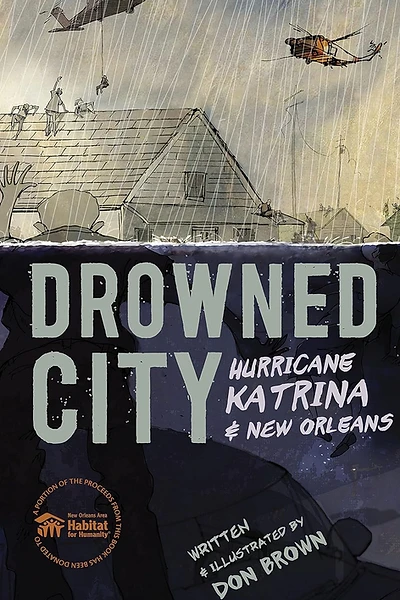
 5-8
5-8GN BROWN
Drowned City: Hurricane Katrina and New Orleans
by Don Brown
Pacing MaterialA graphic novel account of Hurricane Katrina and its devastating impact on New Orleans, from the storm's approach through the levee failures, flooding, and the prolonged recovery efforts.
Big Idea
Natural disasters reveal both the fragility of infrastructure and the strength of community resilience.
Discussion Questions
- 1.Why did the levees fail, and what does that tell us about infrastructure planning?
- 2.How did different levels of government respond, and what could have been done differently?
- 3.What role did socioeconomic status play in who was most affected?
- 4.How do communities rebuild after catastrophic loss?
Classroom Activity
Disaster Response Mapping
Students map the timeline of Hurricane Katrina events and analyze the response efforts at each stage.
Lesson Plan
Learning Goals
- Understand the sequence of events during Hurricane Katrina
- Analyze the relationship between infrastructure and disaster preparedness
- Examine the role of government agencies in emergency response
- Develop empathy for communities affected by natural disasters
Activity Steps
- 1.Read key excerpts from the graphic novel together as a class
- 2.Have students create a chronological map of events from storm formation to recovery
- 3.In small groups, students research one aspect of the response (evacuation, levees, rescue, rebuilding)
- 4.Groups present their findings and discuss what lessons can be applied today
- 5.Reflect on how communities can prepare for and respond to natural disasters
Standards Connections
- ELA: RL.5.1 — Ask and answer questions about key details
- ELA: RL.5.2 — Retell stories, including key details
- ELA: RL.5.3 — Describe characters, setting, and events
- ELA: RL.8.6 — Acknowledge differences in characters' points of view
- ELA: SL.5.1 — Participate in collaborative conversations about the text
- ELA: W.5.3 — Write narratives recounting events with descriptive details
- SEL: Self-Management
- SEL: Responsible Decision-Making
- Art: VA:Re7 — Perceive and analyze artistic work
Pace-Write-Read Study with Pace-Write It!
Focus question: How does Don Brown control the speed of a true disaster story so readers feel both the shock of Hurricane Katrina and the long, painful work of recovery? In Drowned City: Hurricane Katrina and New Orleans, Don Brown uses the graphic novel form to move between quick, urgent moments and slower, reflective ones. The pacing helps readers experience the storm’s immediate danger, the chaos after the levees failed, and the resilience of people rebuilding after catastrophe.
| Element | How to notice or teach it in the novel |
|---|---|
| Pace | Read: Notice how Don Brown speeds up the action as Hurricane Katrina approaches and then slows down to show the suffering, waiting, and recovery in New Orleans. Classroom Activity: Write two short paragraphs about the same disaster event—one in a fast pace with brief sentences, and one in a slow pace with reflective details. |
| Plot | Read: Trace the sequence from warnings about the storm, to landfall, to levee failures, to flooding, rescues, and recovery efforts in Drowned City. Classroom Activity: Make a 6-step plot ladder and then write a short narrative scene that expands one step, such as the levees breaking or families waiting for help. |
| Prosody | Read: Listen to how the narration in Drowned City sounds when read aloud—some lines feel clipped and urgent, while others feel heavy and mournful. Classroom Activity: Choose one page and rewrite its narration to be read aloud with either urgency or sorrow, then mark where your voice should speed up or slow down. |
| Word pause | Read: Notice where single words or short phrases create emotional stops, especially in moments of shock, flood, and loss after Katrina. Classroom Activity: Write 5-7 lines about a crisis using one-word or two-word pauses to make readers stop and feel the moment. |
| Concept | Read: Notice that Drowned City is not just about a storm; it is about human choices, inequality, government failure, and resilience in New Orleans. Classroom Activity: Write a theme statement about the book’s message and then create a short explanatory paragraph that shows how one event from the book supports it. |
| Voice & World View | Read: Notice how Don Brown’s voice is serious, compassionate, and critical of the failures that made Katrina even worse for vulnerable people. Classroom Activity: Write a short nonfiction-style passage about a community crisis in a voice that is informative but also clearly compassionate. |
| Setting & Place | Read: Pay attention to how New Orleans is shown as a unique city shaped by water, levees, neighborhoods, and culture before and after the storm. Classroom Activity: Write a setting paragraph about a real place threatened by nature, using details that show why the place matters to the people who live there. |
| Point of View | Read: Notice that Drowned City uses an outside narrator but also shows the experiences of stranded residents, rescuers, and public officials. Classroom Activity: Rewrite one event from the book from the point of view of a child on a rooftop, a rescuer in a boat, or a person waiting in the Superdome. |
| Original Characters | Read: Even though this is a historical graphic novel, Don Brown helps readers imagine the real people of New Orleans as individuals facing fear, hunger, and uncertainty. Classroom Activity: Create an original character who lived through Katrina and write a short scene showing what that person saw, heard, and feared. |
| Dialogue | Read: Notice how limited dialogue in Drowned City makes spoken words feel important, especially in moments of warning, confusion, or pleading for rescue. Classroom Activity: Write a brief dialogue between two people during the flooding, making each line reveal fear, hope, or frustration. |
| Details | Read: Watch for precise details about rising water, crowded shelters, helicopters, rooftops, and ruined homes that make the disaster real. Classroom Activity: List 8 concrete details from a crisis scene and use at least 5 of them in a descriptive paragraph. |
| Descriptions | Read: Notice how Don Brown describes destruction and human suffering without overexplaining, letting images and carefully chosen words do the work. Classroom Activity: Write a 6-sentence description of a flooded street using sensory details and one strong final image. |
| Strong First Lines | Read: Notice how the opening of Drowned City immediately places readers into the danger and significance of Hurricane Katrina. Classroom Activity: Write three possible opening lines for a disaster narrative, each designed to create urgency right away. |
| Immediacy & Engagement | Read: Notice how the book makes readers feel close to events through present-feeling action, visual storytelling, and scenes of people in immediate danger. Classroom Activity: Write a short scene in which readers feel they are in the middle of the event by using active verbs and close-up details. |
| Story Scenes & Summaries & Unique Structures | Read: Notice how Drowned City shifts between scene-by-scene moments, such as rescue and flooding, and summary sections that explain larger causes and aftermath. Classroom Activity: Write one scene about a family escaping floodwater and one summary paragraph explaining the broader disaster around them. |
| Flashback & Flash Forward & Cliffhangers | Read: Notice how the book uses background information about New Orleans and the levee system to deepen the main timeline, while page endings often leave readers wondering what will happen next. Classroom Activity: Write a short passage about a storm that includes one brief flashback and ends with a cliffhanger sentence. |
| Tension & Suspense & Surprise | Read: Notice how suspense builds as warnings increase, the storm strikes, and then the shocking levee failures make the disaster even worse. Classroom Activity: Write a suspenseful paragraph that begins with a warning and ends with a surprising turn of events. |
| Page Turns and Chapter Breaks | Read: In this graphic novel, notice how turning the page can reveal a sudden change—more flooding, greater destruction, or a new stage of recovery. Classroom Activity: Plan a two-page comic or storyboard and decide what important moment should be hidden until the page turn. |
| Performance | Read: Notice how the narration of Drowned City could be performed with shifts in tone—calm explanation, rising alarm, grief, and determination. Classroom Activity: Prepare and perform 4-6 lines from your own disaster writing, marking where your voice should pause, intensify, or soften. |
| Personality | Read: Notice how the people in Drowned City are shown through actions under pressure—helping others, waiting bravely, calling for rescue, or enduring loss. Classroom Activity: Write a character sketch of a Katrina survivor whose personality is revealed through actions rather than labels. |
| Humor | Read: Notice that Drowned City uses very little humor because the subject is devastating, which makes the serious tone part of its pacing and impact. Classroom Activity: Write a reflection explaining when humor does not fit a topic, then revise a dramatic scene to keep its tone respectful and serious. |
| Pause | Read: Notice how moments of stillness—people stranded, waiting, watching water rise—slow the pace and make the tragedy feel heavier. Classroom Activity: Write a short scene where the action stops for a moment and the character notices one powerful image before the story continues. |
| Poetry and Poetic Devices | Read: Notice how Don Brown sometimes uses vivid imagery and compressed language that feels almost poetic, especially when showing the city underwater. Classroom Activity: Write a 5-line poem about New Orleans after Katrina using imagery, repetition, or metaphor. |
| Repetition | Read: Notice repeated ideas in Drowned City such as water rising, people waiting, and help arriving too slowly, all of which reinforce the scale of the disaster. Classroom Activity: Write a paragraph that repeats one key phrase three times to emphasize fear, loss, or resilience. |
| Rhythm | Read: Notice the rhythm created by alternating brief factual lines with fuller explanatory ones as the disaster unfolds. Classroom Activity: Write 6-8 sentences about an emergency, alternating short and long sentences to create a strong reading rhythm. |
| Punctuation | Read: Notice how punctuation in Drowned City helps control urgency—dashes, commas, and short sentence endings can make events feel abrupt or heavy. Classroom Activity: Rewrite a calm paragraph about a storm into a more urgent one by changing punctuation and sentence length. |
| Questions | Read: As you read Drowned City, ask questions about who was protected, who was left waiting, and why recovery took so long. Classroom Activity: Write three essential questions about Hurricane Katrina and then answer one in a short evidence-based paragraph. |
| Compare-Contrast | Read: Notice the contrasts between before and after the storm, safety and danger, wealthier areas and vulnerable communities, and rescue versus delay. Classroom Activity: Write a compare-contrast paragraph about New Orleans before Katrina and after the flooding, using signal words like before, after, while, and however. |
| Objects | Read: Notice the importance of objects in the book—boats, levees, rooftops, buses, supplies, and ruined belongings all carry meaning. Classroom Activity: Choose one object from the story, such as a rooftop or rescue boat, and write a paragraph explaining its practical and symbolic importance. |
| Threes | Read: Notice how groups of three details can strengthen description, such as listing dangers, losses, or acts of courage during and after Katrina. Classroom Activity: Write a sentence series using three details in each sentence to describe the storm, the flooding, and the recovery. |
| Whitespace & Negative Space | Read: Notice how open space on the page and uncluttered panels can create silence, loneliness, and emotional weight in Drowned City. Classroom Activity: Design a simple comic panel layout for a disaster scene and explain where you would leave blank space to show isolation or loss. |
| Art & Graphics | Read: Study how Don Brown’s illustrations and panel choices shape pacing, especially in scenes of rising water, overcrowded shelters, and wrecked neighborhoods. Classroom Activity: Create a 4-panel storyboard of a historical or environmental crisis, making each panel change the pace of the event. |
| Interactives & Gamification | Read: Think about how Drowned City could be explored through timelines, map paths, cause-and-effect cards, or decision points about evacuation and rescue. Classroom Activity: Create a simple classroom interactive such as a cause-and-effect matching game or timeline challenge based on the events of Hurricane Katrina. |
Pace-Write It!
20-Minute Classroom Flow\nRead (5 min): Read aloud 2-4 pages from Drowned City: Hurricane Katrina and New Orleans by Don Brown that show the storm approaching, the levees failing, or residents waiting for rescue. Ask students to listen for where the story speeds up and where it slows down.\n\nNotice (5 min): Students identify two pacing moves Don Brown uses, such as short sentences, page turns, moments of pause, repeated images of water, or scene-to-summary shifts. Chart responses under two headings: Fast Pace and Slow Pace.\n\nWrite (7 min): Students write a short disaster scene inspired by the book’s pacing techniques. Writing frame: 'First, ________. Then, ________. The water/wind/noise ________. For one moment, ________. After that, ________. I realized ________.' Challenge students to include one fast-paced section, one pause, and at least three concrete details.\n\nShare (3 min): Partners read their scenes aloud and explain one place where they intentionally controlled pacing. Invite 1-2 volunteers to share how their pauses or short sentences changed the mood.\n\nExit ticket: In 1-2 sentences, answer: How does Don Brown’s pacing in Drowned City help readers understand both the danger of Hurricane Katrina and the resilience of the people affected?