 4-7
4-7GN TELGEMEIER
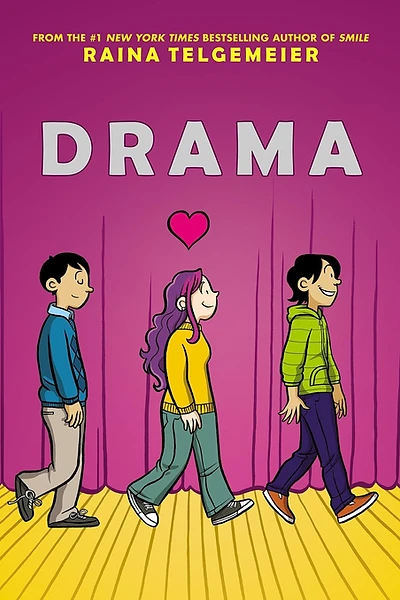
Drama
by Raina Telgemeier
Pacing MaterialCallie navigates middle school theater production, balancing her passion for set design with crushes, friendships, and the drama both on and off the stage.
Big Idea
Creative collaboration teaches us about ourselves and each other — and the best productions happen when everyone works together.
Discussion Questions
- 1.How does Callie's love of set design differ from the actors' experiences?
- 2.What dramas unfold offstage, and how do they affect the production?
- 3.How does Callie handle conflict with her friends and crew?
- 4.What does it take to put on a successful show?
Classroom Activity
Set Design Storyboard
Students design a set for a scene from a favorite book or story, explaining their creative choices.
Lesson Plan
Learning Goals
- Understand the roles involved in theater production
- Explore how set design supports storytelling
- Analyze how characters navigate relationships and conflict
- Develop creative problem-solving skills
Activity Steps
- 1.Discuss the different roles in a theater production: actors, crew, designers
- 2.Have students choose a scene from a favorite book to design a set for
- 3.Students create a storyboard showing their set design with labels
- 4.Share designs and explain how the set supports the story
- 5.Discuss how collaboration made Callie's production possible
Standards Connections
- ELA: RL.4.1 — Ask and answer questions about key details
- ELA: RL.4.2 — Retell stories, including key details
- ELA: RL.4.3 — Describe characters, setting, and events
- ELA: RL.7.6 — Acknowledge differences in characters' points of view
- ELA: SL.4.1 — Participate in collaborative conversations about the text
- ELA: W.4.3 — Write narratives recounting events with descriptive details
- SEL: Relationship Skills
- SEL: Social Awareness
- Art: VA:Re7 — Perceive and analyze artistic work
Pace-Write-Read Study with Pace-Write It!
Focus question: How does Raina Telgemeier speed up and slow down the story in Drama to show friendship, feelings, and middle school tension? In Drama by Raina Telgemeier, Callie works on her school’s theater production while managing crushes, friendships, and backstage problems. Telgemeier uses the graphic novel format, quick dialogue, expressive art, and well-timed page turns to create pacing that feels lively, emotional, and true to middle school life.
| Element | How to notice or teach it in the novel |
|---|---|
| Pace | Read: Notice how Drama moves quickly during rehearsals, set changes, and backstage problems, but slows down in moments when Callie reflects on Greg, Jesse, Justin, and her friendships. The pacing matches the ups and downs of middle school and theater life. Classroom Activity: Write a short scene about a school event that has one fast part and one slow part, and label where the pace changes. |
| Plot | Read: Track how the story builds from Callie’s excitement about stage crew to conflicts involving friendships, crushes, and opening night. The plot weaves theater challenges with personal drama to keep readers turning pages. Classroom Activity: Make a plot ladder with five steps from rehearsal to performance, then write a new problem that could fit between two steps. |
| Prosody | Read: Listen to how the dialogue in Drama sounds when read aloud—some lines are rushed, awkward, excited, or dramatic, just like middle school conversations. The rhythm of speech helps show emotion and pacing. Classroom Activity: Choose a short exchange between Callie and another character, then rewrite it as a read-aloud script with performance notes like pause, whisper, or excited. |
| Word pause | Read: Notice places where a single word, short reply, or reaction creates a pause, especially in surprising or embarrassing moments for Callie. In a graphic novel, a brief line can make a feeling land harder. Classroom Activity: Write a 6-line dialogue where one one-word response changes the mood of the scene. |
| Concept | Read: The big concept in Drama is that theater brings people together, but relationships can still be messy. Friendship, kindness, identity, and belonging all shape the way the story unfolds. Classroom Activity: Write 3-4 sentences explaining how one school activity can create both teamwork and conflict, using Drama as a model. |
| Voice & World View | Read: The story shows a middle school world where feelings are intense, embarrassing moments matter, and kindness can repair hurt. Callie’s world values creativity, friendship, and self-expression even when things go wrong. Classroom Activity: Write a paragraph in the voice of a student who believes school theater is the most important place in school. |
| Setting & Place | Read: Pay attention to how the school, stage, backstage areas, and auditorium shape the action in Drama. Different places create different pacing: crowded hallways feel quick, while behind-the-scenes moments can feel private or tense. Classroom Activity: Describe a school setting in 5-6 sentences and explain how it changes what characters say or do. |
| Point of View | Read: Drama closely follows Callie, so readers experience rehearsals, crushes, and disappointments through her perspective. This keeps the pacing tied to what she notices and worries about most. Classroom Activity: Rewrite one theater moment from the point of view of Jesse, Justin, or Liz to show how pacing changes with a different perspective. |
| Original Characters | Read: Notice how Callie, twins Jesse and Justin, Greg, and Liz each bring different energy to the story. Their distinct personalities keep scenes lively and prevent the middle school drama from feeling repetitive. Classroom Activity: Invent an original student for the stage crew or cast and write a character card plus a short scene introducing them. |
| Dialogue | Read: Watch how dialogue carries much of the story in Drama. The quick back-and-forth talk between friends, crushes, and theater teammates helps scenes move fast and reveals misunderstandings without long explanation. Classroom Activity: Write a 10-line dialogue between two students working on a play where one misunderstanding creates tension. |
| Details | Read: Small details—costumes, set pieces, facial expressions, and rehearsal problems—make Drama feel realistic and help readers understand Callie’s passion for theater. These details support pacing by making quick scenes still feel full. Classroom Activity: Write a short backstage scene with at least four specific details that show the setting without naming the emotion directly. |
| Descriptions | Read: In a graphic novel, descriptions come from both words and pictures. Telgemeier keeps written description brief, letting expressions, body language, and stage images carry much of the meaning. Classroom Activity: Describe a dramatic school moment in 4-5 sentences using short, vivid descriptions as if an artist will draw it. |
| Strong First Lines | Read: Think about how opening moments in Drama quickly place readers in Callie’s world of excitement, feelings, and theater. A strong start creates instant interest and sets the pace for what kind of story this will be. Classroom Activity: Write three possible opening lines for a realistic school story about preparing for a big event. |
| Immediacy & Engagement | Read: Drama feels immediate because readers are right inside rehearsals, awkward conversations, and emotional reactions as they happen. The combination of expressive art and quick scenes makes Callie’s experiences feel close and urgent. Classroom Activity: Write a scene in present tense about a student facing a problem minutes before a performance or presentation. |
| Story Scenes & Summaries & Unique Structures | Read: Some parts of Drama play out moment by moment in scenes, while others move more quickly through time as rehearsals continue. This balance helps Telgemeier focus on the most important emotional and dramatic moments. Classroom Activity: Write one event first as a 6-line scene and then as a 2-sentence summary. |
| Flashback & Flash Forward & Cliffhangers | Read: Drama mostly stays in the present, but it uses suspenseful scene endings and page turns like cliffhangers to make readers want to know what happens next with Callie’s friendships and crushes. Notice when a scene ends just before an answer or reaction. Classroom Activity: Write a scene ending for a graphic novel page where a student opens a door and sees something surprising, then stop before the reveal. |
| Tension & Suspense & Surprise | Read: Tension builds in Drama through social misunderstandings, changing relationships, and theater problems that could ruin the show. Surprises involving characters like Jesse, Justin, and Greg reshape what Callie and the reader expect. Classroom Activity: Write a short school scene where a character expects one outcome but gets a surprising different one. |
| Page Turns and Chapter Breaks | Read: Notice how page turns in Drama act like mini suspense beats, especially before a reveal, a reaction, or a new complication. In graphic novels, the turn itself controls pacing. Classroom Activity: Plan a 4-panel page and decide what image or line should come right before the page turn to make readers curious. |
| Performance | Read: Because Drama centers on a school musical, performance matters both onstage and offstage. Characters perform in front of audiences, but they also sometimes hide feelings or act differently around others. Classroom Activity: Write a paragraph comparing a character’s onstage performance with how they act in a private backstage moment. |
| Personality | Read: Callie’s enthusiasm, Greg’s awkwardness, the twins’ different styles, and Liz’s steady friendship shape the energy of each scene. Personality affects pacing because some characters create chaos while others create calm. Classroom Activity: Write two mini-scenes about the same problem, one with an energetic character and one with a calm character. |
| Humor | Read: Humor in Drama often comes from awkward middle school moments, exaggerated reactions, and theater mishaps. These funny beats lighten the emotional tension and keep the pacing lively. Classroom Activity: Write a humorous backstage problem that starts as a disaster but ends in a small laugh. |
| Pause | Read: Notice the emotional pauses in Drama when Callie is disappointed, confused, or quietly observing what is happening around her. These slower moments help readers process the faster dramatic scenes. Classroom Activity: Write a 5-sentence pause moment where a character stops talking and notices what is happening around them after bad news. |
| Poetry and Poetic Devices | Read: Drama is realistic prose, not poetry, but it still uses repeated images, expressive language, and emotional contrasts that can feel poetic. Think about how stage lights, applause, and silence can become symbols of feeling. Classroom Activity: Write a 6-line free-verse poem from Callie’s point of view about the stage before the curtain rises. |
| Repetition | Read: Repeated rehearsal routines, recurring worries, and ongoing friendship questions help create structure in Drama. Repetition also shows how middle school emotions can circle back again and again. Classroom Activity: Write a paragraph that repeats one phrase three times to show a character’s growing worry before a big event. |
| Rhythm | Read: The rhythm of Drama comes from alternating busy theater scenes with quieter emotional ones. This pattern keeps the story from feeling flat and reflects the beat of school life. Classroom Activity: Write a scene in three parts—rush, calm, rush—to create rhythm in your pacing. |
| Punctuation | Read: Study how punctuation in Drama—ellipses, exclamation marks, question marks, and dashes—helps shape emotion and timing in dialogue. In graphic novels, punctuation works with facial expressions to control how a line is heard. Classroom Activity: Write the same line of dialogue three ways using different punctuation to change the feeling. |
| Questions | Read: Readers keep asking questions while reading Drama: Who likes whom? Will the set be finished? Will friendships survive the misunderstandings? These questions keep the story moving. Classroom Activity: Write five reader questions that could hook someone into a realistic school story by the end of page one. |
| Compare-Contrast | Read: Compare onstage drama with real-life drama in Callie’s middle school world. Also contrast characters like Jesse and Justin, or Callie’s hopes with what actually happens. Classroom Activity: Write a compare-contrast paragraph about theater drama versus friendship drama in school. |
| Objects | Read: Props, sets, costumes, flowers, and backstage materials matter in Drama because objects often carry emotion and move the action forward. Callie’s connection to theater objects shows her passion and point of view. Classroom Activity: Choose one object from a school event and write how it could symbolize a friendship or a problem. |
| Threes | Read: Look for patterns of three in events, reactions, or details to build emphasis, such as three worries before opening night or three small mishaps in rehearsal. Groups of three can make pacing feel complete and memorable. Classroom Activity: Write a short scene that includes three escalating problems before a solution appears. |
| Whitespace & Negative Space | Read: In Drama, silence, panel spacing, and moments with little text can slow readers down and highlight emotion. Negative space in a graphic novel can make an awkward pause or disappointment feel bigger. Classroom Activity: Plan a 3-panel scene and decide which panel should have almost no words so the feeling stands out. |
| Art & Graphics | Read: The art in Drama is essential to pacing—facial expressions, body movement, panel size, and visual transitions show mood and speed without needing many words. Telgemeier’s illustrations help readers instantly understand Callie’s excitement, embarrassment, or hope. Classroom Activity: Sketch or describe a 4-panel sequence showing a friendship misunderstanding only through expressions and body language. |
| Interactives & Gamification | Read: Drama is not interactive in a digital way, but readers can engage by predicting relationships, performance problems, and scene outcomes. The theater setting makes it easy to imagine choices and alternate outcomes. Classroom Activity: Create a choose-your-path chart for Callie before opening night with at least three choices and possible results. |
Pace-Write It!
20-Minute Classroom Flow Read (5 min): Read a short section from Drama that shows both a busy rehearsal or backstage problem and a quieter emotional reaction from Callie. Ask students to notice where the story speeds up and where it slows down. Notice (5 min): Discuss: How do the pictures, dialogue, and page turns control pacing? Chart student observations under Fast, Slow, and Why the author changed the pace. Point out specific characters such as Callie, Jesse, Justin, Greg, or Liz. Write (7 min): Students write their own realistic school scene about preparing for an event, friendship tension, or a backstage-style problem. Writing frame: “At first, __________ was happening fast because __________. Then everything slowed down when __________. I noticed __________, __________, and __________. When __________ said, ‘__________,’ the moment changed because __________.” Encourage students to include at least one line of dialogue and one pause moment. Share (3 min): Partners read their scenes aloud and identify one fast-paced line and one slow-paced line. Invite 1-2 volunteers to share how they used pacing like Raina Telgemeier. Exit ticket: In one sentence, explain one way Drama uses pacing to show friendship, kindness, or middle school emotions.