 PreK-3
P TRACY
Don't Leave!
by Kristen Tracy
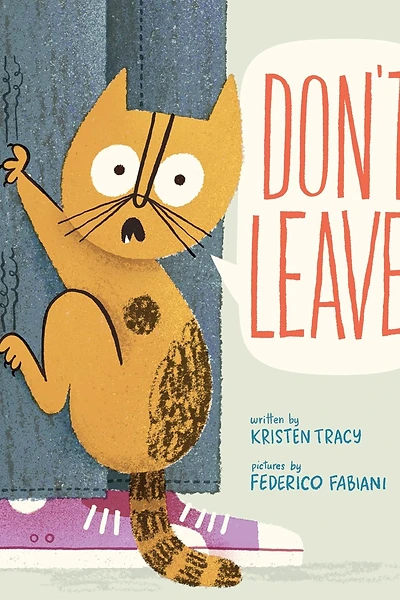
Pacing MaterialA clingy orange cat does everything it can to stop its person from leaving — a funny and heartfelt look at separation anxiety and the love between pets and their people.
Big Idea
It's hard to let go of the ones we love, but love means trusting they'll come back.
Discussion Questions
- 1.Why doesn't the cat want its person to leave?
- 2.What are some funny things the cat does to try to stop them?
- 3.How do you feel when someone you love has to leave?
- 4.What helps you feel better when you miss someone?
Classroom Activity
Welcome Home
Draw a picture of how you welcome someone home. Write one sentence about what you do to show them you missed them.
Lesson Plan
Learning Goals
- Identify how the orange cat feels when its person prepares to leave, using clues from the story and illustrations.
- Describe how the cat’s actions show love, worry, and a wish to stay close to its person.
- Discuss ways to manage missing someone, such as sharing feelings or planning a welcome-home greeting.
- Draw a welcome-home scene and dictate or write one sentence explaining how to show someone they were missed.
Activity Steps
- 1.Introduce “Don’t Leave!” by Kristen Tracy. Ask, “How might a pet feel when its person goes out?” Invite children to name feelings without requiring them to share personal experiences.
- 2.Read the book aloud, pausing to examine the orange cat’s expressions and attempts to keep its person from leaving. Ask, “What does the cat do? What might it be feeling?”
- 3.Discuss how someone can leave and still care about us. Brainstorm comforting actions while waiting, such as taking slow breaths, enjoying an activity, or talking with a trusted adult.
- 4.Introduce “Welcome Home.” Invite children to imagine welcoming a loved one—or the cat welcoming its person—home. Model a greeting that respects the other person’s wishes, such as waving, saying “I missed you,” or offering a hug.
- 5.Have children draw their welcome-home scene and add one sentence describing their greeting. Offer the frame “When you come home, I ___ to show I missed you.” PreK–K children may dictate; grades 1–3 may write independently.
- 6.Invite volunteers to share their pictures and sentences. Close by connecting their greetings to the cat’s love for its person and discussing how caring continues even when people are apart.
Standards Connections
- ELA: RL.K.3 — With prompting and support, identify characters and major events, including the cat’s attempts to stop its person from leaving.
- ELA: RL.1.7 — Use illustrations and story details to describe the cat and its feelings.
- ELA: W.K.2 — Use drawing, dictating, and writing to explain a welcome-home greeting.
- SEL: Self-awareness — Identify and name feelings associated with missing someone.
- SEL: Relationship skills — Practice expressing affection and welcoming others while respecting their preferences.
Pace-Write-Read Study with Pace-Write It!
Focus question: How does an author slow down or speed up a story to show big feelings? In Don't Leave! by Kristen Tracy, a determined orange cat tries every possible trick to keep its person from going away. The book uses quick funny moments, repeated attempts, and well-timed page turns to pace the cat’s worry and show the loving bond between pet and person.
| Element | How to notice or teach it in the novel |
|---|---|
| Pace | Read: Notice how the story moves quickly as the orange cat tries one idea after another to stop its person from leaving, which matches the cat’s urgent feelings. Classroom Activity: Write 3 fast actions your own animal or character does in a row to stop someone from leaving. |
| Plot | Read: Notice the clear plot pattern in this book: the person gets ready to go, the cat interferes, the problem grows, and the love between them still shines through. Classroom Activity: Make a 4-box plot sketch for a story about a character trying to stop a goodbye. |
| Prosody | Read: Listen to how the sentences can be read with dramatic expression, especially when the cat’s actions become bigger and funnier. Classroom Activity: Choose one page idea from the story and rewrite it so it sounds extra dramatic when read aloud. |
| Word pause | Read: Notice places where a reader naturally pauses before the next funny cat attempt, building anticipation. Classroom Activity: Write one short sentence and add a pause with a dash or ellipsis before the big action. |
| Concept | Read: The big idea is that separation anxiety can look silly on the outside but comes from love and attachment. Classroom Activity: Write a sentence explaining what the orange cat really wants and why. |
| Voice & World View | Read: Notice how the story centers the cat’s clingy, emotional way of seeing the world, making every departure feel huge. Classroom Activity: Write 2 lines in the voice of a pet who thinks a short goodbye is a giant problem. |
| Setting & Place | Read: Notice how the home setting gives the cat familiar places to block, climb, hide, or cling, which helps the action move. Classroom Activity: Draw and label 3 places in a home where a pet could try to stop someone from leaving, then write a sentence for one place. |
| Point of View | Read: Think about how the story invites readers to focus closely on the cat’s feelings, even while we understand the person has to leave. Classroom Activity: Rewrite one moment from the person’s point of view, showing love for the cat. |
| Original Characters | Read: The orange cat feels memorable because it is extra clingy, determined, funny, and loving all at once. Classroom Activity: Invent an original pet character with one exaggerated trait and write how that trait causes trouble. |
| Dialogue | Read: Notice how any spoken words or imagined pet-to-person meaning can make the goodbye feel personal and immediate. Classroom Activity: Write a 2-line dialogue between the cat and its person at the door. |
| Details | Read: Small details about the cat’s body, movement, and attempts help readers picture each effort to keep the person close. Classroom Activity: List 5 tiny details about a pet trying not to be left alone, then use 2 in a sentence. |
| Descriptions | Read: Notice how description helps us see the orange cat as soft and lovable even when its behavior is dramatic. Classroom Activity: Write a describing sentence about a pet using color, movement, and feeling. |
| Strong First Lines | Read: Think about how the opening quickly brings readers into the problem of leaving, so we know the story’s tension right away. Classroom Activity: Write an opening line for a story that starts at the moment someone is about to go. |
| Immediacy & Engagement | Read: The book feels immediate because the cat acts right away, pulling readers into the emotional problem from the start. Classroom Activity: Begin a story with action in the very first sentence, not background information. |
| Story Scenes & Summaries & Unique Structures | Read: Notice how the book likely highlights scene after scene of the cat’s attempts rather than long explanation, which keeps pacing lively and visual. Classroom Activity: Write 3 mini-scenes, each showing a new attempt by a character to solve one problem. |
| Flashback & Flash Forward & Cliffhangers | Read: This story mostly stays in the present, which makes the cat’s feelings feel urgent, but page-by-page suspense can act like tiny cliffhangers. Classroom Activity: End a sentence with a cliffhanger such as “But then the cat saw...” and let a partner finish it. |
| Tension & Suspense & Surprise | Read: Each new cat plan creates tension because readers wonder what the cat will do next and whether the person will still leave. Classroom Activity: Write a surprise next attempt for the orange cat that readers would not expect. |
| Page Turns and Chapter Breaks | Read: In a picture book like Don't Leave!, page turns help deliver jokes, surprises, and the next stage of the cat’s clinginess. Classroom Activity: Fold a paper into 4 pages and plan what a reader sees before and after one surprise page turn. |
| Performance | Read: The cat’s behavior is almost like a performance, with exaggerated actions that could be acted out for an audience. Classroom Activity: Act out one cat moment, then write a sentence that matches the action. |
| Personality | Read: The orange cat’s personality drives the whole story because it is loving, dramatic, stubborn, and needy in a funny way. Classroom Activity: Write a character profile with 4 traits for a pet or child who hates goodbyes. |
| Humor | Read: The humor comes from how serious the cat is about stopping something ordinary, turning a common goodbye into a big event. Classroom Activity: Write one funny way a pet might “help” so the person cannot leave. |
| Pause | Read: Notice how a pause before the next cat move gives readers time to feel the worry or enjoy the joke. Classroom Activity: Write 2 short lines, putting the second line alone to create a pause before the big feeling. |
| Poetry and Poetic Devices | Read: Even in prose, the book can use playful sound, image, and pattern to make the cat’s emotions feel bigger. Classroom Activity: Write a simile for the cat, such as “The cat clung like...” and finish it. |
| Repetition | Read: Repeated attempts and repeated feelings help show the cat’s determination and make the pacing feel playful and building. Classroom Activity: Write a repeating line a pet says or seems to say each time the person reaches for the door. |
| Rhythm | Read: The rhythm may speed up with short actions as the cat scrambles, leaps, and blocks, matching anxious energy. Classroom Activity: Write 3 short action phrases in a row to create a fast rhythm. |
| Punctuation | Read: Exclamation points, commas, and dashes can help show urgency, interruptions, and strong emotion in a story like this one. Classroom Activity: Write one sentence about the cat using an exclamation point and one using a dash. |
| Questions | Read: Readers may keep wondering, “What will the cat do next?” and “How will the person respond kindly?” Classroom Activity: Write 2 questions a reader might ask during the story, then answer one. |
| Compare-Contrast | Read: Compare the cat’s big emotional reaction with the ordinary routine of the person leaving; that contrast creates both humor and heart. Classroom Activity: Write 2 sentences comparing how the cat feels and how the person feels at goodbye time. |
| Objects | Read: Everyday objects connected to leaving, like shoes, bags, coats, or the door, can become important because the cat reacts to them. Classroom Activity: Choose one leaving object and write how a pet feels when it appears. |
| Threes | Read: Stories often feel satisfying when actions come in threes, and the cat’s repeated attempts could be grouped that way for strong pacing. Classroom Activity: Plan 3 tries your character makes to stop a goodbye, making each one bigger than the last. |
| Whitespace & Negative Space | Read: In a picture book, open space on the page can make one cat pose, one moment of waiting, or one big feeling stand out. Classroom Activity: Make a page sketch with just one sentence and one big picture idea to show a lonely pause. |
| Art & Graphics | Read: The illustrations in a book like Don't Leave! work with the words to show the orange cat’s body language, closeness, and comic timing. Classroom Activity: Draw the cat in two poses—calm and clingy—and write one caption for each. |
| Interactives & Gamification | Read: Readers can interact by predicting the next cat plan or acting out a goodbye scene, which helps them notice pacing choices. Classroom Activity: Create a “What will the cat do next?” choice card game with 3 possible actions and write the best one as a sentence. |
Pace-Write It!
20-Minute Classroom Flow\nRead (5 min): Read Don't Leave! by Kristen Tracy aloud. Pause at key moments before the cat’s next attempt and ask students to predict what the orange cat will do.\nNotice (5 min): Discuss how Kristen Tracy uses repeated attempts, page turns, short action moments, and funny surprises to show the cat’s separation anxiety and love. Make a quick class chart: “What speeds up the story?” and “What slows it down?”\nWrite (7 min): Students write a mini story about a pet or person trying to stop someone from leaving. Writing frame: “When _____ got ready to leave, _____ said, ‘Don’t leave!’ First, _____. Next, _____. Then, _____. But finally, _____. I felt _____ because _____.” Encourage students to make each attempt bigger than the one before.\nShare (3 min): Partners read their stories aloud with expression, adding dramatic pauses before the funniest or biggest moment. Invite 2 volunteers to share with the whole group.\nExit ticket: Write one sentence answering: “How did repeating actions make the story feel faster, funnier, or more emotional?”
Pace-Write-Read Connection
Teach this book using the Pace-Write-Read method — Tool 20: Play.
Open the Mastery Manual