 1-4
1-4GN PILKEY
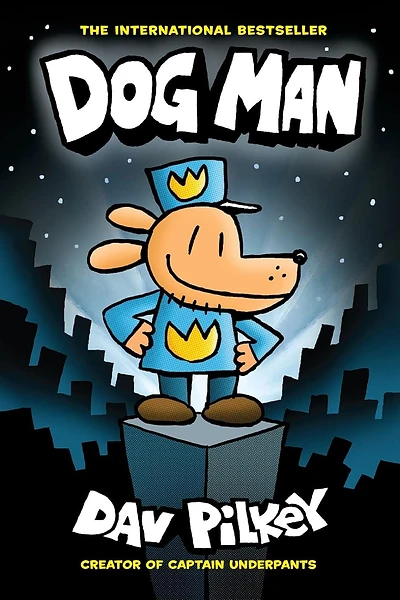
Dog Man
by Dav Pilkey
Pacing MaterialA half-dog, half-policeman hero fights crime with heart and hilarity in a wildly popular, kid-favorite series.
Big Idea
Even heroes make mistakes — what matters is that you keep trying to do good and make others laugh along the way.
Discussion Questions
- 1.What makes Dog Man a hero even though he's silly?
- 2.How does the author use humor to tell the story?
- 3.What mistakes does Dog Man make, and how does he fix them?
- 4.How do the pictures add to the jokes?
Classroom Activity
Hero Flip-O-Rama
Invent your own silly hero. Draw a four-panel comic showing one funny problem they solve, and write a caption for each panel.
Lesson Plan
Learning Goals
- Describe how Dog Man’s actions show that a hero can make mistakes and still try to help others.
- Explain how Dav Pilkey uses pictures, captions, and silly situations to tell a humorous story.
- Create an original silly hero and sequence a problem, a mistaken attempt, a new attempt, and a solution in four comic panels.
- Write or dictate a caption for each panel that helps readers understand the action and the hero’s perseverance.
Activity Steps
- 1.Read a short, teacher-selected excerpt from Dog Man. Discuss: What makes Dog Man an unusual hero? How do his actions and the pictures make readers laugh? When something goes wrong, how can a hero keep trying?
- 2.Examine how panels guide readers through a comic. Demonstrate a Flip-O-Rama feature from the book, noting how two drawings suggest movement. Explain that students will make a four-panel comic and may add an optional two-picture flip animation.
- 3.Invite students to invent a silly hero inspired by Dog Man’s unexpected combination of traits, such as a half-cat, half-chef helper. Have them name the hero and choose one funny, manageable problem to solve.
- 4.Model planning four panels: introduce the problem, show an attempt that goes wrong, show the hero trying a different approach, and reveal a helpful, funny solution. Students sketch their own sequence.
- 5.Have students finish their drawings and add one caption per panel. For grades 1–2, offer dictation or sentence starters such as “Oops!” and “I’ll try again!” For grades 3–4, encourage specific action words and optional speech bubbles. Early finishers can draw two versions of one action on small stacked sheets to create a flip animation.
- 6.Pair students to share their comics. Partners identify the hero’s mistake, explain how the hero kept trying to do good, and point out one detail that made them laugh. Allow students to revise any unclear panel or caption.
Standards Connections
- ELA: CCSS RL.1.3 — Describe characters and major events using key details during the Dog Man discussion.
- ELA: CCSS RL.2.7 — Use information from illustrations and words to demonstrate understanding of characters and plot.
- ELA: CCSS W.1.3–W.4.3 — Develop grade-appropriate narratives with sequenced events and a sense of closure through comic panels and captions.
- ELA: CCSS SL.1.1–SL.4.1 — Participate in collaborative discussions about the book and classmates’ comics.
- SEL: Self-management and responsible decision-making — Explore perseverance after mistakes and choose helpful solutions to problems.
Pace-Write-Read Study with Pace-Write It!
Focus question: How does Dav Pilkey speed up and slow down a funny adventure so readers stay excited and keep turning pages? In Dog Man by Dav Pilkey, a half-dog, half-police officer hero races through silly crime-fighting adventures with Petey, Chief, and other comic characters. The book uses pacing through short panels, quick dialogue, cliffhangers, visual jokes, and dramatic page turns that make the humor and action feel fast, playful, and engaging.
| Element | How to notice or teach it in the novel |
|---|---|
| Pace | Read: Notice how Dog Man moves quickly from problem to problem with short scenes, fast action, and comic panel changes as he faces trouble caused by Petey and other criminals. Classroom Activity: Write a 4-panel mini scene where your hero solves a problem quickly, using one sentence per panel to keep the pace fast. |
| Plot | Read: Notice how the plot in Dog Man follows a clear pattern: a crime or problem begins, Dog Man tries to help, chaos grows, and the ending brings a funny solution or twist. Classroom Activity: Write a beginning-middle-end plot for a silly hero who stops a goofy crime in your school or neighborhood. |
| Prosody | Read: Listen to how the words in Dog Man sound aloud, especially in exciting or funny parts, with bouncy phrasing, sound effects, and expressive speech. Classroom Activity: Read a favorite Dog Man-style action line aloud, then write 3 action sentences meant to sound exciting when spoken. |
| Word pause | Read: Notice where Dav Pilkey uses single words, line breaks, or short speech bubbles to make readers pause before a joke or surprise. Classroom Activity: Write a short comic moment that uses a one-word line before the punch line, such as 'Wait...' or 'Uh-oh...'. |
| Concept | Read: Notice how the main concept of Dog Man is instantly funny and memorable: a hero who is half dog and half man uses dog traits and human job duties to fight crime. Classroom Activity: Invent a new mixed-up hero and write 3 sentences explaining the character's powers, problem, and funny weakness. |
| Voice & World View | Read: Notice the playful, kid-friendly voice in Dog Man that sees the world as silly, imaginative, and full of second chances, even when characters make mistakes. Classroom Activity: Write a paragraph in a funny, hopeful voice about a character who messes up but keeps trying to do good. |
| Setting & Place | Read: Notice how the city in Dog Man feels busy and comic-book dramatic, with police stations, streets, buildings, and crime scenes that let action happen fast. Classroom Activity: Create a setting for a funny rescue scene and write 5 details that make the place feel active and ready for adventure. |
| Point of View | Read: Notice how Dog Man often lets readers watch the action from outside the characters, so we can see Dog Man, Petey, and others collide in funny ways. Classroom Activity: Rewrite a silly action moment first from Dog Man's view and then from Petey's view. |
| Original Characters | Read: Notice how Dog Man, Petey, Chief, and Li'l Petey feel original because they each have clear traits, funny habits, and strong roles in the story. Classroom Activity: Invent an original sidekick or villain and list the character's look, goal, catchphrase, and one surprising soft side. |
| Dialogue | Read: Notice how the dialogue in Dog Man is short, funny, and easy to follow, helping scenes move quickly while showing character feelings. Classroom Activity: Write 6 lines of dialogue between a hero and villain where each line is short and reveals personality. |
| Details | Read: Notice how little details in Dog Man, like a goofy expression, a tiny background joke, or a silly object, make scenes funnier without slowing the story too much. Classroom Activity: Write a short scene and add 3 small funny details that make the action more interesting. |
| Descriptions | Read: Notice that descriptions in Dog Man are usually brief and vivid, giving just enough information for readers to picture the joke, character, or action. Classroom Activity: Describe a ridiculous villain in 4 strong details without writing a long paragraph. |
| Strong First Lines | Read: Notice how Dog Man hooks readers right away with high energy, humor, and a sense that something big or silly is about to happen. Classroom Activity: Write 3 possible first lines for a comic adventure story that make readers want to keep going. |
| Immediacy & Engagement | Read: Notice how Dog Man makes events feel immediate by dropping readers into action quickly, using urgent problems, visual motion, and funny reactions. Classroom Activity: Start a story in the middle of an emergency, using action right away in the first 2 sentences. |
| Story Scenes & Summaries & Unique Structures | Read: Notice how Dog Man mixes full action scenes with quick summaries and comic-book structures like panels, captions, and mini transitions to control speed. Classroom Activity: Write one action scene in 4 lines, then add a 2-line summary that jumps ahead to the next problem. |
| Flashback & Flash Forward & Cliffhangers | Read: Notice how Dog Man sometimes uses cliffhanger-style endings and quick shifts that make readers wonder what happens next, especially when Petey's plans are unfolding. Classroom Activity: Write a short scene ending with a cliffhanger about a hero opening a mysterious door or hearing a strange sound. |
| Tension & Suspense & Surprise | Read: Notice how Dav Pilkey builds tension in Dog Man by letting problems grow, then breaks the suspense with a surprising joke, rescue, or twist. Classroom Activity: Write 5 sentences that build suspense about a trap, then end with a funny surprise. |
| Page Turns and Chapter Breaks | Read: Notice how Dog Man uses page turns and chapter breaks to hide a joke, reveal a new problem, or make readers rush ahead to see Dog Man's next move. Classroom Activity: Plan a 2-page comic idea and write what the reader should learn only after the page turn. |
| Performance | Read: Notice how Dog Man feels performative, as if characters are acting on a stage, with exaggerated expressions, dramatic reactions, and big comic timing. Classroom Activity: Choose a scene and script it like a mini performance with stage directions such as gasp, leap, crash, and grin. |
| Personality | Read: Notice how Dog Man's loyal, eager personality and Petey's sneaky but sometimes changing personality affect the speed and tone of scenes. Classroom Activity: Write a character sketch showing how a hero's personality causes both a problem and a solution. |
| Humor | Read: Notice how Dog Man uses slapstick, puns, silly misunderstandings, and visual comedy to keep even action scenes light and funny. Classroom Activity: Write a humorous scene where a serious mission gets interrupted by one very silly mistake. |
| Pause | Read: Notice how pauses in Dog Man often happen right before a reveal, a reaction shot, or a joke, making the next panel funnier. Classroom Activity: Write a 5-line scene that includes one planned pause before the funniest line. |
| Poetry and Poetic Devices | Read: Notice how Dog Man sometimes plays with sound, rhythm, and repeated phrasing in ways that feel musical and fun, especially in jokes and action language. Classroom Activity: Write 4 lines about a hero chase using alliteration or rhyme, such as 'Dog Man dashed down the dark driveway.' |
| Repetition | Read: Notice how repeated words, running jokes, and repeated character traits in Dog Man help build humor and make the pacing feel playful and familiar. Classroom Activity: Write a short comic scene that repeats a funny phrase 3 times, with a different meaning each time. |
| Rhythm | Read: Notice how the rhythm of Dog Man comes from quick panel beats, short dialogue, and bursts of action followed by reaction. Classroom Activity: Write 6 sentences that alternate between action and reaction to create a comic rhythm. |
| Punctuation | Read: Notice how exclamation marks, question marks, ellipses, and big comic lettering in Dog Man help show speed, surprise, and emotion. Classroom Activity: Rewrite a plain sentence 3 ways using different punctuation to show fear, excitement, and confusion. |
| Questions | Read: Notice how Dog Man makes readers ask questions like whether Dog Man will save the day, what Petey will do next, or how a mess will be fixed. Classroom Activity: Write 4 story questions that could pull readers through your own funny adventure. |
| Compare-Contrast | Read: Notice how Dog Man and Petey contrast in behavior, goals, and choices, yet both can surprise readers with heart and change. Classroom Activity: Make a compare-contrast chart for a hero and villain, then use it to write a paragraph about their biggest difference. |
| Objects | Read: Notice how objects in Dog Man, like gadgets, tools, or silly crime-related items, often spark action and jokes at the same time. Classroom Activity: Pick one object, such as a giant bone, robot shoe, or slime machine, and write a scene where it causes trouble. |
| Threes | Read: Notice how funny stories like Dog Man often use groups of three in actions, attempts, or jokes so the third moment becomes the funniest or most surprising. Classroom Activity: Write a scene where a character tries 3 times to solve a problem, and the third try creates the best twist. |
| Whitespace & Negative Space | Read: Notice how open space between panels, around speech bubbles, or on a page in Dog Man gives readers a moment to rest, notice a reaction, or prepare for the next joke. Classroom Activity: Plan a comic page and mark where you would leave extra space to make one reaction or reveal stand out. |
| Art & Graphics | Read: Notice how the drawings, panel sizes, motion lines, and expressions in Dog Man do pacing work by speeding up chases and slowing down funny reactions. Classroom Activity: Draw or describe 3 panels of action, using one visual choice in each panel to show fast, faster, and fastest. |
| Interactives & Gamification | Read: Notice how Dog Man includes playful features and a kid-centered style that makes reading feel active, almost like joining the joke or helping tell the story. Classroom Activity: Create a reader challenge for your story, such as 'Find 3 clues,' 'Guess the villain,' or 'Choose the next gadget,' and write directions for it. |
Pace-Write It!
20-Minute Classroom Flow\nRead (5 min): Read aloud a short, funny action sequence from Dog Man by Dav Pilkey. Ask students to listen for places where the story speeds up, slows down, or pauses before a joke or surprise.\nNotice (5 min): Chart what students observe: short dialogue, quick panels, cliffhangers, repeated jokes, sound effects, and expressive punctuation. Discuss how Dog Man, Petey, and Chief help create fast, funny pacing through their actions and reactions.\nWrite (7 min): Students write a mini comic-style scene about a silly hero solving a problem fast. Writing frame: 'At first, ____ was happening in ____. Then ____ shouted, "____!" Next, my hero ____ fast. For a moment... ____. Finally, ____ solved the problem, but ____ made it funny.' Encourage students to use one pause, one surprise, and one short line of dialogue.\nShare (3 min): Partners read their scenes aloud with expression and identify where the pacing speeds up and where it pauses for humor. Invite 1-2 volunteers to share a favorite funny line.\nExit ticket: Write one sentence answering: 'How did I use pacing today to make my story funny or exciting?'
Pace-Write-Read Connection
Teach this book using the Pace-Write-Read method — Tool 20: Play.
Open the Mastery Manual