 2-4
2-4C DISASTER
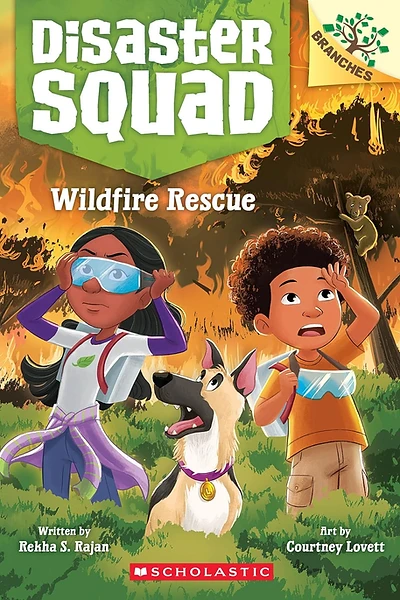
Disaster Squad: Wildfire Rescue
by Rekha S. Rajan
Pacing MaterialWhen wildfire smoke fills the sky near their town, the kids of Disaster Squad spring into action. Led by quick-thinking Mia and resourceful Diego, the team helps neighbors evacuate safely, teaches fire safety basics to younger kids, and even helps rescue a family pet trapped near the fire line. Along the way, the squad learns about how wildfires start, how firefighters and communities work together, and how courage means staying calm and helping others even when you're scared.
Big Idea
Real courage is choosing to help others even when a situation feels scary and uncertain.
Discussion Questions
- 1.Why do you think the author chose kids as the main heroes of this story instead of adults?
- 2.What are three things the Disaster Squad did to help their community during the wildfire?
- 3.Have you ever had to follow an emergency plan, like a fire drill? How did it feel?
- 4.How did the characters manage their fear while still helping others?
- 5.What is one fact about wildfires you learned from this book that surprised you?
- 6.Why is teamwork important during an emergency like a wildfire?
Classroom Activity
Build Your Own Family Wildfire Safety Plan
Working individually or in small groups, students create an illustrated 'Family Emergency Plan' poster modeled after the steps the Disaster Squad follows in the book. Students list three things to pack in a go-bag, draw a map of two exit routes from their home or classroom, and write a short paragraph describing what job each family member (or classmate) would have during an evacuation, just like each Disaster Squad member has a special role in the story.
Lesson Plan
Learning Goals
- Describe how Mia and Diego demonstrate courage, calm thinking, and teamwork, using details from Disaster Squad: Wildfire Rescue.
- Identify three useful go-bag items and explain how they support a safe evacuation.
- Draw and label two possible exit routes from a home or classroom, with adult guidance.
- Write a short paragraph assigning safe, age-appropriate evacuation roles to family members or classmates.
- Explain that helping during a wildfire means following trusted adults and emergency responders, not approaching fire or attempting rescues.
Activity Steps
- 1.Discuss selected scenes in which Mia and Diego help neighbors and work as a team. Ask: “How do they show courage while feeling scared?” Record examples from the text, and distinguish story adventures from safe actions children should take in real emergencies.
- 2.Introduce the illustrated Family Emergency Plan poster. Explain that children should stay with a trusted adult, follow evacuation instructions promptly, and leave belongings behind if collecting them would delay leaving. Never approach a fire line or return for a pet; tell an adult or emergency responder instead.
- 3.Have students work individually or in small groups to draw and label three go-bag items, such as drinking water, a flashlight, and emergency contact information. Add a sentence explaining each choice. Remind students that adults prepare supplies ahead of time.
- 4.Have students sketch a simple home or classroom map with two possible exit routes and an adult-approved meeting place. Use the classroom's established evacuation plan as a model; home routes are drafts for caregivers to review, and actual wildfire evacuation directions come from adults and local officials.
- 5.Connect Mia and Diego's teamwork to emergency responsibilities. Students write a short paragraph assigning safe roles, such as an adult checking official alerts and guiding everyone out, and children staying together and following directions. Offer sentence frames: “The adult will ___. My job will be ___.”
- 6.Invite students to share their posters and explain one way their plan shows calm, helpful courage. Check for three items, two routes, a meeting place, and safe roles. Send home plans for caregiver review, or have classroom plans reviewed by the teacher.
Standards Connections
- ELA: CCSS RL.2.3 — Describe how characters respond to major events and challenges, using Mia and Diego's responses to the wildfire.
- ELA: CCSS RL.3.3 — Describe characters' traits, motivations, and feelings and explain how their actions contribute to events.
- ELA: CCSS W.2.2–W.4.2 — Write informative explanations of go-bag choices and safe evacuation responsibilities.
- ELA: CCSS SL.2.1–SL.4.1 — Participate in collaborative discussions about the story and share emergency-plan ideas.
- SEL: Responsible decision-making and relationship skills — Choose safe ways to help others and cooperate with trusted adults during an emergency.
Pace-Write-Read Study with Pace-Write It!
Disaster Squad: Wildfire Rescue moves at a brisk, high-stakes pace typical of adventure chapter books for young readers, balancing short punchy action scenes with quieter moments of friendship and problem-solving. The following 33 craft elements offer close-reading opportunities paired with hands-on writing tasks, helping students notice how Rajan builds tension, develops teamwork-driven characters, and keeps young readers turning pages during a real-world disaster scenario.
| Element | How to notice or teach it in the novel |
|---|---|
| Pace | Read: Notice how short chapters and quick scene changes mirror the urgency of an evacuation, speeding up during fire scenes and slowing down during planning moments. Classroom Activity: Students rewrite a slow classroom scene to make it feel fast-paced using short sentences and active verbs. |
| Plot | Read: Notice how the wildfire creates a ticking-clock structure — the squad must evacuate neighbors before the fire reaches the road. Classroom Activity: Students map the story's plot on a five-event storyboard labeled Problem, Rising Action, Climax, Falling Action, Resolution. |
| Prosody | Read: Notice how sentence length shortens during action (‘Smoke. Sirens. Run.’) and lengthens during calmer explanation scenes. Classroom Activity: Students write two versions of the same event — one in short urgent sentences, one in longer descriptive sentences — and compare the feel of each. |
| Word pause | Read: Notice how single-word sentences like ‘Wait.’ or ‘Listen.’ create dramatic stops during the rescue scenes. Classroom Activity: Students add one single-word sentence to a paragraph they've written to create a moment of tension. |
| Concept | Read: Notice how the book introduces the real-world concept of wildfire safety through story rather than lecture. Classroom Activity: Students choose another disaster (flood, earthquake) and brainstorm three safety facts they could turn into a story scene. |
| Voice & World View | Read: Notice how Mia's practical, take-charge voice reflects her belief that kids can make a real difference in emergencies. Classroom Activity: Students write a journal entry in Mia's voice describing how she feels the night before the wildfire reaches town. |
| Setting & Place | Read: Notice how the smoky orange sky, ash falling like snow, and evacuation center gym create a vivid disaster setting. Classroom Activity: Students write a paragraph describing a setting using at least three sensory details (sight, sound, smell). |
| Point of View | Read: Notice how the third-person narration shifts focus between squad members, letting readers see the wildfire from multiple perspectives. Classroom Activity: Students rewrite one scene from a different character's point of view. |
| Original Characters | Read: Notice how each Disaster Squad member has a distinct skill (map-reading, first aid, calming others) that makes them essential to the team. Classroom Activity: Students invent a new Disaster Squad member and write a profile listing their special skill and how it helps during a wildfire. |
| Dialogue | Read: Notice how clipped, realistic dialogue (‘Go! I've got the dog!’) moves action scenes quickly without slowing for description. Classroom Activity: Students write a six-line dialogue exchange between two characters during an emergency, using no dialogue tags longer than 'said.' |
| Details | Read: Notice small factual details, like how ash can travel miles from a fire, that make the story feel realistic and informative. Classroom Activity: Students research one true fact about wildfires and weave it naturally into a short story paragraph. |
| Descriptions | Read: Notice how the author describes the fire using comparisons kids can relate to, like ‘orange like a jack-o-lantern.’ Classroom Activity: Students write a description of something scary using a comparison to something familiar and friendly. |
| Strong First Lines | Read: Notice how the opening line drops readers immediately into smoke and urgency rather than a slow introduction. Classroom Activity: Students rewrite the first line of a story they've read to make it more attention-grabbing. |
| Immediacy & Engagement | Read: Notice how present-tense-feeling action verbs make readers feel like they're running alongside the characters. Classroom Activity: Students revise a sentence from past tense description into an active, immediate action sentence. |
| Story Scenes & Summaries & Unique Structures | Read: Notice how the book alternates between full action scenes and brief summarized transitions (‘Three hours later, the fire had grown closer’). Classroom Activity: Students write one full scene and one summary sentence covering the same time period, then compare pacing. |
| Flashback & Flash Forward & Cliffhangers | Read: Notice how each chapter ends on a small cliffhanger, like a sudden wind shift, to keep readers turning pages. Classroom Activity: Students rewrite the ending of a paragraph to end on a cliffhanger instead of a full resolution. |
| Tension & Suspense & Surprise | Read: Notice how the missing family pet subplot builds suspense alongside the main evacuation storyline. Classroom Activity: Students add a subplot problem (like a lost item) to raise tension in a story they are writing. |
| Page Turns and Chapter Breaks | Read: Notice how chapter titles like ‘Smoke on the Wind’ hint at danger without giving away what happens. Classroom Activity: Students write three possible chapter titles for a story that build curiosity without spoiling the plot. |
| Performance | Read: Notice how dialogue and action cues make this book fun to read aloud with different voices for each squad member. Classroom Activity: Students perform a script version of one scene in small groups, assigning parts and reading with expression. |
| Personality | Read: Notice how Diego's joking nature contrasts with Mia's seriousness, giving the team balance. Classroom Activity: Students write two short reactions to the same event from two characters with opposite personalities. |
| Humor | Read: Notice small lighthearted moments, like a joke about smoky-smelling socks, that relieve tension during scary scenes. Classroom Activity: Students add one light, humorous line to a serious scene without breaking the mood entirely. |
| Pause | Read: Notice how short paragraph breaks after dramatic moments give readers a breath before the story continues. Classroom Activity: Students insert a paragraph break in a fast scene to create a moment of pause for the reader. |
| Poetry and Poetic Devices | Read: Notice the use of onomatopoeia, like ‘crackle’ and ‘hiss,’ to bring the wildfire sounds to life. Classroom Activity: Students write four onomatopoeia words that could describe sounds during a storm or fire. |
| Repetition | Read: Notice the repeated phrase ‘Stay calm, stay together’ used by squad leaders throughout the story to reinforce their teamwork motto. Classroom Activity: Students create a repeated phrase or motto for their own invented rescue team. |
| Rhythm | Read: Notice how repeated short sentence rhythms during action scenes create a heartbeat-like urgency. Classroom Activity: Students write three short sentences in a row describing motion to create a rhythmic, fast-paced effect. |
| Punctuation | Read: Notice how exclamation points and ellipses are used sparingly but effectively during high-tension dialogue. Classroom Activity: Students revise a flat sentence using punctuation choices to increase excitement or suspense. |
| Questions | Read: Notice how characters ask urgent questions (‘Where's the dog?’) that pull the reader forward to find answers. Classroom Activity: Students write a paragraph that ends with an unanswered question to build curiosity. |
| Compare-Contrast | Read: Notice how the calm neighborhood at the story's start contrasts with the chaotic evacuation later, highlighting the fire's impact. Classroom Activity: Students write two paragraphs comparing a 'before' and 'after' version of the same setting. |
| Objects | Read: Notice how a red backpack filled with emergency supplies becomes a recurring symbolic object throughout the story. Classroom Activity: Students choose one meaningful object for their own story and describe why it matters to the character. |
| Threes | Read: Notice how the squad's plan often breaks into three clear steps (Alert, Assist, Assemble) making instructions memorable. Classroom Activity: Students create their own three-step emergency plan for a make-believe disaster scenario. |
| Whitespace & Negative Space | Read: Notice how short paragraphs and generous spacing on the page make the book feel fast and accessible for younger readers. Classroom Activity: Students revise a dense paragraph by breaking it into shorter paragraphs with more white space. |
| Art & Graphics | Read: Notice how occasional black-and-white illustrations highlight key emotional or action moments in the story. Classroom Activity: Students draw an illustration for a scene of their own writing and explain why they chose that moment to depict. |
| Interactives & Gamification | Read: Notice the back-of-book 'Are You Ready?' wildfire safety checklist that invites reader participation. Classroom Activity: Students create their own interactive checklist or quiz related to a safety topic of their choice. |
Pace-Write It!
In this workshop, students rotate through five stations, each focused on a cluster of pacing elements (Plot & Tension, Character & Dialogue, Description & Setting, Structure & Sound, Interactive Extensions). At each station, they complete the paired classroom task using excerpts from Disaster Squad: Wildfire Rescue as mentor text, then compile their favorite pieces into a class anthology titled 'Our Own Disaster Squad Stories,' culminating in a read-aloud performance celebrating both craft and courage.