 2-4
2-4C DISASTER
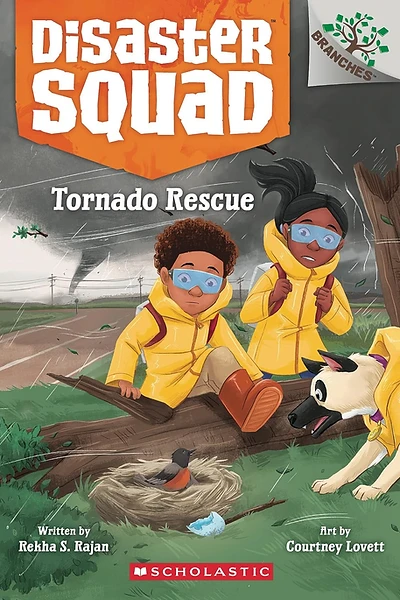
Disaster Squad: Tornado Rescue
by Rekha S. Rajan
Pacing MaterialWhen a tornado siren wails across their small Midwestern town, the Disaster Squad—a team of resourceful kids trained in emergency response—spring into action. As funnel clouds touch down, the squad splits up to check on neighbors, rescue a trapped family pet, and help set up a temporary shelter, all while navigating debris-strewn streets and their own fears. Through quick thinking, teamwork, and courage, the squad proves that even young people can make a real difference when disaster strikes.
Big Idea
Ordinary kids can take extraordinary action when they work together, stay calm, and use their unique skills to help their community.
Discussion Questions
- 1.How did each member of the Disaster Squad use a different skill to help during the tornado?
- 2.Why do you think the author included specific safety facts about tornadoes throughout the story?
- 3.How did the characters feel before, during, and after the tornado? How do you know?
- 4.What would you do if you heard a tornado siren where you live?
- 5.How did the squad work together even when they were scared?
- 6.What role did teamwork play in the rescue of the missing pet?
- 7.How does the author use short sentences to make the tornado scenes feel fast and scary?
- 8.What does the aftermath of the tornado teach the characters about their community?
Classroom Activity
Build Your Own Disaster Squad
Students design their own 'Disaster Squad' team of four characters, each with a unique skill (e.g., first aid, communication, building, comfort/support). In small groups, students write a one-page emergency scenario (flood, fire, blizzard) showing how each character's skill contributes to solving the problem, then illustrate their squad's emergency kit and present their scenario to the class.
Lesson Plan
Learning Goals
- Describe how the Disaster Squad’s teamwork, quick thinking, and courage help their community, using details from the book.
- Create four original squad characters with distinct skills and explain how each skill contributes to a shared goal.
- Collaboratively write a one-page emergency adventure with a clear beginning, problem, sequence of actions, and resolution.
- Distinguish safe, age-appropriate ways children can help from dangerous tasks that require trained adults.
- Present a group’s scenario and illustrated emergency kit, explaining how teamwork helps characters manage fear.
Activity Steps
- 1.Discuss the Disaster Squad’s response to the tornado. Ask: How do the characters use different skills? What helps them manage fear? Record examples from the reading. Explain that the story is fictional: in real emergencies, children should stay with trusted adults, follow official directions, and never enter dangerous areas or attempt rescues.
- 2.Form groups of four. Each group invents a squad with four characters, assigning each a name, a unique skill, and a safe role. Possible roles include sharing information with a trusted adult, checking a supply list, comforting someone in a safe shelter, and organizing emergency contact information.
- 3.Have each group choose a flood, fire, or blizzard scenario. Use a planning sheet to identify the setting, problem, characters’ feelings, adult helpers, and safe actions. Require a meaningful contribution from every character; adult emergency responders handle rescues and hazardous conditions.
- 4.Guide groups in writing a one-page story with a beginning, middle, and end. Include dialogue, sequencing words, and a moment when characters stay calm and work together, connecting their choices to the book’s big idea. Grade 2 students may dictate or use sentence starters; grades 3–4 can add descriptive details.
- 5.Have groups draw and label their squad’s emergency kit, including items such as water, a flashlight, a battery-powered radio, emergency contacts, and a first-aid kit for adult use. Ask them to explain how at least three items support their scenario.
- 6.Invite groups to present their stories and kit drawings. Listeners identify each character’s contribution and one safe choice. Close with an individual response: 'Like the Disaster Squad, I can help my community safely by ___.’
Standards Connections
- ELA: CCSS RL.2.3, RL.3.3, RL.4.3 — Describe characters and explain how their responses, traits, and actions shape story events.
- ELA: CCSS W.2.3, W.3.3, W.4.3 — Write narratives with sequenced events, relevant details, and a clear conclusion.
- ELA: CCSS SL.2.1, SL.3.1, SL.4.1 — Participate in collaborative discussions, build on others’ ideas, and share responsibility.
- ELA: CCSS SL.2.4, SL.3.4, SL.4.4 — Present stories clearly with relevant details and understandable speech.
- SEL: Relationship skills and responsible decision-making — Use complementary strengths, manage disagreements, and choose safe ways to support others.
Pace-Write-Read Study with Pace-Write It!
Disaster Squad: Tornado Rescue moves with the urgency of the storm itself—short, punchy sentences during crisis moments give way to slower, reflective passages once the danger passes. This pacing guide breaks down 33 craft elements teachers can use to help students notice how Rekha S. Rajan builds tension, develops character, and creates a satisfying rhythm between action and calm throughout the book.
| Element | How to notice or teach it in the novel |
|---|---|
| Pace | Read: Notice how the pace quickens with shorter sentences and fragments as the tornado approaches, then slows into longer, descriptive sentences once the storm passes. Classroom Activity: Have students rewrite a calm paragraph from the book as a fast-paced action scene using short sentences and fragments. |
| Plot | Read: Notice how the plot moves from warning sirens to rescue mission to recovery, each stage raising the stakes. Classroom Activity: Ask students to create a plot map with three stages—Warning, Action, Aftermath—for their own disaster story. |
| Prosody | Read: Notice how the sentence rhythm mimics gusting wind, with bursts of short words followed by longer flowing phrases. Classroom Activity: Have students read a storm passage aloud, exaggerating the rhythm to feel how sentence length affects sound. |
| Word pause | Read: Notice single-word sentences like 'Run.' or 'Now.' that force readers to stop and feel urgency. Classroom Activity: Students write a three-sentence scene using at least one single-word sentence for dramatic effect. |
| Concept | Read: Notice the central concept that preparedness and teamwork save lives during disasters. Classroom Activity: Have students brainstorm one disaster-prep concept and write a short paragraph explaining why it matters. |
| Voice & World View | Read: Notice the narrator's steady, brave voice even in scary moments, reflecting the squad's trained mindset. Classroom Activity: Students rewrite a fearful moment from the book in a panicked voice, then compare it to the calm original voice. |
| Setting & Place | Read: Notice how the setting shifts from a quiet neighborhood to a debris-covered street to a crowded shelter. Classroom Activity: Have students draw three settings from the book and label sensory details for each. |
| Point of View | Read: Notice how the story's point of view lets readers experience the squad leader's decisions and fears up close. Classroom Activity: Students rewrite a scene from a different character's point of view, such as the rescued neighbor. |
| Original Characters | Read: Notice how each squad member has a distinct skill and personality that shapes their role in the rescue. Classroom Activity: Have students create a character profile card for an original disaster-response character, including their special skill. |
| Dialogue | Read: Notice the clipped, urgent dialogue exchanged over walkie-talkies during the rescue. Classroom Activity: Students write a short walkie-talkie dialogue between two characters coordinating a rescue. |
| Details | Read: Notice specific sensory details like hail hitting rooftops and the smell of rain-soaked earth. Classroom Activity: Have students add three sensory details to a plain sentence to bring a storm scene to life. |
| Descriptions | Read: Notice how the approaching tornado is described through color, sound, and movement before it's named. Classroom Activity: Students write a description of an approaching storm without naming it, using only sensory clues. |
| Strong First Lines | Read: Notice how the book opens with the piercing sound of a siren to immediately hook readers. Classroom Activity: Have students write three possible opening lines for a disaster story and vote on the strongest one. |
| Immediacy & Engagement | Read: Notice how present-tense action verbs during the tornado scene pull readers directly into the moment. Classroom Activity: Students rewrite a past-tense sentence in present tense to increase immediacy. |
| Story Scenes & Summaries & Unique Structures | Read: Notice how full action scenes are balanced with short summarized passages and 'Disaster Fact' sidebars. Classroom Activity: Have students write one scene and one summary paragraph covering the same event, then compare the effect. |
| Flashback & Flash Forward & Cliffhangers | Read: Notice how chapters often end right before the tornado touches down, creating a cliffhanger. Classroom Activity: Students rewrite a chapter ending to create a cliffhanger that makes readers want to turn the page. |
| Tension & Suspense & Surprise | Read: Notice how the uncertain fate of a trapped neighbor builds suspense across several chapters. Classroom Activity: Have students write a paragraph where a character's fate is left unknown to build suspense. |
| Page Turns and Chapter Breaks | Read: Notice how short chapters end with questions or urgent statements that push readers to keep going. Classroom Activity: Students revise a chapter ending to include a question that creates a page-turning hook. |
| Performance | Read: Notice how dialogue and sound effects make this book ideal for dramatic read-aloud performance. Classroom Activity: Have small groups perform a scene aloud, adding vocal sound effects for wind and sirens. |
| Personality | Read: Notice how each squad member's personality—brave, cautious, funny—shows through their actions during the crisis. Classroom Activity: Students write a short scene showing a character's personality through action rather than description. |
| Humor | Read: Notice small moments of lighthearted banter between squad members that ease tension without undercutting danger. Classroom Activity: Have students add one humorous line of dialogue to a tense scene without breaking the mood. |
| Pause | Read: Notice the still, quiet moment after the tornado passes before the characters assess the damage. Classroom Activity: Students write a 'pause' paragraph describing silence and stillness after a big event. |
| Poetry and Poetic Devices | Read: Notice the use of onomatopoeia like 'whoosh' and 'crack' to bring the storm's sounds to life. Classroom Activity: Have students write a short poem about a storm using at least three onomatopoeic words. |
| Repetition | Read: Notice the repeated rallying phrase 'Disaster Squad, assemble!' that signals action and unity. Classroom Activity: Students create their own repeated rallying phrase for a team and use it three times in a short scene. |
| Rhythm | Read: Notice how varying sentence lengths create a rhythm that speeds up and slows down with the action. Classroom Activity: Have students write a paragraph alternating short and long sentences to control pacing rhythm. |
| Punctuation | Read: Notice the heavy use of exclamation points and dashes during high-tension scenes. Classroom Activity: Students revise a calm sentence using exclamation points and dashes to increase urgency. |
| Questions | Read: Notice rhetorical questions like 'Would they make it in time?' that heighten suspense. Classroom Activity: Have students insert a rhetorical question into their own story to build tension. |
| Compare-Contrast | Read: Notice how the neighborhood is described before and after the tornado to show contrast and impact. Classroom Activity: Students write two paragraphs comparing a place before and after a disaster. |
| Objects | Read: Notice recurring objects like the flashlight, walkie-talkie, and emergency kit that symbolize preparedness. Classroom Activity: Have students choose one object and explain its importance to a character's survival. |
| Threes | Read: Notice how the squad often completes tasks in sets of three, such as three steps to check a house for safety. Classroom Activity: Students write a three-step safety procedure for a disaster scenario of their choice. |
| Whitespace & Negative Space | Read: Notice how short paragraphs and blank space on the page create dramatic pauses during tense scenes. Classroom Activity: Have students format a tense paragraph with line breaks and white space to slow the reader down. |
| Art & Graphics | Read: Notice how illustrations of storm damage and maps help readers visualize the setting and danger. Classroom Activity: Students draw an illustration of a key scene and add a caption explaining what's happening. |
| Interactives & Gamification | Read: Notice the back-matter disaster-prep checklist that invites readers to apply the story's lessons. Classroom Activity: Have students create their own home emergency-prep checklist inspired by the book's back matter. |
Pace-Write It!
In a dedicated pacing workshop, have students select two contrasting passages from Disaster Squad: Tornado Rescue—one high-tension action scene and one calm aftermath scene. In pairs, students annotate each passage for sentence length, punctuation, and word choice, then create a 'pacing graph' plotting the story's tension level chapter by chapter. Conclude by having students apply what they've learned to revise a personal narrative, deliberately speeding up or slowing down pacing to match the emotional moment they want to convey.