 2-4
2-4C DISASTER
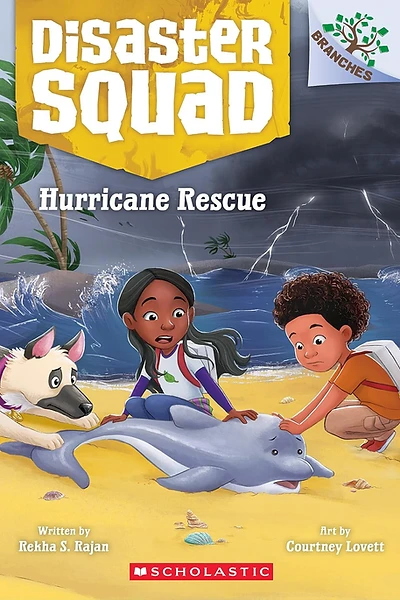
Disaster Squad: Hurricane Rescue
by Rekha S. Rajan
Pacing MaterialWhen a powerful hurricane threatens their coastal town, the kids of the Disaster Squad spring into action. Working alongside firefighters, meteorologists, and neighbors, Mia, Jayden, and their teammates map flood zones, pack emergency kits, and guide frightened families to safety. As rising water and falling trees test their courage, the Squad must use teamwork, quick thinking, and real-world science to protect their community and help it begin to heal after the storm passes.
Big Idea
Even young people can make a life-saving difference when they combine courage, preparation, and teamwork during a crisis.
Discussion Questions
- 1.What jobs did each member of the Disaster Squad have during the hurricane, and why did teamwork matter so much in an emergency?
- 2.How did the characters feel before, during, and after the storm? How did their feelings change?
- 3.What real hurricane safety steps from the book could you and your family use at home?
- 4.Why do you think the author included both scary moments and hopeful moments in the story?
- 5.How did the community come together to recover after the hurricane passed?
- 6.If you were on the Disaster Squad, which job would you want and what skills would you need to practice?
Classroom Activity
Build Your Own Disaster Squad Emergency Plan
Students work in small teams to design an illustrated 'Emergency Action Plan' poster modeled after the Disaster Squad's strategies in the book. Each team lists three hurricane safety steps, assigns 'jobs' to each team member (like the characters in the story), and draws a simple map showing an evacuation route for a fictional neighborhood. Teams present their plans aloud, practicing clear, confident classroom speaking skills.
Lesson Plan
Learning Goals
- Describe how Mia, Jayden, and their teammates use preparation, teamwork, and science to support their community during the hurricane.
- Identify three hurricane safety steps that children can follow with guidance from trusted adults.
- Create an illustrated emergency plan with classroom team roles and a clearly labeled evacuation route for a fictional neighborhood.
- Present a team plan clearly, explaining how its choices help families stay safe.
Activity Steps
- 1.Discuss the book’s hurricane response: How do the Disaster Squad members work with firefighters, meteorologists, and neighbors? Have students identify story details showing preparation and teamwork. Explain that children should stay with trusted adults and never enter floodwater or attempt rescues.
- 2.Model three safety steps for posters: help an adult prepare an emergency kit; follow official weather alerts and adult instructions; and evacuate with a trusted adult when authorities direct. Connect these steps to the Squad’s preparations and introduce common kit supplies.
- 3.Form teams of three or four. Assign classroom planning jobs inspired by the Squad’s teamwork, such as safety-step writer, emergency-kit illustrator, mapmaker, and presenter. Students may share roles; these are classroom jobs, not real emergency-response duties.
- 4.Give each team a fictional neighborhood map with homes, streets, a shoreline, a low-lying flood zone, and a designated shelter on higher ground. Have students draw arrows showing a practice evacuation route that avoids the flood zone. Explain that real evacuation routes must follow local authorities’ directions.
- 5.Have teams create an illustrated 'Emergency Action Plan' poster containing three safety steps, their team members’ planning jobs, pictures of emergency-kit supplies, and the labeled fictional map.
- 6.Invite teams to present their posters, explaining their route and how teamwork strengthens their plan. Check that each poster includes three safe actions, assigned roles, and a clear route. Close with students naming one safe preparation task they could discuss with a trusted adult.
Standards Connections
- ELA: CCSS RL.2.3 — Describe how characters respond to major events and challenges, using the Disaster Squad’s hurricane response.
- ELA: CCSS SL.3.1 — Participate effectively in collaborative discussions while developing a team emergency plan.
- ELA: CCSS SL.4.4 — Report on a topic in an organized manner, using relevant details and clear speech to present the plan.
- Science: NGSS 3-ESS3-1 — Make a claim about the merit of a design solution that reduces the impacts of a weather-related hazard.
- SEL: Relationship skills and responsible decision-making — Share planning responsibilities and choose safe, adult-guided responses to emergencies.
Pace-Write-Read Study with Pace-Write It!
This guide walks through 33 craft elements teachers can highlight while reading 'Disaster Squad: Hurricane Rescue' aloud or in small groups. Each entry pairs a close-reading observation with a quick, standards-aligned classroom task, helping students notice how Rekha S. Rajan builds tension, teamwork, and hope into a fast-paced disaster-adventure story for young readers.
| Element | How to notice or teach it in the novel |
|---|---|
| Pace | Read: Notice how short, punchy sentences speed up during the storm scenes while calmer moments use longer, flowing sentences. Classroom Activity: Have students rewrite a calm paragraph from the book as a fast-paced action scene using shorter sentences. |
| Plot | Read: Notice how the story moves from hurricane warning, to evacuation, to rescue, to recovery in a clear cause-and-effect sequence. Classroom Activity: Students create a four-box plot map labeling Warning, Evacuation, Rescue, and Recovery with one sentence each. |
| Prosody | Read: Notice how the rhythm of sentences quickens with short bursts like 'Wind howled. Rain slammed.' during the storm. Classroom Activity: Ask students to read a storm passage aloud, clapping the beat of each sentence to feel the rhythm. |
| Word pause | Read: Notice one-word or two-word sentences the author uses to make readers stop, like 'Silence. Then screaming.' Classroom Activity: Students write their own two-word 'pause sentence' to insert into a suspenseful moment in their own writing. |
| Concept | Read: Notice how the book teaches real hurricane safety concepts, like flood zones and evacuation routes, inside an exciting story. Classroom Activity: Students list three factual concepts they learned and explain them in their own words. |
| Voice & World View | Read: Notice how each Disaster Squad member speaks and thinks differently based on their role, like the planner versus the worrier. Classroom Activity: Students write a diary entry from one character's point of view during the hurricane. |
| Setting & Place | Read: Notice how the coastal town setting, with its beach houses and rising floodwaters, creates constant danger and urgency. Classroom Activity: Students draw a before-and-after map of the town showing storm damage. |
| Point of View | Read: Notice how the story is told from a close third-person view that lets readers feel what the young rescuers feel. Classroom Activity: Students rewrite one scene in first person from a chosen character's perspective. |
| Original Characters | Read: Notice how each Disaster Squad member has a distinct skill, like map-reading or first aid, that makes them memorable. Classroom Activity: Students invent a new Disaster Squad member with a unique skill and name. |
| Dialogue | Read: Notice how quick, overlapping dialogue during the storm shows teamwork and urgency. Classroom Activity: Students write a short dialogue scene between two characters coordinating during an emergency. |
| Details | Read: Notice small sensory details, like the smell of wet sand or the sound of sirens, that make the disaster feel real. Classroom Activity: Students add three sensory details to a paragraph describing a storm. |
| Descriptions | Read: Notice how the author describes the hurricane's power through comparisons, like waves 'as tall as buses.' Classroom Activity: Students write a descriptive sentence comparing something powerful to a familiar object. |
| Strong First Lines | Read: Notice how the chapter opens with an urgent line that hooks readers immediately. Classroom Activity: Students draft three possible strong first lines for their own disaster story. |
| Immediacy & Engagement | Read: Notice how present-tense-feeling action verbs pull readers directly into the danger of the moment. Classroom Activity: Students revise a slow sentence using stronger, more active verbs. |
| Story Scenes & Summaries & Unique Structures | Read: Notice how some chapters are full action scenes while others briefly summarize time passing during recovery. Classroom Activity: Students write one full scene and one summary sentence covering the same event. |
| Flashback & Flash Forward & Cliffhangers | Read: Notice how chapters often end right before danger strikes, creating a cliffhanger. Classroom Activity: Students rewrite a chapter ending to make it a cliffhanger. |
| Tension & Suspense & Surprise | Read: Notice how the rising floodwater creates suspense as characters race against time. Classroom Activity: Students write a paragraph where a character has limited time to solve a problem. |
| Page Turns and Chapter Breaks | Read: Notice how chapter breaks often occur right as a decision must be made, encouraging readers to keep going. Classroom Activity: Students identify a chapter break and explain why the author chose that stopping point. |
| Performance | Read: Notice how dialogue and action scenes are written to be read aloud dramatically. Classroom Activity: Students perform a favorite scene in small groups, using voices and expressions. |
| Personality | Read: Notice how each character's personality, brave, cautious, funny, shows up in how they react to danger. Classroom Activity: Students write how their own personality might affect how they'd react in a hurricane. |
| Humor | Read: Notice small lighthearted jokes between teammates that ease tension during scary moments. Classroom Activity: Students add one funny line of dialogue to a tense scene without breaking the mood. |
| Pause | Read: Notice quiet moments after danger where characters catch their breath and reflect. Classroom Activity: Students write a short reflective paragraph for a character right after a scary event. |
| Poetry and Poetic Devices | Read: Notice alliteration like 'wind whipped and whistled' that adds rhythm to storm descriptions. Classroom Activity: Students write an alliterative sentence describing wind or rain. |
| Repetition | Read: Notice repeated phrases like 'Stay calm, stay safe' used as a team motto. Classroom Activity: Students create a repeated safety chant for their own imagined rescue team. |
| Rhythm | Read: Notice how repeated short sentence patterns during action scenes create a heartbeat-like rhythm. Classroom Activity: Students write three short repeating sentences to build rhythm in an action scene. |
| Punctuation | Read: Notice how exclamation points and ellipses are used to show urgency and hesitation. Classroom Activity: Students revise a flat sentence using punctuation to show emotion. |
| Questions | Read: Notice how characters ask urgent questions like 'Is everyone safe?' to drive the plot forward. Classroom Activity: Students write two urgent questions a character might ask during a crisis. |
| Compare-Contrast | Read: Notice how the calm town before the storm is contrasted with the flooded town after. Classroom Activity: Students create a before-and-after chart comparing the town's condition. |
| Objects | Read: Notice how objects like flashlights, life vests, and walkie-talkies become important tools in the rescue. Classroom Activity: Students choose one object from the book and explain why it matters to the story. |
| Threes | Read: Notice how safety steps or warnings are often grouped in threes, like 'grab, go, and check in.' Classroom Activity: Students write their own set of three safety steps for an emergency. |
| Whitespace & Negative Space | Read: Notice how short paragraphs and white space on the page create pauses during tense scenes. Classroom Activity: Students format a paragraph using short lines and spacing to build suspense. |
| Art & Graphics | Read: Notice how illustrations show maps, weather symbols, and character expressions that support the text. Classroom Activity: Students draw an illustration for a scene and explain what it adds to the story. |
| Interactives & Gamification | Read: Notice how the book includes safety checklists or diagrams that invite reader participation. Classroom Activity: Students design their own interactive hurricane safety checklist for classmates to use. |
Pace-Write It!
Use these 33 elements across a multi-day read-aloud workshop: introduce 3–4 elements per session, modeling the 'Read' observation together as a class before releasing students to the paired 'Classroom task.' By the end of the unit, students will have built a portfolio of writing samples—maps, dialogues, safety plans, and descriptive scenes—that mirror the craft techniques Rekha S. Rajan uses to make 'Disaster Squad: Hurricane Rescue' both thrilling and educational.