 K-5
K-5C DISASTER DIARIES
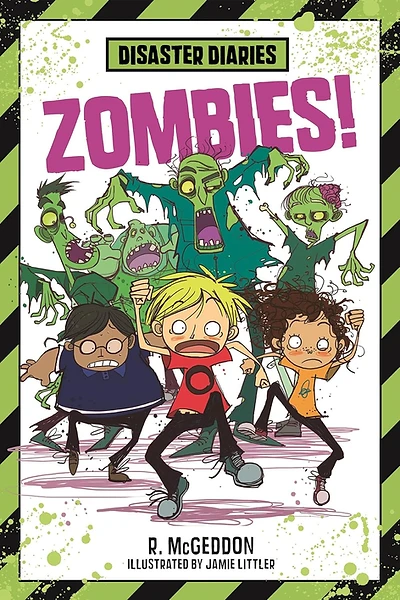
Disaster Diaries: Zombies!
by R. McGeddon
Pacing MaterialThree kids protect the town of Sitting Duck from a zombie invasion.
Big Idea
Survival requires quick thinking, teamwork, and the ability to adapt to unexpected challenges, even when facing a silly or scary zombie invasion.
Discussion Questions
- 1.If a zombie invasion happened in our town, what is the first thing you would do to stay safe?
- 2.How do the three main characters use their different strengths to work together as a team?
- 3.Why do you think the author chose to write this story as a 'diary' instead of a regular story?
- 4.What makes the zombies in this book funny rather than just scary?
- 5.If you were writing your own disaster diary, what kind of disaster would you choose to write about and why?
Classroom Activity
My Survival Guide: Zombie Edition
Students will create their own 'Survival Diary' entry, illustrating and describing a plan for how they would handle a specific, humorous disaster scenario in their own school or neighborhood.
Lesson Plan
Learning Goals
- Students will identify the key elements of a diary-style narrative.
- Students will practice creative problem-solving by developing a survival plan.
- Students will demonstrate understanding of character perspective by writing in the first person.
Activity Steps
- 1.Brainstorm a list of 'disasters' that could happen in a classroom (e.g., a zombie invasion, a flood of glitter, a robot takeover).
- 2.Choose one scenario and sketch a 'Survival Kit' containing three essential items needed to solve the problem.
- 3.Write a diary entry from the perspective of a survivor, explaining how the items in the kit were used.
- 4.Illustrate the scene, focusing on the action and the humor of the situation.
- 5.Share the diary entries with a partner to compare survival strategies.
Standards Connections
- ELA: W.3.3 (Write narratives to develop real or imagined experiences)
- ELA: RL.3.3 (Describe characters in a story and explain how their actions contribute to the sequence of events)
- SEL: Responsible Decision-Making
Pace-Write-Read Study with Pace-Write It!
Disaster Diaries: Zombies! serves as an excellent mentor text for teaching the 'diary' format, which relies heavily on immediacy and personal voice. By using a diary structure, R. McGeddon creates a sense of urgency that pulls the reader directly into the action, making the fictional zombie invasion feel like a real-time event. This book teaches students how to balance narrative summary with 'in-the-moment' scene building. It demonstrates how to use a casual, conversational tone to build rapport with the reader while simultaneously advancing a plot through short, punchy entries that keep the pacing fast and engaging.
| Element | How to notice or teach it in the novel |
|---|---|
| Pace | The short, dated entries keep the story moving rapidly, mimicking the frantic nature of a survival situation. |
| Plot | The plot follows a clear 'problem-solution' structure centered on the kids' attempts to secure Sitting Duck. |
| Prosody | Encourage students to read with a sense of urgency and breathlessness to match the narrator's panic. |
| Word Pause | Use the diary dates as natural pauses to allow the reader to process the passage of time between events. |
| Concept | The concept is 'survival through humor,' showing that even scary situations can be managed with a lighthearted perspective. |
| Voice & World View | The voice is distinctly youthful and slightly overwhelmed, reflecting how a child might view a world-ending event. |
| Setting & Place | Sitting Duck is established as a small, relatable town, making the invasion feel more personal and contained. |
| Point of View | The first-person perspective limits the reader's knowledge to what the narrator sees, increasing the suspense. |
| Original Characters | The characters are defined by their specific roles in the survival effort, making them easy for students to identify with. |
| Dialogue | Dialogue is sparse and functional, used primarily to coordinate survival plans rather than for long exposition. |
| Details | Focus on the specific, mundane items the kids use as weapons or tools to make the zombies seem less threatening. |
| Descriptions | Descriptions are quick and visual, focusing on the 'zombie look' to provide immediate imagery. |
| Strong First Lines | The opening lines immediately establish the stakes, pulling the reader into the 'disaster' right away. |
| Immediacy & Engagement | The diary format creates a 'right now' feeling that makes the reader feel like they are reading a secret document. |
| Story Scenes & Summaries & Unique Structures | The book alternates between action scenes and summary entries that explain what happened between the dates. |
| Flashback & Flash Forward & Cliffhangers | Each entry often ends on a cliffhanger, forcing the reader to turn the page to see if the kids survive the night. |
| Tension & Suspense & Surprise | Tension is built through the threat of the zombies, while surprise comes from the kids' creative, often silly, solutions. |
| Page Turns and Chapter Breaks | Page turns are used to reveal the next 'day' of the diary, maintaining the momentum of the narrative. |
| Performance | The text invites dramatic reading, especially when the narrator is describing a close call with a zombie. |
| Personality | The narrator's personality shines through their dry wit and determination to save their town. |
| Humor | Humor is derived from the contrast between the serious threat of zombies and the kids' childish, inventive reactions. |
| Pause | Use the gaps between diary entries to ask students to predict what might happen next. |
| Poetry and Poetic Devices | The rhythm of the short sentences mimics the heartbeat of someone running from danger. |
| Repetition | The repetition of the 'zombie threat' reinforces the constant danger the characters face. |
| Rhythm | The rhythm is staccato and fast, reflecting the high-energy nature of the survival plot. |
| Punctuation | Exclamation points are used frequently to convey the narrator's high level of excitement and fear. |
| Questions | The narrator often asks rhetorical questions to the reader, making the diary feel like a direct conversation. |
| Compare-Contrast | Compare the kids' reactions to the zombies with how adults might react in a similar situation. |
| Objects | Everyday objects are repurposed as survival gear, teaching students to look at their environment creatively. |
| Threes | The trio of main characters provides a balanced team dynamic, with each child bringing a different skill. |
| Whitespace & Negative Space | The layout uses whitespace to make the diary entries feel like authentic, handwritten notes. |
| Art & Graphics | The illustrations provide visual evidence of the zombies and the kids' inventions, enhancing the humor. |
| Interactives & Gamification | The book feels like a game, encouraging readers to think about their own 'survival stats' and strategies. |
Pace-Write It!
Students have 20 minutes to write a 'Day 1' entry for their own disaster diary. They must include one 'problem' (the disaster), one 'character' (a friend or pet), and one 'silly tool' they plan to use to survive. The goal is to establish the voice and the stakes in under 200 words.