 2-6
2-6GN MAGRUDER
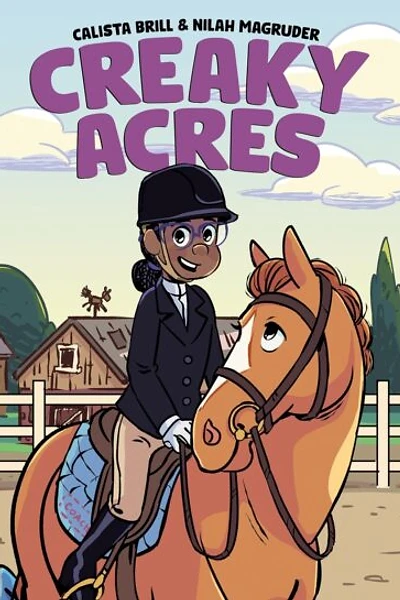
Creaky Acres
by Calista Brill and Nilah Magruder
Pacing MaterialA young rider discovers that life at Creaky Acres farm is full of big challenges — and even bigger heart — as they learn to ride, care for horses, and believe in themselves.
Big Idea
Caring for animals teaches us patience, responsibility, and the power of showing up every day.
Discussion Questions
- 1.What challenges does the rider face at Creaky Acres?
- 2.What does caring for a horse teach the main character?
- 3.How does the rider grow throughout the story?
- 4.What's something you've worked hard at? What kept you going?
Classroom Activity
My Caring Plan
Choose an animal (real or imaginary) you'd care for. Draw them and write a daily checklist of what they need to be healthy and happy.
Lesson Plan
Learning Goals
- Use details from Creaky Acres to explain how caring for horses requires patience, responsibility, and consistent effort.
- Explain how illustrations and dialogue work together to show a character’s feelings or response to a challenge.
- Identify an animal’s daily needs and create a practical checklist for keeping it healthy and happy.
- Describe how showing up every day can build trust with an animal and confidence in oneself.
Activity Steps
- 1.Read or revisit selected panels from Creaky Acres that show horse care, riding challenges, or growing confidence. Ask: What do the pictures and words reveal about the effort needed to care for horses?
- 2.Create a class chart labeled “Healthy” and “Happy.” Gather daily animal-care needs, such as appropriate food, fresh water, a clean and safe living space, exercise, and gentle attention. Connect these needs to the book’s big idea.
- 3.Introduce “My Caring Plan.” Have students choose a real or imaginary animal, name it, and draw it in a safe habitat. For real animals, use a teacher-approved reference to check their care needs; for imaginary animals, invent consistent needs.
- 4.Have students write a daily checklist with 5–7 specific care tasks and checkboxes. Encourage action phrases such as “Refill the water bowl each morning.” Grades 2–3 may use labeled pictures and sentence starters; grades 4–6 should include timing and explain why at least two tasks matter.
- 5.Ask students to add a sentence completing “When caring for my animal gets challenging, I will…” Connect their responses to patience, persistence, and believing in oneself in Creaky Acres.
- 6.Invite partners to share their plans and check whether each animal has what it needs to be healthy and happy. Students revise one item, then explain how daily care can build trust. Remind students that real animal care requires adult guidance.
Standards Connections
- ELA: RL.2.3–RL.6.3 — Describe and analyze characters, their responses to challenges, and how they develop across a story, using grade-appropriate expectations.
- ELA: RL.2.7–RL.5.7 — Explain how illustrations and visual elements contribute to meaning, character, mood, or tone.
- ELA: W.2.2–W.6.2 — Write informative texts that communicate an animal’s needs through clear facts, details, and explanations.
- ELA: SL.2.1–SL.6.1 — Participate in collaborative discussions, listen to others, and build on ideas.
- SEL: Self-management and responsible decision-making — Plan consistent care routines, practice persistence, and consider an animal’s well-being.
Pace-Write-Read Study with Pace-Write It!
Focus question: How does an author and illustrator speed up or slow down a story so readers can feel a character’s courage growing? In Creaky Acres by Calista Brill and Nilah Magruder, a young rider faces the challenges of farm life, horse care, and learning to trust themself. The graphic novel uses pacing through page turns, panels, dialogue, action scenes, and quiet reflective moments to show resilience building one step at a time.
| Element | How to notice or teach it in the novel |
|---|---|
| Pace | Read: Notice how Creaky Acres moves quickly during riding mishaps and busy barn moments, then slows down when the young rider reflects, cares for a horse, or tries again after a hard moment. Classroom Activity: Write two short scenes about a student learning something difficult—one fast and action-packed, one slow and thoughtful—to show resilience. |
| Plot | Read: Track how the story builds from arriving at Creaky Acres and facing challenges to growing more confident with horses and with oneself. Classroom Activity: Create a 5-box plot ladder labeled beginning, problem, struggle, turning point, and growth, then plan your own adventure story about learning a new skill. |
| Prosody | Read: Listen to how the dialogue and narration in Creaky Acres sound different in exciting scenes, worried scenes, and proud scenes; the rhythm changes with the rider’s emotions. Classroom Activity: Read a short page aloud with expression, then write 4 lines of dialogue that sound nervous at first and confident by the end. |
| Word pause | Read: Notice where a single word, an ellipsis, or a short speech bubble makes you pause during a tough riding or horse-care moment. Classroom Activity: Write a comic-style moment where your character stops before trying again, using 1-3 word lines to create pauses. |
| Concept | Read: The big idea in Creaky Acres is that courage is not being fearless—it is showing up, caring, and trying again even when things feel hard. Classroom Activity: Write a theme statement about resilience, then write a short scene that teaches that idea through action instead of explanation. |
| Voice & World View | Read: Notice how the story’s voice feels warm, encouraging, and honest about mistakes, showing a world where growth happens through effort, care, and community at the farm. Classroom Activity: Write a paragraph in a supportive voice about a place where people learn from mistakes. |
| Setting & Place | Read: Study how Creaky Acres farm feels like a living place with barns, horses, chores, dust, movement, and a mix of challenge and comfort. Classroom Activity: Describe a training place—stable, field, gym, studio, or playground—using 5 sensory details that affect your character’s emotions. |
| Point of View | Read: Pay attention to how closely readers experience the young rider’s worries, hopes, and growing confidence, even in a visual format. Classroom Activity: Rewrite a difficult farm moment from the point of view of the rider, then from the point of view of a horse or coach. |
| Original Characters | Read: Notice how the characters at Creaky Acres feel distinct through expressions, choices, and the different ways they help, challenge, or encourage the young rider. Classroom Activity: Invent a supporting character for a barn story and give them one trait, one fear, and one way they help the main character grow. |
| Dialogue | Read: Look at how dialogue in Creaky Acres reveals encouragement, uncertainty, humor, and instruction during riding lessons and chores. Classroom Activity: Write 6 lines of dialogue between a beginner and a mentor where the mentor helps without solving the problem for them. |
| Details | Read: Notice the small details about horse care, barn routines, and body language that make the challenges at Creaky Acres believable. Classroom Activity: Make a detail list of 8 specific things a character would notice while learning a new job or skill, then use 4 in a scene. |
| Descriptions | Read: Study how the book uses both words and images to describe a horse, a barn space, or a tense lesson without overexplaining. Classroom Activity: Write a 5-sentence description of an animal or training space, making each sentence show a different sense or feeling. |
| Strong First Lines | Read: Think about how a graphic novel opening must quickly pull readers into the world, conflict, and feeling of Creaky Acres. Classroom Activity: Write 3 possible opening lines for a story about a child arriving at a place where they must be brave. |
| Immediacy & Engagement | Read: Notice how action, facial expressions, and quick panel-to-panel movement make readers feel right beside the young rider during mistakes and successes. Classroom Activity: Write a present-tense scene that begins in the middle of a challenge, such as slipping, missing a cue, or facing a nervous horse. |
| Story Scenes & Summaries & Unique Structures | Read: Watch how some parts of Creaky Acres are shown as full scenes while other parts move more quickly through summary, helping the story cover growth over time. Classroom Activity: Write one detailed scene of a lesson and one 3-sentence summary of a week of practice. |
| Flashback & Flash Forward & Cliffhangers | Read: Notice where readers are left wondering what will happen next after a hard lesson, a mistake, or a new challenge at the farm. Classroom Activity: End a short comic script with a cliffhanger after your character says or sees something unexpected in the barn. |
| Tension & Suspense & Surprise | Read: Look for moments when the rider is unsure, embarrassed, or physically challenged, and how those moments build suspense before a small breakthrough. Classroom Activity: Write a scene where your character prepares for a difficult attempt; include one surprise that changes the outcome. |
| Page Turns and Chapter Breaks | Read: In Creaky Acres, page turns can reveal a new horse, a mistake, a reaction, or a hopeful next step, making readers want to keep going. Classroom Activity: Plan a 4-page comic and mark one page turn where the reader discovers the biggest problem. |
| Performance | Read: Notice how riding, caring for horses, and speaking bravely in front of others all feel like performances that show the rider’s growth. Classroom Activity: Write a short scene where a character must perform a skill in front of others and show both their outside actions and inside feelings. |
| Personality | Read: Study how personality comes through in the rider, the people at the farm, and even the horses through habits, reactions, and energy. Classroom Activity: Create a character card for a rider or horse with 3 personality traits and one behavior that shows each trait. |
| Humor | Read: Notice how Creaky Acres uses humor in expressions, awkward moments, and farm surprises to balance harder feelings and keep the story inviting. Classroom Activity: Write a brief funny scene in which a mistake with an animal or chore becomes a moment of learning instead of failure. |
| Pause | Read: Look for quiet pauses after frustration, before trying again, or during gentle horse-care moments that let courage feel real. Classroom Activity: Add a pause panel or a silent sentence to your scene to show your character thinking before acting. |
| Poetry and Poetic Devices | Read: Even though Creaky Acres is an adventure graphic novel, some moments feel poetic through imagery, repeated sounds, or strong comparisons about motion, fear, and trust. Classroom Activity: Write 3 lines comparing a horse, a barn, or a brave feeling to something else using simile or metaphor. |
| Repetition | Read: Notice repeated actions—practice, trying again, caring routines, encouraging words—that show resilience growing over time at Creaky Acres. Classroom Activity: Write a paragraph using a repeated phrase such as “I try again” or “At the barn” to show growth across several moments. |
| Rhythm | Read: Feel how the story’s rhythm changes from busy chores to bumpy lessons to calmer care-taking scenes, matching the rider’s emotional journey. Classroom Activity: Write 6 sentences that alternate between short, quick action and longer, calmer reflection. |
| Punctuation | Read: Study how exclamation points, ellipses, question marks, and dashes help shape emotion and timing in dialogue during stressful or exciting farm scenes. Classroom Activity: Rewrite the same line of dialogue three ways using different punctuation to change the feeling from scared to determined to relieved. |
| Questions | Read: Notice the questions the young rider asks out loud or silently: Can I do this? What if I fail? What does this horse need? These questions drive the story forward. Classroom Activity: Write 5 questions your main character asks during a challenge, then answer one through action in a scene. |
| Compare-Contrast | Read: Compare the rider at the beginning of Creaky Acres with the rider later in the story; contrast fear with confidence, and struggle with growth. Classroom Activity: Make a T-chart comparing “At the start” and “Later on,” then write a paragraph about what changed and why. |
| Objects | Read: Pay attention to meaningful objects at the farm—gear, tools, brushes, tack, or stable items—that show work, responsibility, and readiness. Classroom Activity: Choose one object from a training or care setting and write about how it symbolizes your character’s progress. |
| Threes | Read: Look for patterns of three in challenges, attempts, or pieces of advice that make the story feel balanced and memorable. Classroom Activity: Write a scene where your character makes three attempts at a difficult task, with each try revealing new learning. |
| Whitespace & Negative Space | Read: In a graphic novel like Creaky Acres, open space around panels or in a quiet image can slow pacing and highlight loneliness, thinking, or relief. Classroom Activity: Plan a comic page with one panel that uses extra space to show a big feeling after a tough moment. |
| Art & Graphics | Read: Notice how Nilah Magruder’s art helps pace the story through panel size, facial expressions, movement lines, and visual focus during lessons and emotional beats. Classroom Activity: Sketch a 3-panel sequence showing fear, effort, and courage without using many words. |
| Interactives & Gamification | Read: Think about how readers could interact with Creaky Acres by tracking the rider’s progress, horse-care steps, or courage moments like levels in a game. Classroom Activity: Design a simple “Courage at the Farm” progress chart with 3 levels and write the scene for unlocking each one. |
Pace-Write It!
20-Minute Classroom Flow\nRead (5 min): Read a short section from Creaky Acres that shows the young rider struggling and then trying again during a riding or horse-care moment. Ask students to notice where the story speeds up and where it slows down.\nNotice (5 min): Students turn and talk: What do the words and pictures do to create pacing? Chart student observations such as quick dialogue, action panels, quiet pauses, page turns, and close-up reactions. Connect these choices to the theme of resilience and courage.\nWrite (7 min): Students write their own short scene about learning a difficult skill. Require one fast moment, one slow moment, and one line of dialogue from a helper or mentor. Writing frame: “At first, I/____ felt ____. Everything happened fast when ____. Then time seemed to slow down as I noticed ____. ‘____,’ said ____. I took a breath and tried again. This time, ____.”\nShare (3 min): Invite partners to read their scenes aloud and identify where the pacing changed. Ask listeners to name one detail that made the character’s courage believable.\nExit ticket: Write one sentence answering: How can slowing down one moment in a story make a character’s resilience stronger for the reader?