 2-5
2-5R PINCUS
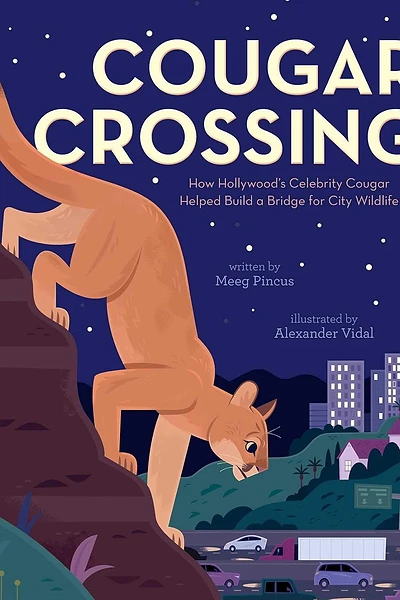
Cougar Crossing: How Hollywood's Celebrity Cougar Helped Build a Bridge for City Wildlife
by Meeg Pincus
Pacing MaterialThe true story of P-22, the mountain lion who crossed two freeways and became the face of a movement to build wildlife crossings in Los Angeles.
Big Idea
One animal's story can inspire a city to change, and people can redesign the world to share it with wildlife.
Discussion Questions
- 1.How did P-22 cross the freeways?
- 2.Why was his journey so remarkable?
- 3.How did his story inspire change?
- 4.What is a wildlife corridor?
- 5.How can a city make room for wild animals?
Classroom Activity
Animal Migration Story
Choose a wild animal in your area and map its route. Label three dangers and one solution for each.
Lesson Plan
Learning Goals
- Explain how P-22’s journey across two Los Angeles freeways helped inspire support for a wildlife crossing.
- Describe how roads and other human-built features can separate animals from food, shelter, and mates.
- Create a map of a local wild animal’s possible travel route, labeling three dangers and a solution for each.
- Use information from the book and a local wildlife resource to explain how people can share space with wildlife.
Activity Steps
- 1.Read Cougar Crossing aloud, pausing to discuss P-22’s freeway crossings and life in Los Angeles. Ask: Why was his journey dangerous? How did his story motivate people to help wildlife?
- 2.Choose a local wild animal using teacher-provided wildlife resources. Identify its habitat and why it might travel, such as finding food, water, shelter, or a mate. Explain that everyday animal movement is not always seasonal migration.
- 3.Draw a map of a real or imagined area in your community with habitat patches, roads, buildings, and water. Add a title, a map key, and arrows showing the animal’s possible route between places it needs.
- 4.Label three dangers along the route, such as a busy road, a fence blocking movement, or a stream with polluted water. For each danger, draw and label one matching solution, such as a wildlife crossing, a wildlife-friendly fence opening, or stream cleanup.
- 5.Write a short Animal Migration Story explaining the animal’s journey and how the solutions would help. Include one connection to P-22’s story. Grades 2–3 may use sentence frames; grades 4–5 should add supporting details from the resources.
- 6.Share maps with a partner and check that each danger has a matching solution. Close by discussing how P-22’s story shows that one animal can inspire people to redesign a city.
Standards Connections
- ELA: CCSS RI.2.3 — Describe connections among events in P-22’s journey and the community’s response.
- ELA: CCSS RI.3.1 / RI.4.1 / RI.5.1 — Use details and evidence from informational texts to explain wildlife challenges and solutions.
- ELA: CCSS W.2.2–W.5.2 — Write informative explanations of an animal’s route, dangers, and possible solutions.
- Science: NGSS 3-LS4-4 — Make a claim about a solution to a problem caused by environmental change affecting organisms.
- Geography: Map skills — Use symbols, a map key, and route arrows to show relationships between habitats and human-built features.
Pace-Write-Read Study with Pace-Write It!
Focus question: How does an author slow down and speed up a true story to help readers feel both danger and hope? In Cougar Crossing: How Hollywood's Celebrity Cougar Helped Build a Bridge for City Wildlife, Meeg Pincus tells the real story of P-22, the mountain lion who crossed busy Los Angeles freeways and inspired people to protect wildlife. The book uses pacing by stretching exciting moments, like the freeway crossing, and then moving quickly through time to show how one cougar helped spark a larger movement for a wildlife bridge.
| Element | How to notice or teach it in the novel |
|---|---|
| Pace | Read: Notice how Meeg Pincus changes the speed of the story in Cougar Crossing: How Hollywood's Celebrity Cougar Helped Build a Bridge for City Wildlife. The dangerous freeway crossing feels slow and tense, while later parts move more quickly through the growing effort to build a wildlife crossing. Classroom Activity: Write 4-6 sentences about an animal on the move. Slow down one risky moment and speed up the part that happens over many days or months. |
| Plot | Read: Track the true-story plot: P-22 leaves one habitat, crosses freeways, survives in Griffith Park, becomes famous, and helps inspire people to support a wildlife bridge. Each event builds from one cougar's journey to a citywide conservation effort. Classroom Activity: Make a plot ladder with 5 steps from P-22's crossing to the bridge movement, then write a short summary using the words first, next, then, later, and finally. |
| Prosody | Read: Listen to how the sentences can be read aloud with changes in expression—calm for nature details, urgent for traffic danger, and proud or hopeful when people respond to P-22's story. The sound of the language helps shape pacing. Classroom Activity: Choose 3 sentences or sentence ideas from the book and mark where your voice should sound slow, tense, or hopeful. Then write your own 3-sentence read-aloud about P-22 using those same shifts. |
| Word pause | Read: Notice where single words or short phrases create tiny pauses that make readers stop and pay attention, especially around danger, waiting, and discovery. These pauses help spotlight P-22's struggle in a crowded city. Classroom Activity: Write 3 short lines about P-22 crossing near the freeway. Use one line with just 1-3 words to create a strong pause. |
| Concept | Read: The big idea in this book is that wildlife needs safe pathways even in cities. Meeg Pincus connects one mountain lion's life to the larger concept of urban ecology and wildlife crossings. Classroom Activity: Write 2-4 sentences explaining how P-22's story teaches the concept of animals and humans sharing space. Include the words habitat, city, and safe. |
| Voice & World View | Read: The author's voice is informative, caring, and urgent. The worldview of the book suggests that cities should make room for wild animals and that people can solve problems they helped create. Classroom Activity: Write a paragraph in a voice that is both factual and caring about P-22. End with one sentence that shows your view about why wildlife crossings matter. |
| Setting & Place | Read: Pay attention to the contrast between wild spaces and Los Angeles roads, neighborhoods, and Griffith Park. The setting is not just background—it creates the problem P-22 must survive. Classroom Activity: Describe two connected settings from the story: a natural habitat and a busy city place. Write how each setting changes P-22's choices. |
| Point of View | Read: The book is written from an outside narrator's point of view, but it helps readers imagine what P-22 faces as he moves through the city. This lets us learn facts while still feeling close to the cougar's experience. Classroom Activity: Rewrite one event from the book in first person from P-22's point of view, beginning with “I looked…” or “I heard…”. |
| Original Characters | Read: Even though this is nonfiction, P-22 stands out as a memorable real-life central figure—solitary, resilient, and surprising. The people in the story, such as wildlife supporters and city helpers, become important because they respond to his journey. Classroom Activity: Make a character web for P-22 with 4 traits and evidence from the story, then write a sentence about how one human group helped his story matter. |
| Dialogue | Read: In a nonfiction picture book like this one, there may be little or no direct dialogue, but readers can still imagine what people might say when they learn about P-22 or the wildlife bridge. The absence of lots of dialogue keeps the pacing focused on action and facts. Classroom Activity: Write a short imagined conversation between two people who hear about P-22, with one saying why the cougar is amazing and the other saying why a crossing is needed. |
| Details | Read: Notice the factual details about freeways, habitat, the mountain lion's route, and the human response. These details make the true story believable and help readers understand why P-22 became so important. Classroom Activity: Write 5 detail-rich facts or fact-like sentences about P-22's challenge living near Los Angeles, then combine 3 into a short paragraph. |
| Descriptions | Read: Meeg Pincus uses description to help readers picture a powerful wild cat near loud, dangerous city roads. The descriptions of movement, space, and risk help slow the story at key moments. Classroom Activity: Write a descriptive paragraph about P-22 at the edge of a freeway using at least 3 senses, such as sight, sound, and feeling. |
| Strong First Lines | Read: Think about how the beginning of the book quickly introduces a mountain lion in an unexpected city-world problem. A strong opening makes readers wonder how P-22 will survive and what will happen next. Classroom Activity: Write 2 different opening lines for a true story about an animal in danger in a city. Make one opening surprising and one opening dramatic. |
| Immediacy & Engagement | Read: The book creates immediacy by placing readers close to the moment of crossing and the danger of traffic. Readers feel that P-22's choices matter right now, not just sometime in the past. Classroom Activity: Write 3-5 sentences that make the reader feel they are right there with P-22 as he nears the freeway. Use action verbs like crept, listened, and leaped. |
| Story Scenes & Summaries & Unique Structures | Read: Notice how some parts of the book feel like close-up scenes, such as the crossing, while other parts summarize bigger stretches of time, such as the growing public support for wildlife crossings. This mix helps the true story stay clear and engaging. Classroom Activity: Write one scene of 3-4 sentences about a single moment from P-22's journey, then one 2-sentence summary of what happened after people learned his story. |
| Flashback & Flash Forward & Cliffhangers | Read: This true story may hint at what comes next by showing how P-22's journey leads to future change, almost like a flash forward to the wildlife bridge movement. Moments of uncertainty also act like cliffhangers because readers wonder whether he will survive. Classroom Activity: Write a short paragraph that ends with a cliffhanger question about P-22, then add one sentence that flashes forward to the idea of helping other animals too. |
| Tension & Suspense & Surprise | Read: The biggest tension comes from a wild mountain lion trying to cross two freeways in one of the busiest urban areas in the country. It is surprising that P-22 survives and becomes a celebrity cougar who changes public action. Classroom Activity: Write 4 sentences that build suspense before a crossing. Save the surprising fact—that he survives or becomes famous—for the last sentence. |
| Page Turns and Chapter Breaks | Read: In a picture book, page turns can hold suspense, especially when readers are waiting to see whether P-22 makes it through danger. The turn from problem to public action also changes the pace. Classroom Activity: Plan a 4-page mini-book about P-22. Write what happens on each page and make page 2 end with a sentence that makes the reader want to turn the page. |
| Performance | Read: This book invites dramatic oral reading because the pacing shifts from quiet searching to high danger to hopeful change. A reader can perform P-22's journey through pauses, volume, and expression. Classroom Activity: Practice reading a short section or your own writing about P-22. Mark where to whisper, pause, or sound excited, then perform it for a partner. |
| Personality | Read: P-22's personality comes through as determined, adaptable, and mysterious, even in a factual account. The book also gives personality to the movement around him by showing human admiration and concern. Classroom Activity: Write a “profile card” for P-22 with 3 personality traits and one example for each trait from the story. |
| Humor | Read: Even though the topic includes danger, the idea of a “celebrity cougar” adds a light touch that can make readers smile. This small bit of humor balances the serious message about wildlife survival in cities. Classroom Activity: Write 2-3 sentences that use gentle humor to describe how famous P-22 became, while still respecting that the story is true and important. |
| Pause | Read: Notice how the story gives readers moments to pause and think after danger and before the larger message about building a bridge for wildlife. These reflective pauses help the ending feel meaningful. Classroom Activity: Write a paragraph about P-22 and add one intentional pause using a dash, ellipsis, or a very short sentence like “He waited.” |
| Poetry and Poetic Devices | Read: Some nonfiction picture books use poetic language, strong imagery, and sound devices to make facts memorable. In P-22's story, vivid images of a lone cougar against roaring freeways can feel almost poetic. Classroom Activity: Write 3 lines about P-22 using imagery and one poetic device, such as alliteration in “freeway lights flashed” or personification in “the city roared.” |
| Repetition | Read: Repeated ideas in the book—crossing, danger, survival, and safe passage—help the message stay with readers. Repetition can also echo the ongoing problem many animals face in divided habitats. Classroom Activity: Write a short piece of 4-5 sentences that repeats a key phrase like “He needed a safe way through” to build meaning and rhythm. |
| Rhythm | Read: The rhythm of the language may become quick during action and slower during reflection. This change in sentence flow matches P-22's tense journey and the hopeful movement that follows. Classroom Activity: Write one short, fast sentence and one longer, slower sentence about P-22. Put them together to show a rhythm change. |
| Punctuation | Read: Look for punctuation that shapes pace—periods for stopping, commas for a slower flow, dashes for surprise, and exclamation points for strong feeling. In a book like this, punctuation can make the crossing feel more urgent. Classroom Activity: Write 3 versions of the same sentence about P-22 near the freeway, changing the punctuation each time. Explain which version feels most tense. |
| Questions | Read: The story naturally raises questions: How did P-22 survive? Why are freeways so dangerous for wildlife? What can people do? These questions keep readers engaged and help lead to the book's environmental message. Classroom Activity: Write 3 strong questions a reader might ask while reading about P-22, then answer one of them in 2 sentences. |
| Compare-Contrast | Read: Compare the wild life P-22 was built for with the city landscape he had to navigate. Contrast the danger of freeways with the safety a wildlife bridge could offer. Classroom Activity: Make a T-chart comparing “Life in a natural habitat” and “Life near Los Angeles freeways” for P-22, then write 3 compare-contrast sentences. |
| Objects | Read: Important objects in this story include roads, cars, cameras, maps, and the idea of a bridge or crossing structure. These objects are not random—they help tell the story of danger, discovery, and solution. Classroom Activity: Choose one object from the story, such as a freeway or bridge, and write a paragraph explaining how it affects P-22's life. |
| Threes | Read: Writers often group ideas in threes because it sounds strong and complete. In this book, readers can think about three linked parts: the cougar, the city, and the bridge. Classroom Activity: Write a sentence or short paragraph using a rule of three about P-22, such as “He listened, waited, and crossed.” |
| Whitespace & Negative Space | Read: In picture books, open space on a page can slow readers down and make a moment feel quiet, lonely, or important. This can match the image of one mountain lion moving through a huge city landscape. Classroom Activity: Create a 6-line poem about P-22 and leave one blank line between two important lines to show a pause or lonely feeling. |
| Art & Graphics | Read: The illustrations and design in a book like this help show scale—the small figure of P-22 against giant roads, hills, and city spaces. Art can also help readers understand the theme of wildlife and urban ecology. Classroom Activity: Sketch a simple map or scene of P-22's route and label it with 3-5 words or phrases that add pacing, such as “wait,” “danger,” and “safe passage.” |
| Interactives & Gamification | Read: This book invites interactive thinking because readers can trace routes, predict choices, and solve the problem of how animals move safely through cities. The real story of P-22 can become a challenge: design a safer path for wildlife. Classroom Activity: Create a simple “Help P-22 Cross” game on paper with 5 steps, 2 dangers, and 1 safe solution. Then write instructions explaining how the player wins by protecting wildlife. |
Pace-Write It!
20-Minute Classroom Flow\nRead (5 min): Read aloud a key section of Cougar Crossing: How Hollywood's Celebrity Cougar Helped Build a Bridge for City Wildlife by Meeg Pincus, focusing on P-22 approaching and crossing the freeways, then the part that explains how his story inspired action. Ask students to listen for places where the story slows down and speeds up.\nNotice (5 min): Discuss: Where did the author stretch time to build tension? Where did the author move quickly through time to show a bigger change? Chart student ideas under two headings: “Slow moment” and “Fast summary.”\nWrite (7 min): Students write their own short nonfiction-style paragraph about P-22 or another wild animal facing a city challenge. Writing frame: “First, _____ was in _____. Then, _____ noticed _____. The moment slowed when _____. I could almost see/hear _____. Later, time sped up as _____. Because of this, _____.” Encourage students to include one short sentence for tension and one longer sentence for summary.\nShare (3 min): Partners read their paragraphs aloud and tell each other where they heard the pacing slow down and speed up. Invite 1-2 students to share an especially strong “slow moment” sentence with the class.\nExit ticket: Write one sentence answering: Why did Meeg Pincus slow down the freeway crossing but speed up the later movement to build a wildlife bridge?
Pace-Write-Read Connection
Teach this book using the Pace-Write-Read method — Tool 15: Story Scenes, Summaries & Structures.
Open the Mastery Manual