 2-6
2-6GN LAI
Chicken Pox
by Remy Lai
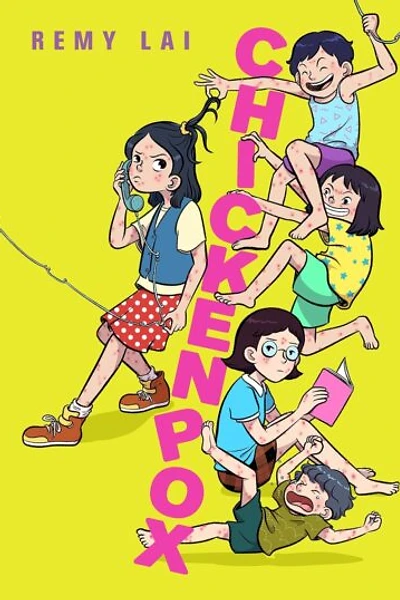
Pacing MaterialWhen chicken pox sweeps through a group of friends, each kid handles the itchy, annoying, and sometimes funny experience in their own way.
Big Idea
Even miserable moments can bring us together — and laughter is the best medicine when things are tough.
Discussion Questions
- 1.How do the different characters handle being sick?
- 2.What's funny about the chicken pox situation?
- 3.How do the friends help each other feel better?
- 4.What's a time you were sick? What helped you get through it?
Classroom Activity
Feel-Better Cards
Create a get-well card for a friend. Write a funny poem or draw a silly picture to cheer them up when they're not feeling well.
Lesson Plan
Learning Goals
- Describe how different friends in Chicken Pox respond to feeling itchy and unwell, using details from the words and illustrations.
- Explain how friendship and humor can help someone feel supported during a difficult experience.
- Create a feel-better card with a funny poem or silly picture that suits the recipient’s feelings.
- Combine words and images to communicate kindness, drawing inspiration from the graphic novel format.
Activity Steps
- 1.Read selected pages from Chicken Pox aloud. Pause to examine facial expressions, speech bubbles, and other visual clues that show how each friend handles being sick.
- 2.Discuss: How do the friends react differently to chicken pox? Which moments feel funny, frustrating, or comforting? Have students support their answers with a detail from the book.
- 3.Introduce Feel-Better Cards. Brainstorm gentle jokes, imaginary remedies, and cheerful pictures. Explain that humor should comfort someone—not make fun of their illness—and that laughter supports feelings but does not replace medical care.
- 4.Have students choose a real or imaginary friend who needs encouragement. Fold paper into a card and plan a kind message plus a short funny poem or silly drawing. Younger students may dictate a message; older students may add rhyme or a brief comic strip with speech bubbles.
- 5.Create the cards, including a specific supportive message such as 'I hope your itchy day gets better!' Invite students to check that their words and pictures are kind, clear, and appropriate for their recipient.
- 6.Invite volunteers to share their cards and explain how their choices might cheer someone up. Connect their ideas to the friendship in Chicken Pox, then send cards through an appropriate adult or display cards made for imaginary recipients.
Standards Connections
- ELA: RL.2.3–RL.6.3 — Describe and analyze characters’ responses to challenges and how those responses shape the story, with grade-appropriate expectations.
- ELA: RL.2.7 — Use information from illustrations and words to demonstrate understanding of characters, setting, or plot.
- ELA: W.2.5–W.6.5 — Strengthen writing through planning, revising, and editing with appropriate peer or adult support.
- ELA: SL.2.1–SL.6.1 — Participate in collaborative discussions, listen to others, and build on their ideas.
- SEL: Social awareness and relationship skills — Recognize others’ feelings and express empathy through thoughtful, supportive communication.
Pace-Write-Read Study with Pace-Write It!
Focus question: How does Remy Lai use quick moments, funny scenes, and graphic-novel page turns to show courage during a tough week? In Chicken Pox by Remy Lai, a group of friends experiences the same itchy illness in very different ways, creating a story that feels both relatable and adventurous. The pacing moves quickly through panels, dialogue, and scene changes, then slows down for uncomfortable, funny, or brave moments so readers can feel each character’s resilience.
| Element | How to notice or teach it in the novel |
|---|---|
| Pace | Read: Notice how Chicken Pox moves quickly through panel-to-panel action when the friends react to getting sick, then slows down to show itchy, frustrating, or brave moments. Classroom Activity: Write a 6-panel mini scene about one kid facing a problem, using 3 fast moments and 3 slow moments to control the pace. |
| Plot | Read: Notice how the main problem in Chicken Pox is simple—everyone is dealing with chicken pox—but each friend’s experience adds small events that build the adventure and show resilience. Classroom Activity: Make a beginning-middle-end plot ladder for a new graphic-novel episode about a school problem that spreads through a friend group. |
| Prosody | Read: Notice how the dialogue in Chicken Pox sounds different when characters complain, joke, panic, or encourage each other, giving the reading a lively rhythm. Classroom Activity: Write four speech bubbles for the same moment—one worried, one dramatic, one funny, and one brave—and read them aloud with expression. |
| Word pause | Read: Notice where short words, ellipses, or separate speech bubbles in Chicken Pox make readers pause before a character reacts to itching, embarrassment, or surprise. Classroom Activity: Write a short dialogue between two friends using at least three intentional pauses to build anticipation. |
| Concept | Read: Notice how Chicken Pox turns an everyday childhood illness into a story about resilience, courage, and how people handle the same challenge differently. Classroom Activity: Choose an ordinary problem and write 5 sentences showing how it could become an adventure story with a strong theme. |
| Voice & World View | Read: Notice how Chicken Pox presents childhood feelings honestly—itchiness feels huge, boredom feels endless, and small victories feel important. Classroom Activity: Write a paragraph in a child’s voice about being stuck at home with a problem that feels unfair but also a little funny. |
| Setting & Place | Read: Notice how the home and friend spaces in Chicken Pox shape the pacing, making some scenes feel trapped and slow while other moments feel playful and energetic. Classroom Activity: Describe one room where a character is stuck, then add three details that make the place feel either boring, cozy, or chaotic. |
| Point of View | Read: Notice how Chicken Pox helps readers understand different kids’ reactions to the same illness, showing that one event can feel different depending on who is experiencing it. Classroom Activity: Write the same itchy moment from two different friends’ points of view. |
| Original Characters | Read: Notice how the friends in Chicken Pox each respond in their own way—some dramatic, some patient, some funny, some frustrated—so the shared problem never feels repetitive. Classroom Activity: Invent three friends with different reactions to the same bad day and write one line of dialogue for each. |
| Dialogue | Read: Notice how the dialogue in Chicken Pox keeps scenes moving quickly and reveals character through complaints, jokes, and encouragement. Classroom Activity: Write a dialogue-only scene between two friends arguing about the best way to survive being sick. |
| Details | Read: Notice the specific details in Chicken Pox about itching, waiting, boredom, and small comforts that make the story feel real and relatable. Classroom Activity: List five tiny details a character notices while stuck at home, then turn them into a short paragraph. |
| Descriptions | Read: Notice how Chicken Pox balances short descriptions with visual storytelling so readers can feel what the characters are going through without long paragraphs. Classroom Activity: Write 4 concise description sentences about an uncomfortable day, using sensory details but keeping each sentence under 10 words. |
| Strong First Lines | Read: Notice how graphic novels like Chicken Pox need an opening that quickly introduces the problem, mood, or character energy. Classroom Activity: Write three possible first lines for a story about a kid discovering they have a problem that changes the whole week. |
| Immediacy & Engagement | Read: Notice how Chicken Pox quickly pulls readers into the friends’ discomfort, humor, and reactions so the story feels immediate from the start. Classroom Activity: Write an opening paragraph or first panel caption that drops readers right into a kid’s urgent problem. |
| Story Scenes & Summaries & Unique Structures | Read: Notice how Chicken Pox likely uses scenes for the funniest or most dramatic moments and summaries to move quickly through time between itchy episodes. Classroom Activity: Write one full scene about a hard moment and one 2-sentence summary that skips ahead to later that day. |
| Flashback & Flash Forward & Cliffhangers | Read: Notice where a graphic novel like Chicken Pox could use a memory, a worry about what comes next, or an end-of-page surprise to keep readers turning pages. Classroom Activity: End your mini-scene with a cliffhanger about what the character sees, feels, or discovers next. |
| Tension & Suspense & Surprise | Read: Notice how Chicken Pox builds tension from simple questions: Who got sick? How bad will it get? How will each friend handle it? Classroom Activity: Write a short scene that builds suspense around an ordinary event, such as seeing a rash, hearing a phone call, or waiting for news. |
| Page Turns and Chapter Breaks | Read: Notice how page turns in Chicken Pox can reveal a joke, a new symptom, or another friend’s reaction at just the right moment. Classroom Activity: Plan a 4-page graphic-novel scene and mark what surprise or reveal happens after each page turn. |
| Performance | Read: Notice how Chicken Pox invites dramatic reading because the characters’ feelings can be acted out through voice, facial expression, and timing. Classroom Activity: Choose one scene and rehearse it as a read-aloud, marking where to speak louder, slower, or softer. |
| Personality | Read: Notice how each friend’s personality in Chicken Pox changes the pacing—dramatic characters may speed up a scene, while calmer characters may slow it down. Classroom Activity: Write a character card for a kid who turns a small problem into either a huge drama or a calm plan. |
| Humor | Read: Notice how Chicken Pox uses humor to make an unpleasant experience easier to read about, showing that courage can include laughing at hard moments. Classroom Activity: Write three funny but kind observations a character might make while dealing with an itchy, annoying day. |
| Pause | Read: Notice how Chicken Pox can pause on a facial expression, a silent panel, or a waiting moment to let embarrassment, discomfort, or relief sink in. Classroom Activity: Create a silent 3-panel sequence showing a character realizing something important without using words. |
| Poetry and Poetic Devices | Read: Notice how repeated sounds, strong images, and playful wording in Chicken Pox can make ordinary moments feel vivid and memorable. Classroom Activity: Write a 6-line poem comparing itchiness to something unexpected, such as ants, sparks, or popcorn. |
| Repetition | Read: Notice how repeated complaints, actions, or visual patterns in Chicken Pox can emphasize how long and annoying the illness feels while also adding humor. Classroom Activity: Write a paragraph using repetition on purpose to show a character’s growing frustration. |
| Rhythm | Read: Notice how short panels, quick dialogue, and recurring reactions in Chicken Pox create a reading rhythm that feels bouncy even during a tough situation. Classroom Activity: Write 8 short lines about one day, alternating between action and reaction to create rhythm. |
| Punctuation | Read: Notice how exclamation marks, ellipses, question marks, and bold comic-style words in Chicken Pox help control pacing and emotion. Classroom Activity: Rewrite one simple sentence four ways using different punctuation to show panic, annoyance, confusion, and relief. |
| Questions | Read: Notice how readers keep asking questions in Chicken Pox about what will happen next and how each friend will cope. Classroom Activity: Write five reader questions that could hook someone into your own graphic-novel story. |
| Compare-Contrast | Read: Notice how Chicken Pox compares and contrasts the different friends’ reactions, showing that courage does not look the same for everyone. Classroom Activity: Use a T-chart to compare two characters’ responses to the same problem, then write a paragraph about what that teaches. |
| Objects | Read: Notice how everyday objects in Chicken Pox—blankets, medicine, snacks, thermometers, or mirrors—can become important story tools that reveal mood and character. Classroom Activity: Choose one object a sick kid might keep nearby and write how it helps tell the story. |
| Threes | Read: Notice how stories like Chicken Pox can use groups of three reactions, jokes, or attempts to create satisfying pacing and humor. Classroom Activity: Write a scene where a character tries three ways to solve one annoying problem, with the third try changing the story. |
| Whitespace & Negative Space | Read: Notice how the open space between panels and around images in Chicken Pox can slow readers down, spotlight feelings, or make a joke land better. Classroom Activity: Sketch a simple comic layout and decide where extra blank space should go to show waiting, loneliness, or surprise. |
| Art & Graphics | Read: Notice how the graphic-novel format in Chicken Pox uses expressions, panel size, and visual humor to help pacing and deepen the theme of resilience. Classroom Activity: Draw or plan a 4-panel comic where the art, not the narration, shows a character moving from discomfort to courage. |
| Interactives & Gamification | Read: Notice how Chicken Pox could inspire readers to track reactions, rank funny moments, or map character choices because each friend handles the challenge differently. Classroom Activity: Create a choice board titled “How would you handle it?” with three character-style responses to a tough day, then write the outcome of each choice. |
Pace-Write It!
20-Minute Classroom Flow\nRead (5 min): Read a short excerpt from Chicken Pox by Remy Lai that shows one or more friends reacting to being sick. Ask students to listen for where the story speeds up, slows down, and becomes funny or brave.\nNotice (5 min): Students identify one pacing move they notice: quick dialogue, a pause, a page-turn surprise, repeated actions, or a silent moment. Chart responses under the headings Fast, Slow, Funny, and Brave.\nWrite (7 min): Students write their own short graphic-novel scene about a kid facing an uncomfortable problem and showing courage. Writing frame: “At first, _____ felt _____. Then _____ happened fast: _____, _____, and _____. After a pause, _____ noticed _____. In the end, _____ showed courage by _____.” Encourage students to add dialogue, punctuation, and one page-turn or panel-break moment.\nShare (3 min): Partners read their scenes aloud and point out one place where the pacing speeds up and one place where it slows down. Invite 1–2 volunteers to share how they used humor or a pause to show resilience.\nExit ticket: Write one sentence answering this question: How can a writer use pacing to show both discomfort and courage?
Pace-Write-Read Connection
Teach this book using the Pace-Write-Read method — Tool 20: Play.
Open the Mastery Manual