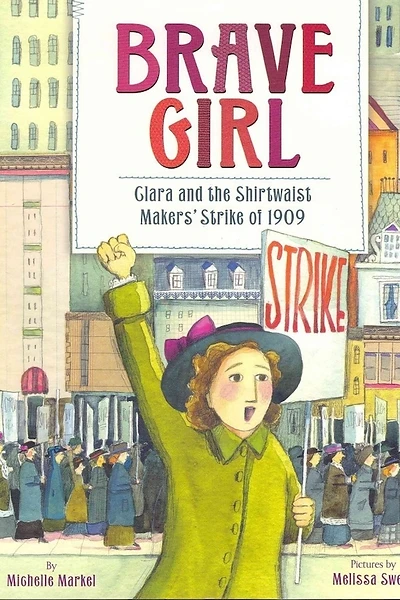
 2-5
2-5R MARKEL
Brave Girl: Clara Lemlich and the Shirtwaist Makers' Strike
by Michelle Markel
Pacing MaterialThe true story of Clara Lemlich, a young immigrant garment worker who led the largest women's strike in U.S. history and fought for fair labor.
Big Idea
One young person's courage can spark a movement, and standing together gives workers a voice.
Discussion Questions
- 1.What conditions did Clara face in the factory?
- 2.Why did Clara lead the strike?
- 3.What did the workers gain?
- 4.How did being an immigrant shape Clara's fight?
- 5.What would you stand up for?
Classroom Activity
Justice Banner
Create a protest banner for a cause you believe in. Include a slogan and three reasons people should join.
Lesson Plan
Learning Goals
- Describe how Clara Lemlich showed courage by speaking up about unfair conditions in garment factories.
- Explain how workers used a strike and collective action to seek safer workplaces, fair pay, and reasonable hours.
- Create a justice banner with a clear slogan and three reasons that support a chosen cause.
- Use details from Clara’s story to explain how one person’s voice can inspire others to act together.
Activity Steps
- 1.Read Brave Girl aloud, pausing to discuss Clara’s experiences as an immigrant and garment worker. Define immigrant, garment, strike, and slogan in age-appropriate language.
- 2.Create a class chart labeled 'Unfair Conditions' and 'Changes Workers Wanted.' Add examples from the book, such as long hours and unsafe conditions, and discuss why Clara and other workers joined together.
- 3.Introduce the Justice Banner activity. Invite students to choose a cause they care about, such as safer playgrounds, welcoming new students, or keeping shared spaces clean. Students may also create a historical banner supporting Clara’s fellow workers.
- 4.Have students draft a short slogan and three reasons people should join their cause. Model a historical example: 'Safe Work for Everyone!' Encourage specific reasons; younger students may dictate ideas or use sentence frames.
- 5.Have students turn their drafts into banners using large lettering, illustrations, and three clearly visible reasons. Ask partners to check whether the slogan and reasons communicate the desired change respectfully.
- 6.Hold a classroom banner gallery walk. Each student shares the cause and one reason, then explains a connection to Clara’s courage or the workers’ strength in standing together.
Standards Connections
- ELA: CCSS RI.2.3–RI.5.3 — Describe or explain connections among people, events, and ideas in Clara’s true story, with grade-appropriate complexity.
- ELA: CCSS W.2.1–W.5.1 — State an opinion about a cause and support it with reasons; older students develop reasons with facts and details.
- ELA: CCSS SL.2.1–SL.5.1 — Participate in collaborative discussions, listen to classmates, and build on others’ ideas.
- Social Studies: Civic participation — Explore how workers used collective action to advocate for fair treatment and workplace change.
- SEL: Social awareness and responsible decision-making — Recognize unfair treatment and consider respectful ways to advocate for others.
Pace-Write-Read Study with Pace-Write It!
Focus question: How does an author speed up and slow down a true story to show courage growing into action? In Brave Girl: Clara Lemlich and the Shirtwaist Makers' Strike by Michelle Markel, the story moves from Clara’s hard daily work in crowded factories to the exciting build-up of a historic strike. Markel uses pacing to slow down important moments of fear, pain, and bravery, then speed up during organizing, marching, and change so readers feel Clara’s determination.
| Element | How to notice or teach it in the novel |
|---|---|
| Pace | Read: Notice how the story begins with Clara’s difficult life and long factory hours, then speeds up as she decides to speak out and join the strike. Classroom Activity: Write 4-5 sentences about a character who starts in a slow, hard routine and then rushes into a brave action. |
| Plot | Read: Follow the true sequence of Clara Lemlich’s journey from immigrant child to garment worker to strike leader fighting unfair labor conditions. Classroom Activity: Make a beginning-middle-end plot summary, then write one extra sentence telling where the most exciting part happens. |
| Prosody | Read: Listen to how the sentences sound when read aloud, especially in scenes of hard work, injury, and Clara’s powerful speech to the crowd. Classroom Activity: Choose one scene and rewrite it in 3 lines meant to be read aloud with strong feeling and expression. |
| Word pause | Read: Notice where you naturally stop while reading because of commas, dashes, or short sentences that highlight Clara’s exhaustion or bravery. Classroom Activity: Write 3 sentences about a protest scene and add punctuation that creates pauses for drama. |
| Concept | Read: Think about the big idea that workers deserve fairness, safety, and respect, and that one brave voice can help many people. Classroom Activity: Write a short paragraph explaining the lesson readers learn from Clara’s actions. |
| Voice & World View | Read: Notice how the book presents Clara as determined, justice-seeking, and hopeful, while also showing the harsh world of factory owners and unsafe labor. Classroom Activity: Write 5 sentences in a narrator’s voice that admires a child who stands up for fairness. |
| Setting & Place | Read: Pay attention to the crowded New York City tenements, factory floors, and meeting halls that shape Clara’s life and choices. Classroom Activity: Describe a workplace or city setting in 4-6 sentences, showing how the place makes the character feel. |
| Point of View | Read: Notice that the book is told in third person but stays close to Clara’s experiences, helping readers understand her struggles and courage. Classroom Activity: Rewrite one moment from Clara’s story in first person beginning with “I...”. |
| Original Characters | Read: Notice that Clara is a real historical figure portrayed as a brave young immigrant worker, and the supporting workers and factory owners help show the conflict. Classroom Activity: Invent a new worker character who could stand beside Clara and write a 5-sentence character sketch. |
| Dialogue | Read: Listen for spoken words and speech moments that show workers arguing, organizing, and Clara calling others to action. Classroom Activity: Write a short dialogue between Clara and another worker about whether to join the strike. |
| Details | Read: Notice the small details about needles, cloth, crowded rooms, injuries, and long hours that make factory life feel real. Classroom Activity: Write a list of 5 sensory details for a hard-working scene, then turn them into 3 complete sentences. |
| Descriptions | Read: Pay attention to how Michelle Markel describes Clara’s world so readers can picture both the hardship and the growing crowds of protesters. Classroom Activity: Write a descriptive paragraph about a meeting hall filled with workers waiting for someone brave to speak. |
| Strong First Lines | Read: Notice how the opening quickly introduces Clara’s strength and struggle, inviting readers into her real story right away. Classroom Activity: Write three possible first lines for a nonfiction narrative about a brave person fighting unfair rules. |
| Immediacy & Engagement | Read: Notice how the book makes readers feel close to Clara’s experience by focusing on urgent problems like injury, hunger, and unfair treatment. Classroom Activity: Write 4 sentences that make a reader feel they are right inside a noisy factory scene. |
| Story Scenes & Summaries & Unique Structures | Read: Notice how some parts are told as full scenes, like key moments of speaking and striking, while other parts summarize time passing and many workers joining. Classroom Activity: Write one scene in 3-4 sentences and one summary in 2 sentences about the same protest story. |
| Flashback & Flash Forward & Cliffhangers | Read: Notice how the story mostly moves forward in time, but readers can think about Clara’s earlier life as an immigrant and wonder what will happen before major action moments. Classroom Activity: Write a short paragraph that ends with Clara about to speak, creating a cliffhanger. |
| Tension & Suspense & Surprise | Read: Feel the tension when workers face danger, arrest, injury, and the risk of losing jobs, and notice the surprise of one young woman influencing so many people. Classroom Activity: Write 5 sentences that build suspense before a character decides to do something brave. |
| Page Turns and Chapter Breaks | Read: Notice where an illustration, a big moment, or a change in action makes you want to turn the page to see what Clara will do next. Classroom Activity: Plan a 4-page picture-book sequence and write the last sentence for each page to encourage a page turn. |
| Performance | Read: Imagine how Clara’s speech and the marchers’ chants could be performed aloud with strength, pauses, and rising emotion. Classroom Activity: Write 4 lines for a short dramatic reading of Clara addressing the workers. |
| Personality | Read: Notice Clara’s bold, stubborn, caring personality and how those traits help her keep going even after hardship and injury. Classroom Activity: Write a character paragraph naming 3 personality traits Clara shows and one action that proves each trait. |
| Humor | Read: Notice that this book is mostly serious because it deals with poverty, danger, and injustice, so the lack of humor helps keep the focus on struggle and courage. Classroom Activity: Write 3 sentences explaining why an author might choose a serious tone for Clara’s story. |
| Pause | Read: Notice how important moments, such as Clara thinking, recovering, or preparing to speak, feel slower and fuller of meaning. Classroom Activity: Write a short paragraph where time seems to slow just before a character makes a brave choice. |
| Poetry and Poetic Devices | Read: Listen for repeated sounds, strong imagery, and powerful language that make the nonfiction story feel lyrical and emotional. Classroom Activity: Write 4 lines about workers marching and include one simile or metaphor. |
| Repetition | Read: Notice repeated ideas about long hours, unfair treatment, courage, and many voices joining together for change. Classroom Activity: Write a short chant or paragraph that repeats a key phrase such as “We deserve...” three times. |
| Rhythm | Read: Feel how sentence length can change the rhythm—slower in hard daily work and quicker in scenes of marching and protest. Classroom Activity: Write one slow sentence and two quick sentences to show a calm moment changing into action. |
| Punctuation | Read: Notice how commas, quotation marks, and exclamation points help shape Clara’s speech and the urgency of strike scenes. Classroom Activity: Write a 4-sentence protest scene using at least one exclamation point and one line of dialogue with quotation marks. |
| Questions | Read: Think about the questions the book raises: Why were workers treated unfairly? What makes someone speak up? How can one voice matter? Classroom Activity: Write 3 thoughtful questions you would ask Clara Lemlich and then answer one of them as if you were Clara. |
| Compare-Contrast | Read: Compare Clara’s life before the strike with life during the strike, or compare workers’ goals with factory owners’ choices. Classroom Activity: Write a compare-contrast paragraph using the frame “Before..., but during...”. |
| Objects | Read: Notice important objects like sewing machines, needles, cloth, signs, and clothing that connect to Clara’s work and the strike. Classroom Activity: Choose one object from the story and write 4 sentences explaining how it symbolizes work, danger, or hope. |
| Threes | Read: Notice groups of three details or ideas you can use to remember Clara’s struggle, such as work, injury, and protest, or courage, voice, and change. Classroom Activity: Write a sentence or short paragraph that uses three strong actions Clara takes in a row. |
| Whitespace & Negative Space | Read: Notice how page layout and spacing can make an illustration or a line of text feel quiet, lonely, or powerful, especially around turning-point moments. Classroom Activity: Create a mini page design with one strong sentence in the center and explain why extra space makes it powerful. |
| Art & Graphics | Read: Study how the illustrations help show crowded factories, the mood of the workers, and the energy of the strike that words alone could not fully show. Classroom Activity: Sketch a scene from Clara’s story and add 3 captions that match the mood and action. |
| Interactives & Gamification | Read: Think about how readers could interact with Clara’s story by tracking brave choices, mapping strike events, or sorting fair and unfair working conditions. Classroom Activity: Create a simple choice chart or card sort with examples from the book: “fair” and “unfair” labor conditions. |
Pace-Write It!
20-Minute Classroom Flow\nRead (5 min): Read aloud the section showing Clara’s factory life and the moment she decides to speak up for the workers. Ask students to listen for places where the story feels slow and heavy and places where it feels fast and urgent.\nNotice (5 min): Discuss: Where did Michelle Markel slow the story down? Where did she speed it up? Why? Point out details about the factory, Clara’s injuries, and the big meeting that build courage and tension.\nWrite (7 min): Students write a short nonfiction-style scene about a brave person standing up for fairness. Writing frame: “At first, __________. Every day, __________. But then, __________. My heart/Their heart __________. So __________ said, ‘__________!’ After that, __________.” Encourage students to use one slow sentence and one fast action sentence.\nShare (3 min): Partners read their scenes aloud and identify where the pacing slows down and speeds up. Invite 1-2 volunteers to share a line that sounds especially powerful.\nExit ticket: Write one sentence answering: How did pacing help show Clara Lemlich’s courage in Brave Girl?
Pace-Write-Read Connection
Teach this book using the Pace-Write-Read method — Tool 6: Voice and Worldview.
Open the Mastery Manual