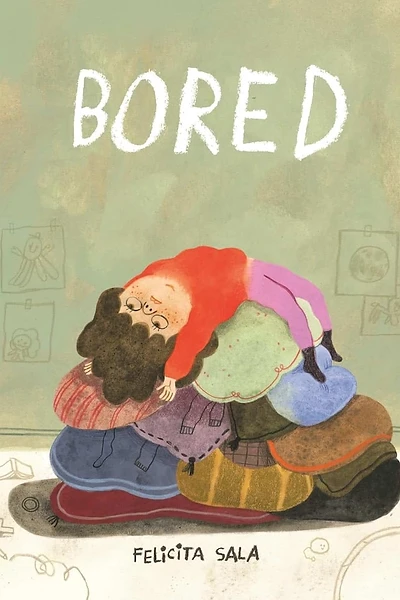
 K-3
K-3P SALA
Bored
by Felicita Sala
Pacing MaterialIn Bored, Rita is having one of those slow, restless days when nothing feels interesting. She is bored, very bored, and at first she cannot imagine anything good coming from that feeling. But as her mind wanders, boredom becomes the doorway to imagination. Rita begins to think about other bored people, strange possibilities, and playful ideas that grow bigger and bigger. Felicita Sala's expressive watercolor illustrations help show how Rita's flat, stuck feeling slowly turns into creativity. The story reminds readers that boredom is not always a problem to fix right away. Sometimes boredom gives the brain room to invent, wonder, and play. Published by Neal Porter Books/Holiday House.
Big Idea
Boredom can feel uncomfortable, but it can also be the beginning of imagination, creativity, and new ideas.
Discussion Questions
- 1.Why do you think Rita feels so bored at the beginning of the story?
- 2.What does Rita do with her boredom?
- 3.How does her imagination change the mood of the story?
- 4.What do the illustrations show that the words do not have to explain?
- 5.Have you ever had a boring day that turned into a creative idea?
- 6.Why might boredom be useful sometimes?
- 7.How does Rita's facial expression or body language change across the story?
- 8.What would have happened if Rita had never let her mind wander?
Classroom Activity
Boredom to Imagination Map
Students fold a paper into three sections — I Feel Bored When..., My Mind Could Wonder About..., My New Idea Is... — then choose one boring moment and turn it into a drawing, comic panel, or short story idea.
Lesson Plan
Learning Goals
- Identify how an everyday feeling can become the beginning of a story
- Recognize how illustrations show emotions that words do not need to explain
- Write or draw a short imaginative scene starting from a feeling
- Understand that boredom can give the brain room to invent, wonder, and play
Activity Steps
- 1.Fold a paper into three sections: I Feel Bored When... / My Mind Could Wonder About... / My New Idea Is...
- 2.Fill in examples: waiting in line → a secret tunnel under the school → a story about a hallway that moves; rainy day inside → clouds having a meeting → a comic about weather bosses; no one can play → toys waking up → a pretend museum of lost toys.
- 3.Choose one boring moment and turn it into a drawing, comic panel, or short story idea.
- 4.Write a short scene using the frame: I was so bored that ___. I looked at ___. Then I imagined ___. Suddenly, ___. My boring day became ___.
- 5.Share the favorite imagined idea. Classmates name the feeling that started the story and the creative idea that grew from it.
- 6.Exit Ticket: Finish this sentence: 'Boredom can be useful because ___.'
Standards Connections
- ELA: RL.K-3.3 Describe characters and events
- ELA: RL.K-3.7 Use illustrations to understand story
- ELA: W.K-3.3 Write narratives
- ELA: SL.K-3.1 Participate in discussions
- SEL: Self-awareness and emotion recognition
- Art: Visual storytelling and creative expression
Pace-Write-Read Study with Pace-Write It!
Focus question: How can a slow, quiet moment of boredom turn into an exciting burst of imagination? In Bored by Felicita Sala, a child begins in a restless, unimpressed mood and gradually discovers that boredom can open the door to creative play and new ideas. Sala uses pacing by stretching out the dull moments at the beginning and then quickening the feeling as the child’s imagination grows, helping readers feel the shift from stuck to inspired.
| Element | How to notice or teach it in the novel |
|---|---|
| Pace | Read: Notice how Bored begins with a slow, dragging feeling as the child seems unstimulated, then moves faster as imagination takes over and ordinary moments become full of possibility. Classroom Activity: Write 3 sentences that start with a bored feeling and then speed up into an imaginative idea. |
| Plot | Read: Notice the simple but meaningful plot in Bored: a child feels bored, sits with that feeling, and then discovers creativity through imagination. Classroom Activity: Make a beginning-middle-end chart showing how boredom changes into creative action, then write your own 3-part mini story. |
| Prosody | Read: Listen to how the words in Bored can be read slowly at first and more energetically later, matching the child’s emotional change. Classroom Activity: Read one page in a sleepy voice and one page in an excited voice, then write 2 lines meant to be read in different ways. |
| Word pause | Read: Notice where a reader naturally pauses in Bored to take in the child’s feelings, the pictures, and the shift into imagination. Classroom Activity: Write a short sentence about being bored and add a dash or ellipsis to show a thinking pause. |
| Concept | Read: Notice that the big idea in Bored is that boredom is not just emptiness; it can become the starting place for creativity and imagination. Classroom Activity: Finish this sentence in writing: 'Boredom can be a doorway to _____ because _____.' |
| Voice & World View | Read: Notice how Bored presents a child’s world where emotions are real and imagination transforms the everyday into something meaningful. Classroom Activity: Write 4 sentences in a childlike voice about a time when nothing seemed interesting until one idea changed everything. |
| Setting & Place | Read: Notice how the everyday spaces in Bored feel ordinary at first, which makes the imaginative shift feel even more powerful. Classroom Activity: Draw or describe an ordinary room or place, then write how it could become magical in your imagination. |
| Point of View | Read: Notice how Bored stays close to the child’s experience so readers understand the feeling of being stuck and then becoming inspired. Classroom Activity: Write 3 sentences from the point of view of a bored child looking around a room for an idea. |
| Original Characters | Read: Notice how the child in Bored feels believable and familiar, and how that relatable character helps readers connect to the theme of creativity. Classroom Activity: Invent a child character who gets bored easily and give that character one surprising imagination habit. |
| Dialogue | Read: Notice any moments in Bored where spoken words or implied conversation help show the child’s mood and movement toward creativity. Classroom Activity: Write a 4-line dialogue between a bored child and an adult or friend about what to do next. |
| Details | Read: Notice the small details in Bored that show boredom at first and then reveal growing imagination in the child’s world. Classroom Activity: Make a T-chart with 'boring details' and 'imaginative details,' then use 2 from each side in a paragraph. |
| Descriptions | Read: Notice how Bored uses description through words and illustrations to change the feeling from flat and dull to rich and alive. Classroom Activity: Write one sentence describing a dull afternoon and one sentence describing the same moment after imagination wakes up. |
| Strong First Lines | Read: Notice how the opening of Bored immediately introduces the child’s problem and sets the slow beginning pace. Classroom Activity: Write 2 opening lines for a story about boredom, one simple and one dramatic, and choose the stronger one. |
| Immediacy & Engagement | Read: Notice how Bored quickly connects readers to a feeling many children know, making the story engaging even though it starts quietly. Classroom Activity: Write a first sentence that makes a reader instantly feel your character’s boredom. |
| Story Scenes & Summaries & Unique Structures | Read: Notice how Bored moves through key moments of feeling, noticing, and imagining instead of filling every second with action. Classroom Activity: Write one full scene of a child staring around in boredom and one summary sentence that skips ahead to when creativity begins. |
| Flashback & Flash Forward & Cliffhangers | Read: Notice that Bored stays mostly in the present, which keeps attention on the child’s immediate emotional change, but readers can imagine what happened before and what may happen next. Classroom Activity: Add a flash forward sentence to show what the child might create after the book ends. |
| Tension & Suspense & Surprise | Read: Notice the tension in Bored comes from wondering whether anything will change for the child, and the surprise is that boredom itself leads to imagination. Classroom Activity: Write 3 sentences that build suspense about a bored child waiting for an idea to appear. |
| Page Turns and Chapter Breaks | Read: Notice how page turns in Bored help reveal emotional shifts, new visual ideas, and the growing energy of the child’s imagination. Classroom Activity: Fold a paper into 4 pages and plan what surprise or change will happen on each page turn. |
| Performance | Read: Notice how Bored invites expressive read-aloud performance, with droopy body language and slow voice at first, then brighter energy as the child imagines. Classroom Activity: Perform one line as if you are deeply bored and another as if you have just had a brilliant idea, then write both lines. |
| Personality | Read: Notice how the child’s personality in Bored comes through in reactions, expressions, and the eventual leap into creativity. Classroom Activity: Write 5 words that describe the child’s personality at the start and 5 words for the personality shown after imagination begins. |
| Humor | Read: Notice the gentle humor in Bored as a familiar problem becomes a surprising and creative adventure. Classroom Activity: Write a funny sentence about the most boring moment ever turning into the silliest idea. |
| Pause | Read: Notice how pauses in Bored give readers time to feel the stillness of boredom and then notice the spark of imagination. Classroom Activity: Write a tiny moment with 2 short sentences and a line break or ellipsis to create a pause before the big idea. |
| Poetry and Poetic Devices | Read: Notice how Bored has a poetic feeling because ordinary emotions and images are treated with care and imagination. Classroom Activity: Write a 3-line poem beginning with 'Boredom is...' and use a simile or metaphor. |
| Repetition | Read: Notice whether repeated feelings, words, or visual patterns in Bored help emphasize the child’s mood before it changes. Classroom Activity: Write a short piece that repeats the phrase 'Nothing to do' two or three times before changing to 'Then I thought...' |
| Rhythm | Read: Notice how the rhythm of Bored feels slower in the beginning and livelier as the child’s imagination starts moving. Classroom Activity: Write 4 short lines with a slow rhythm, then 4 short lines with a quick rhythm about the same character. |
| Punctuation | Read: Notice how punctuation in Bored can help a reader hear boredom, wondering, and excitement in the child’s journey. Classroom Activity: Write one sentence with a period, one with an ellipsis, and one with an exclamation mark to show changing feelings. |
| Questions | Read: Notice how Bored makes readers ask: What can happen when nothing is happening? How will this child escape boredom? Classroom Activity: Write 3 questions a bored child might ask while looking around for inspiration. |
| Compare-Contrast | Read: Compare the beginning of Bored, when the child feels stuck, with the later parts, when imagination makes the world feel open and exciting. Classroom Activity: Write 2 compare-contrast sentences using the frame 'At first..., but later...'. |
| Objects | Read: Notice how everyday objects in Bored can become important once the child begins imagining in new ways. Classroom Activity: Choose one ordinary object from a classroom or home and write how it could become something magical in a story. |
| Threes | Read: Notice places in Bored where ideas, images, or actions could be grouped in threes to build pattern and momentum. Classroom Activity: Write 3 things a bored child sees, 3 things the child imagines, and 3 things the child decides to create. |
| Whitespace & Negative Space | Read: Notice how space on the page and in the illustrations of Bored helps create the feeling of emptiness, quiet, and possibility before imagination fills it. Classroom Activity: Make a page with very few words and lots of blank space, then add one sentence that suggests a new idea is coming. |
| Art & Graphics | Read: Notice how Felicita Sala’s illustrations in Bored help tell the story of changing mood, showing the child’s boredom and then the expanding power of imagination. Classroom Activity: Create a two-panel sketch: one panel shows boredom, and the second shows the same character’s imagination bursting to life. |
| Interactives & Gamification | Read: Notice how Bored invites readers to play a mental game of spotting when the child’s world begins to change from ordinary to imaginative. Classroom Activity: Play 'Idea Hunt' by listing 5 classroom objects and turning each one into something imaginary in writing. |
Pace-Write It!
20-Minute Classroom Flow\nRead (5 min): Read Bored by Felicita Sala aloud. Pause to let students study the pictures and notice how the child’s mood changes from slow boredom to lively imagination.\nNotice (5 min): Ask: 'Where does the story feel slow? Where does it start to feel faster or more exciting?' Chart student ideas under two headings: 'Bored feeling' and 'Imagination feeling.' Point out pacing, page turns, and how the illustrations help the story move.\nWrite (7 min): Students write their own short boredom-to-imagination piece. Writing frame: 'At first, I was bored because _____. I looked at _____. Then I imagined _____. Soon, _____.' Encourage students to include one pause mark such as an ellipsis, dash, or line break to slow a moment before the idea appears.\nShare (3 min): Partners read their writing aloud twice: first in a slow bored voice, then with an excited imaginative voice. Invite 2-3 students to share how their pacing changed.\nExit ticket: Write one sentence answering: 'How can boredom lead to creativity?'