 5-8
5-8M SHEINKIN
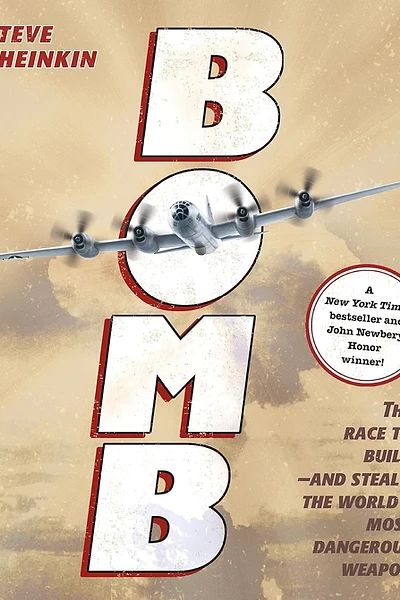
Bomb
by Steve Sheinkin
Pacing MaterialSteve Sheinkin's Bomb weaves together three interlocking storylines—the American Manhattan Project scientists racing to build the atomic bomb, Soviet spies infiltrating that very program, and Norwegian resistance fighters sabotaging Nazi Germany's heavy water supply—into a single thriller-paced narrative. Told with cinematic pacing and vivid characters, the book follows real people like Robert Oppenheimer, Klaus Fuchs, and the Norwegian commandos of Operation Gunnerside as history hurtles toward Hiroshima and Nagasaki, leaving readers to grapple with the weapon's terrible legacy.
Big Idea
Scientific discovery is never neutral; the same knowledge that can save the world can also destroy it, and the people who wield that power bear enormous moral responsibility.
Discussion Questions
- 1.Why do you think Sheinkin chose to tell this story through three separate but connected plotlines instead of one single narrative?
- 2.Robert Oppenheimer and Klaus Fuchs both worked on the bomb but made very different choices. What motivated each of them, and how does the book help you understand their reasoning even if you disagree with it?
- 3.How does the book portray the Norwegian saboteurs differently from the American scientists or Soviet spies? What does this tell us about different forms of wartime heroism?
- 4.Sheinkin includes President Truman's decision to drop the bombs on Hiroshima and Nagasaki. Do you think the book presents this decision as right, wrong, or complicated? What evidence from the text supports your view?
- 5.If you were a scientist working on the Manhattan Project and learned the war in Europe had ended before the bomb was finished, would you have continued the work? Why or why not?
- 6.How does secrecy function as both a tool for winning the war and a source of moral danger throughout the book?
Classroom Activity
Multiple Perspectives Newsroom
Divide students into small groups, each representing a different 'news desk' covering the atomic bomb story from one of the book's perspectives: American scientists, Soviet intelligence, Norwegian resistance, or Japanese civilians. Each group researches their assigned perspective using details from the book and writes a short 'breaking news' article or produces a mock broadcast script about a key event (e.g., the Trinity test, the heavy water sabotage, the bombing of Hiroshima). Groups then present their reports to the class, followed by a discussion of how the same historical event looks different depending on whose story is being told.
Lesson Plan
Learning Goals
- Explain how the Manhattan Project, Soviet espionage, and Norwegian heavy water sabotage connect in Steve Sheinkin’s Bomb, a work of narrative nonfiction.
- Use at least two cited details from the book or teacher-provided historical sources to write an accurate news report.
- Compare how historical roles, available information, and experiences shape accounts of atomic weapons development and use.
- Distinguish documented facts from interpretation and discuss the moral responsibilities of scientists, governments, and journalists.
Activity Steps
- 1.Introduce the Multiple Perspectives Newsroom (10 minutes). Clarify that Bomb tells real history through narrative nonfiction. Locate Norway, the United States, the Soviet Union, and Japan on a map; briefly review Operation Gunnerside, the Trinity test, and the bombings of Hiroshima and Nagasaki.
- 2.Assign four news desks (5 minutes): American scientists, Soviet intelligence, Norwegian resistance, and Japanese civilians. Give each group a relevant passage set and an event to cover. Explain that these are evidence-based reports, not reenactments of victims or fabricated eyewitness testimony.
- 3.Research each desk’s perspective (20 minutes). Groups record what happened, when and where it happened, who was affected, and what people in that position could have known at the time. Require at least two supporting details with page numbers or source citations. Provide accessible survivor accounts or historical summaries for the Japanese civilian desk where the book offers limited detail.
- 4.Create a 200–300-word breaking-news article or a two-minute broadcast script (20 minutes). Include a headline, factual lead, two cited details, and an explanation of the event’s significance to the assigned perspective. Label the reporting date and any fictional newsroom framing; do not invent quotations. For the Soviet desk, distinguish secret information from what could have been reported publicly.
- 5.Present reports and compare coverage (15 minutes). List each desk’s priorities, knowledge, and omissions on a class chart. Then have all four desks briefly explain how news of Hiroshima would affect their perspective, using evidence and clearly labeling hindsight.
- 6.Discuss and reflect (10 minutes). Ask: Who benefited, who suffered, and what responsibilities accompanied this scientific discovery? Discuss civilian harm without graphic imagery or requiring students to defend it. Finish with an exit ticket citing one detail and explaining how another desk changed the student’s understanding.
Standards Connections
- ELA: CCSS.ELA-LITERACY.RI.5.3 — Explain relationships among individuals, events, and ideas in a historical text using specific information.
- ELA: CCSS.ELA-LITERACY.RI.6.1–RI.8.1 — Cite textual evidence to support analysis of informational texts.
- ELA: CCSS.ELA-LITERACY.W.5.2–W.8.2 — Write informative texts that communicate historical information clearly and accurately.
- ELA: CCSS.ELA-LITERACY.SL.5.1–SL.8.1 — Participate in collaborative discussions, building on others’ ideas and supporting claims.
- SEL: Social awareness and responsible decision-making — Consider differing experiences and evaluate the ethical consequences of scientific and political decisions.
Pace-Write-Read Study with Pace-Write It!
Bomb succeeds as narrative nonfiction because Sheinkin borrows techniques from thriller fiction—cliffhanger chapter endings, tight scene-based storytelling, and vivid characterization—while remaining rigorously factual. The elements below help students see how craft choices shape our understanding of real historical events.
| Element | How to notice or teach it in the novel |
|---|---|
| Pace | Read: Notice how Sheinkin alternates short, punchy chapters between the three storylines (American, Soviet, Norwegian) to keep the pace relentless even though it's nonfiction. Classroom Activity: Have students outline a real historical event using three short 'chapters' from different viewpoints, mimicking this braided pacing structure. |
| Plot | Read: Trace how the plot builds through parallel tracks—building the bomb, stealing its secrets, and stopping Germany's bomb—that all converge at Trinity and Hiroshima. Classroom Activity: Students create a plot map showing where the three storylines intersect and diverge across the book. |
| Prosody | Read: Notice the rhythm of Sheinkin's short declarative sentences, especially in tense scenes like the Trinity test countdown. Classroom Activity: Have students rewrite a paragraph of dry historical fact using short, rhythmic sentences to build tension. |
| Word pause | Read: Notice how one-line paragraphs, like 'Then the war changed forever,' force readers to pause and absorb weighty moments. Classroom Activity: Students identify a turning point in a report they're writing and isolate it into its own one-line paragraph for emphasis. |
| Concept | Read: Notice how the abstract concept of nuclear fission is explained through concrete comparisons and human stakes rather than technical jargon. Classroom Activity: Students choose a complex concept (e.g., how a vaccine works) and explain it using an analogy accessible to a younger reader. |
| Voice & World View | Read: Notice how Sheinkin's narrative voice remains urgent and slightly conspiratorial, pulling readers into the secrecy of the story. Classroom Activity: Students rewrite a historical event summary in a 'thriller narrator' voice, using suspenseful phrasing. |
| Setting & Place | Read: Notice how Los Alamos, wartime Norway, and Soviet Moscow are each rendered with sensory, specific detail despite being nonfiction settings. Classroom Activity: Students research a real historical location and write a paragraph describing it using at least three sensory details. |
| Point of View | Read: Notice how the book shifts close-third narration between Oppenheimer, Fuchs, and the Norwegian saboteurs, letting readers inhabit each figure's mindset. Classroom Activity: Students rewrite a single historical event from two different real people's points of view. |
| Original Characters | Read: Notice how Sheinkin makes real historical figures feel like characters through quirky details, like Oppenheimer's chain-smoking or specific quotes. Classroom Activity: Students research one lesser-known figure from the book and write a 'character profile' highlighting distinctive, humanizing details. |
| Dialogue | Read: Notice how Sheinkin uses direct quotations from historical records as dialogue to dramatize key moments, such as Truman's meetings. Classroom Activity: Students find a real quote from a primary source and build a short dramatized scene around it. |
| Details | Read: Notice the specific, concrete details Sheinkin includes, like the exact weight of the uranium core or the smell of a Norwegian mountainside. Classroom Activity: Students revise a bland factual sentence by adding three specific sensory or numerical details. |
| Descriptions | Read: Notice how physical descriptions of key figures, like Klaus Fuchs's nervous habits, hint at their inner character. Classroom Activity: Students write a physical description of a historical figure that subtly reveals something about their personality or motives. |
| Strong First Lines | Read: Notice how many chapters open with punchy, provocative first lines that hook the reader immediately, such as chapter openers posing questions or stating shocking facts. Classroom Activity: Students draft three possible opening lines for a report on a historical event, aiming for maximum hook. |
| Immediacy & Engagement | Read: Notice how present-tense-feeling narration and urgent verbs make decades-old events feel like they're unfolding right now. Classroom Activity: Students rewrite a past historical account using more active, immediate verbs and shorter sentences. |
| Story Scenes & Summaries & Unique Structures | Read: Notice how Sheinkin alternates between fully dramatized scenes (like the sabotage raid) and quicker summary passages that cover months in a paragraph. Classroom Activity: Students take a timeline of events and decide which moments deserve a 'full scene' versus a 'quick summary,' then draft one of each. |
| Flashback & Flash Forward & Cliffhangers | Read: Notice how chapters often end on a cliffhanger, then the next chapter jumps to a different storyline, delaying resolution. Classroom Activity: Students write a short nonfiction scene that ends on a cliffhanger sentence, then explain how they'd delay the payoff in a follow-up section. |
| Tension & Suspense & Surprise | Read: Notice how Sheinkin builds suspense around whether the Norwegian saboteurs will be caught, even though readers may sense they survive. Classroom Activity: Students identify three narrative techniques the author uses to build suspense and apply one to their own historical retelling. |
| Page Turns and Chapter Breaks | Read: Notice how chapter titles like 'The Snatch' or 'Trinity' create intrigue and compel readers to keep turning pages. Classroom Activity: Students draft five possible chapter titles for a report on a historical event, chosen to maximize curiosity. |
| Performance | Read: Notice how key scenes, like the Trinity test, are written almost like a screenplay, with described actions and reactions building toward a climax. Classroom Activity: Students adapt a short passage from their own research into a mini script with stage directions. |
| Personality | Read: Notice how Sheinkin gives even minor figures small personality quirks, making the huge cast of scientists and spies memorable. Classroom Activity: Students choose one minor historical figure and add one memorable, well-researched quirk to their character sketch. |
| Humor | Read: Notice moments of dry, understated humor, such as anecdotes about eccentric scientists at Los Alamos. Classroom Activity: Students find or research a true anecdote and write it with a light comedic touch while staying factual. |
| Pause | Read: Notice how Sheinkin occasionally slows the pace with a reflective aside, like acknowledging the human cost of the bombings. Classroom Activity: Students insert a brief reflective pause into their own writing that steps back from action to consider meaning. |
| Poetry and Poetic Devices | Read: Notice how Sheinkin sometimes uses repetition and parallel structure for emphasis, echoing poetic rhythm in prose. Classroom Activity: Students identify one instance of parallel structure in the book and write their own sentence using the same technique. |
| Repetition | Read: Notice how phrases like 'the race' or 'the bomb' recur throughout the text, reinforcing the central stakes. Classroom Activity: Students choose a key phrase for their own historical report and repeat it strategically across three paragraphs for emphasis. |
| Rhythm | Read: Notice how sentence length varies deliberately—short sentences during action, longer ones during explanation—to control rhythm. Classroom Activity: Students revise a paragraph alternating short and long sentences to control its rhythm and pacing. |
| Punctuation | Read: Notice Sheinkin's use of em dashes and short fragments to create urgency, especially in countdown or action scenes. Classroom Activity: Students rewrite a tense moment using dashes and sentence fragments to increase urgency. |
| Questions | Read: Notice how the book poses rhetorical questions, like whether the bomb should be used, inviting readers to grapple with moral dilemmas. Classroom Activity: Students write two rhetorical questions to open a persuasive paragraph about a moral issue in their own research topic. |
| Compare-Contrast | Read: Notice how Sheinkin contrasts American openness with Soviet secrecy, or German versus Allied approaches to bomb research. Classroom Activity: Students create a Venn diagram comparing two groups or figures from the book, then write a paragraph synthesizing the comparison. |
| Objects | Read: Notice how specific objects, like the heavy water canisters or the Fat Man bomb casing, become symbolic touchstones in the narrative. Classroom Activity: Students choose one object from their research and write a paragraph exploring its symbolic significance. |
| Threes | Read: Notice how the book's entire structure relies on three parallel storylines, and how the 'rule of three' also appears in smaller list-based sentences. Classroom Activity: Students write a sentence or short passage using a group of three for rhythmic and persuasive effect. |
| Whitespace & Negative Space | Read: Notice how short paragraphs and frequent section breaks create visual pauses that mirror the tension of the story. Classroom Activity: Students revise a dense paragraph by breaking it into shorter sections with intentional white space to control pacing. |
| Art & Graphics | Read: Notice how the book includes archival photographs of key figures and locations that ground the narrative in reality. Classroom Activity: Students select or sketch one image to accompany a passage from their own writing and explain how it enhances the text. |
| Interactives & Gamification | Read: Notice how the book's shifting timelines invite readers to mentally track and predict how storylines will converge, functioning like a puzzle. Classroom Activity: Students create a timeline puzzle activity for classmates, mixing up events from the book for peers to correctly sequence. |
Pace-Write It!
In a full workshop session, guide students through a 'Narrative Nonfiction Toolkit' exercise: after reading a chapter of Bomb aloud, have students work in small groups to identify three craft elements from the list above that the author used most effectively in that chapter. Each group presents their findings with textual evidence, then applies one identified technique to a short piece of nonfiction writing about a historical event of their own choosing, culminating in a gallery walk where students compare how different craft choices shape the telling of true stories.