 K-3
K-3P SCHARNHORST
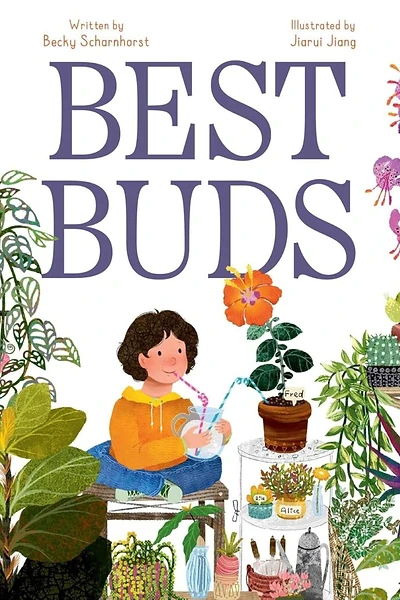
Best Buds
by Becky Scharnhorst
Pacing MaterialA child discovers the joys of friendship and plant parenthood in this charming story about growing together.
Big Idea
Friendship, like plants, grows when you give it care and patience.
Discussion Questions
- 1.How do the plants in the story represent different kinds of friends?
- 2.What does it mean to be a 'best bud'?
Classroom Activity
Plant a Friend
Students plant seeds and pair them with a classmate's plant, tracking growth together.
Lesson Plan
Learning Goals
- Identify qualities of a good friend
- Observe and record plant growth
Activity Steps
- 1.Read the story aloud
- 2.Discuss what makes a good friend
- 3.Plant seeds in cups
- 4.Pair up and track growth over two weeks
Standards Connections
- ELA: RL.K.1 — Ask and answer questions about key details
- ELA: RL.K.2 — Retell stories, including key details
- ELA: RL.K.3 — Describe characters, setting, and events
- ELA: RL.3.6 — Acknowledge differences in characters' points of view
- ELA: SL.K.1 — Participate in collaborative conversations about the text
- ELA: W.K.3 — Write narratives recounting events with descriptive details
- SEL: Relationship Skills
- SEL: Social Awareness
- Art: VA:Re7 — Perceive and analyze artistic work
Pace-Write-Read Study with Pace-Write It!
Focus question: How does an author slow down and speed up a story to help us feel a friendship grow? In Best Buds by Becky Scharnhorst, a child’s journey with a plant buddy becomes a sweet story about care, patience, and connection. Scharnhorst uses pacing by lingering on small plant-growing moments and friendship feelings, then moving quickly through changes over time so readers can feel both waiting and growing.
| Element | How to notice or teach it in the novel |
|---|---|
| Pace | Read: Notice how Best Buds moves slowly during careful moments of tending the plant and more quickly when time passes and the friendship grows. Classroom Activity: Write 4 sentences about becoming friends with something or someone, making 2 sentences slow and detailed and 2 sentences fast to show time passing. |
| Plot | Read: Notice the clear sequence in Best Buds: the child meets the plant, cares for it, faces ups and downs, and discovers what friendship and kindness look like. Classroom Activity: Make a beginning-middle-end plot map for a story about growing a new friendship. |
| Prosody | Read: Listen to how the read-aloud voice can sound gentle, excited, or worried as the child watches the plant grow in Best Buds. Classroom Activity: Mark 3 lines from your own mini-story with symbols to show where your voice should be soft, excited, or paused. |
| Word pause | Read: Notice places in Best Buds where a reader might pause on important words about growth, care, or friendship to let the feeling settle. Classroom Activity: Write 3 short sentences and underline 1 word in each where a reader should pause for meaning. |
| Concept | Read: Notice how Best Buds connects two big ideas: plant parenthood and friendship, showing that both need attention, patience, and kindness. Classroom Activity: Write a sentence stem completion: Friendship is like growing a plant because ______. |
| Voice & World View | Read: Notice the warm, child-centered voice in Best Buds that sees the world as full of wonder, feelings, and small acts of care. Classroom Activity: Write 5 sentences in a child’s voice about taking care of a living thing or helping a friend. |
| Setting & Place | Read: Notice how the home or everyday spaces in Best Buds feel cozy and important because that is where the child and plant spend time together. Classroom Activity: Describe one place where a friendship can grow, using 3 sensory details. |
| Point of View | Read: Notice how Best Buds stays close to the child’s experience so readers understand the child’s hopes, worries, and joy about the plant buddy. Classroom Activity: Rewrite one moment from the point of view of the plant, using I statements. |
| Original Characters | Read: Notice how the child and the plant in Best Buds feel like an unusual but lovable pair of buddies. Classroom Activity: Invent your own unexpected friendship pair and write 4 sentences showing why they belong together. |
| Dialogue | Read: Notice how any spoken words or imagined talk in Best Buds can make the bond between the child and plant feel playful and real. Classroom Activity: Write 4 lines of dialogue between a child and a plant about what they need to grow. |
| Details | Read: Notice the small details in Best Buds that show care, such as watching, waiting, tending, and noticing change. Classroom Activity: List 5 tiny details a character notices while caring for a friend or plant, then use 3 in a paragraph. |
| Descriptions | Read: Notice how Best Buds uses description to make growth feel visible and emotions feel gentle but strong. Classroom Activity: Describe a sprout or a friend’s smile in 3 vivid sentences. |
| Strong First Lines | Read: Notice how the opening of Best Buds quickly welcomes readers into the child’s relationship with the plant and makes us want to keep reading. Classroom Activity: Write 3 possible first lines for a story about a surprising new friend. |
| Immediacy & Engagement | Read: Notice how Best Buds keeps readers close to each moment so we care right away about whether the plant will grow and how the child feels. Classroom Activity: Write 5 sentences beginning with action, such as I peeked, I watered, I waited, to pull readers into the moment. |
| Story Scenes & Summaries & Unique Structures | Read: Notice how Best Buds likely zooms in on special scenes, like caring for the plant, and zooms out when days or weeks pass. Classroom Activity: Write one scene in 3 detailed sentences and one summary sentence that skips ahead in time. |
| Flashback & Flash Forward & Cliffhangers | Read: Notice whether Best Buds stays in the present and how that choice keeps the story simple and focused for young readers, while page-end moments can still create little cliffhangers. Classroom Activity: End a page or paragraph with a cliffhanger sentence about checking on a plant tomorrow. |
| Tension & Suspense & Surprise | Read: Notice the gentle tension in Best Buds as the child wonders what will happen with the plant and what friendship will become. Classroom Activity: Write 4 sentences that build suspense about whether something small will grow, bloom, or change. |
| Page Turns and Chapter Breaks | Read: Notice how picture-book page turns in Best Buds can hold a question, delay an answer, or reveal growth and emotion at just the right moment. Classroom Activity: Create a 2-page plan for a picture book and write what the reader wonders before the page turn and what is revealed after it. |
| Performance | Read: Notice how Best Buds can be performed with gestures like watering, waiting, drooping, and brightening to match the story’s pacing. Classroom Activity: Rehearse and perform 3 lines from your own friendship story using hand motions and facial expressions. |
| Personality | Read: Notice how the child’s caring personality shapes the mood of Best Buds and how the plant may seem to have personality too. Classroom Activity: Write a character card for a plant friend that includes 3 personality traits and one habit. |
| Humor | Read: Notice any light, sweet humor in Best Buds that comes from treating plant care like a friendship adventure. Classroom Activity: Write a funny moment in which a child misunderstands what a plant wants. |
| Pause | Read: Notice the quiet pauses in Best Buds when the child waits, watches, or reflects, and how those pauses slow the story down. Classroom Activity: Write a 3-sentence moment that includes a silent pause while a character waits for change. |
| Poetry and Poetic Devices | Read: Notice any lyrical language in Best Buds that makes growth and friendship sound soft, hopeful, or musical. Classroom Activity: Write a 4-line poem comparing friendship to roots, leaves, sunlight, or rain. |
| Repetition | Read: Notice if Best Buds repeats words, actions, or ideas like caring, checking, or growing to build rhythm and theme. Classroom Activity: Write a short paragraph that repeats a key phrase such as I checked again or We grew together. |
| Rhythm | Read: Notice how the sentence flow in Best Buds may sound calm and steady, matching the gradual pace of growing a plant and a friendship. Classroom Activity: Write 4 sentences with a steady pattern, beginning each one with Then I or Every day. |
| Punctuation | Read: Notice how punctuation in Best Buds can show excitement, waiting, or gentle feeling, such as exclamation points, commas, and ellipses. Classroom Activity: Write the same plant moment 3 ways using a period, an exclamation point, and an ellipsis. |
| Questions | Read: Notice how Best Buds may raise questions for the reader, such as Will it grow? and What makes a good friend? Classroom Activity: Write 3 questions a character might ask while caring for a plant friend, then answer one in a sentence. |
| Compare-Contrast | Read: Notice how Best Buds invites readers to compare caring for a plant with caring for a friend and to contrast loneliness with connection. Classroom Activity: Complete a compare-contrast chart: Plant care is like friendship because ___, but it is different because ___. |
| Objects | Read: Notice how important objects in Best Buds, such as the pot, soil, water, or leaves, help tell the story and slow readers down to notice meaning. Classroom Activity: Choose one object from a plant story and write 3 sentences about why it matters. |
| Threes | Read: Notice whether Best Buds groups actions or details in threes, a common pattern that sounds satisfying in picture books. Classroom Activity: Write a sentence with 3 caring actions, such as I watered, whispered, and waited. |
| Whitespace & Negative Space | Read: Notice how the open space on picture-book pages in Best Buds can create a calm feeling and give important moments room to breathe. Classroom Activity: Plan a page with one short sentence and a sketch idea, leaving space to make the moment feel quiet. |
| Art & Graphics | Read: Notice how the illustrations in Best Buds likely show growth, emotion, and friendship in ways the words do not fully explain. Classroom Activity: Draw a before-and-after picture of a friendship growing, then add 2 caption sentences. |
| Interactives & Gamification | Read: Notice how Best Buds invites readers to predict, notice changes, and track growth like a little observation game. Classroom Activity: Make a 5-box growth tracker for a character and plant friend, adding one sentence to each box to show how both change. |
Pace-Write It!
20-Minute Classroom Flow\nRead (5 min): Read Best Buds by Becky Scharnhorst aloud, stopping once or twice to notice where the story slows down during plant-care moments and speeds up when time passes. Ask: How does the pacing help us feel the friendship growing?\nNotice (5 min): On chart paper, make 2 columns: Slows Down and Speeds Up. Invite students to name one moment when the child carefully notices the plant and one moment when the story moves quickly through time. Point out how kindness, waiting, and small details affect pacing.\nWrite (7 min): Students write a tiny picture-book scene about a new friendship with a plant, pet, or person. Writing frame: First, I met ____. I noticed ____. Every day, I ____, ____, and ____. Time passed, and ____. Then I learned that friendship grows when ____. Encourage students to make one sentence slow and detailed and one sentence quick to show time passing.\nShare (3 min): Partners read their writing aloud and tell which sentence was the slowest and which sentence moved time forward the fastest. Invite 1-2 students to share how they showed kindness through pacing.\nExit ticket: Write one sentence answering: How can an author slow down a story to show that a friendship matters?