 PreK-3
P MILLER
Be Strong
by Pat Zietlow Miller
Pacing MaterialA companion to Be Kind, this story explores what it means to be strong — not just physically, but in heart, mind, and community.
Big Idea
True strength comes from standing together, speaking up, and lifting others.
Discussion Questions
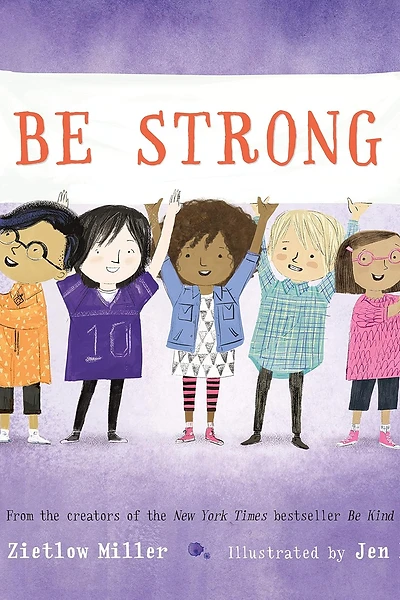
- 1.What are the different ways the children show strength?
- 2.What does it mean to be strong in your heart?
- 3.How does standing together make us stronger?
- 4.When is a time you had to be strong?
Classroom Activity
Strength Banner
Create a classroom banner where each student writes one way they can be strong. Display it as a reminder of collective strength.
Lesson Plan
Learning Goals
- Identify examples from Be Strong that show strength through caring, persistence, speaking up, or helping others—not only physical power.
- Describe how standing together can help people face challenges.
- Draw, dictate, or write one specific action that demonstrates personal strength.
- Collaborate on a classroom banner celebrating ways classmates can support one another.
Activity Steps
- 1.Read Be Strong aloud, pausing to ask: “How is this person showing strength?” and “Who helps someone else feel stronger?” Invite students to point to illustrations or describe story moments that support their answers.
- 2.Discuss the difference between physical strength and strength of heart, mind, and community. Record examples students notice in the book, then connect them to classroom actions such as trying again, asking for help, or supporting a classmate.
- 3.Introduce the Strength Banner with the heading “Together, We Are Strong.” Model a contribution: “I can be strong by speaking up kindly when someone is left out.”
- 4.Give each student a paper banner piece. Have students complete “I can be strong by…” and illustrate their action. PreK–K students may dictate to an adult; grades 1–3 students can write a sentence and explain whom their action helps.
- 5.Invite students to share their pieces with a partner or the class. Attach the pieces to one large banner, emphasizing that many different strengths contribute to a caring community.
- 6.Display the banner and reread several contributions. Close by asking each student to choose one strength action to practice today; revisit the banner during future classroom challenges.
Standards Connections
- ELA: CCSS RL.1.3 — Describe characters and major events using key details when discussing examples of strength in the story.
- ELA: CCSS SL.K.1 / SL.1.1 — Participate in collaborative conversations about the book and classmates’ ideas.
- ELA: CCSS W.K.2 / W.1.2 — Use drawing, dictating, or writing to explain a way to demonstrate strength.
- SEL: Self-awareness — Recognize personal strengths and identify an action that expresses them.
- SEL: Relationship skills — Practice helping others, communicating respectfully, and working toward a shared classroom goal.
Pace-Write-Read Study with Pace-Write It!
Focus question: How does a story show that being strong can happen in small, quiet, and brave moments? In Be Strong by Pat Zietlow Miller, the reader follows a child as she faces worries, mistakes, and hard moments while learning that strength is not only about muscles, but also about courage, kindness, and trying again. The pacing moves through brief everyday scenes, reflective lines, and meaningful page turns that give readers time to feel each moment of challenge and resilience.
| Element | How to notice or teach it in the novel |
|---|---|
| Pace | Read: Notice how Be Strong moves at a gentle, steady pace through small moments of struggle and bravery, helping readers feel that strength grows one step at a time. Classroom Activity: Write 3 short sentences about a time a child felt nervous, then 1 sentence showing the child taking one brave action. |
| Plot | Read: Notice that the plot is built around ordinary challenges rather than one big battle, showing the main child learning that being strong means continuing, helping, and caring. Classroom Activity: Make a beginning-middle-end plan for a story about a child who faces a hard moment and discovers a new kind of strength. |
| Prosody | Read: Notice how the lines in Be Strong sound calm, encouraging, and thoughtful when read aloud, matching the book’s message about steady courage. Classroom Activity: Write 4 lines of advice to a character using a gentle, supportive read-aloud voice. |
| Word pause | Read: Notice where Pat Zietlow Miller uses short phrases and line breaks so readers pause and think about what strength means in the child’s life. Classroom Activity: Write 3 short lines about bravery, putting one important idea on each line to create a pause. |
| Concept | Read: Notice that the central concept of Be Strong is that strength can be emotional, social, and inner strength, not just physical power. Classroom Activity: Finish the sentence stem 3 ways: 'Being strong means ____.'' |
| Voice & World View | Read: Notice how the book’s voice is warm and wise, and how its worldview values empathy, perseverance, and community support. Classroom Activity: Write 2-3 sentences in a caring voice that teach a younger student what real strength looks like. |
| Setting & Place | Read: Notice how the familiar settings in Be Strong feel like a child’s everyday world, which makes the message about courage feel possible and real. Classroom Activity: Write about a school, home, or playground place where a child could show strength in a small but important way. |
| Point of View | Read: Notice how the story stays close to the child’s experiences and feelings so readers connect deeply to moments of fear, effort, and hope. Classroom Activity: Write a first-person sentence beginning with 'I felt strong when...' and add 2 details about the moment. |
| Original Characters | Read: Notice that the child in Be Strong feels believable because she is not a superhero; she is an ordinary child growing stronger in heart and mind. Classroom Activity: Create a child character who has one worry, one hope, and one brave choice. |
| Dialogue | Read: Notice that even without heavy back-and-forth conversation, the book suggests the kinds of supportive words children may hear or say when facing hard moments. Classroom Activity: Write 2 lines of dialogue between a child who wants to give up and a friend or grown-up who encourages them to keep going. |
| Details | Read: Notice the small details that help show what the child is feeling during hard moments and how those details make resilience concrete. Classroom Activity: List 4 tiny details that could show a child is nervous, then use 2 of them in a sentence. |
| Descriptions | Read: Notice how the descriptions in Be Strong are simple but meaningful, helping readers picture both the challenge and the courage. Classroom Activity: Describe a child’s brave moment using one feeling word, one action word, and one image. |
| Strong First Lines | Read: Notice how the opening invites readers to think immediately about the meaning of strength and prepares them for a thoughtful journey. Classroom Activity: Write an opening line for a story that begins with a child facing something hard. |
| Immediacy & Engagement | Read: Notice how the direct, close-to-the-child language makes readers feel inside the moment, as if the challenge is happening right now. Classroom Activity: Write 3 present-tense sentences about a child standing in front of a hard task. |
| Story Scenes & Summaries & Unique Structures | Read: Notice how Be Strong blends scene-like moments with broader reflective ideas, so the story feels both personal and universal. Classroom Activity: Write one scene sentence about a child dropping something important, then one summary sentence about what that teaches about strength. |
| Flashback & Flash Forward & Cliffhangers | Read: Notice that this book stays in the present and does not rely on cliffhangers; instead, it builds meaning through connected moments and reflection. Classroom Activity: Write 1 sentence about something a child remembers from an earlier hard time and 1 sentence about what they might do next time. |
| Tension & Suspense & Surprise | Read: Notice that the tension comes from emotional uncertainty—Will the child keep going?—rather than danger, and the surprise is that strength can look soft and caring. Classroom Activity: Write 2 sentences that build worry and 1 sentence that reveals an unexpected kind of strength. |
| Page Turns and Chapter Breaks | Read: Notice how page turns in a picture book like Be Strong help hold a thought, deepen emotion, or reveal the next example of courage. Classroom Activity: Plan a 4-page picture book by writing what happens before and after 2 page turns. |
| Performance | Read: Notice that this book works well when performed aloud with pauses, steady pacing, and an encouraging tone that honors each brave moment. Classroom Activity: Mark a short passage with slashes for pauses and arrows for where your voice should grow stronger. |
| Personality | Read: Notice how the child’s personality comes through in the way she struggles, keeps trying, and learns, making her relatable to young readers. Classroom Activity: Write 3 personality traits for a child character and match each trait to one action. |
| Humor | Read: Notice that Be Strong is earnest more than funny, which helps the message about courage and resilience feel sincere. Classroom Activity: Write a gentle, hopeful moment instead of a silly one, showing that a story can be engaging without big jokes. |
| Pause | Read: Notice how the story creates emotional pause so readers can think about each example of being strong in body, heart, and community. Classroom Activity: After writing a brave moment, add a one-line pause where the character stops and thinks. |
| Poetry and Poetic Devices | Read: Notice the poetic quality of the language, including repetition, balanced phrasing, and meaningful imagery that make the message memorable. Classroom Activity: Write 3 lines beginning with 'Strong is...' and make each line sound musical. |
| Repetition | Read: Notice how repeated ideas about strength help unify the book and remind readers that courage can appear in many forms. Classroom Activity: Write a short piece repeating the phrase 'You can be strong when...' at the start of 3 sentences. |
| Rhythm | Read: Notice the smooth rhythm of the text, which supports the comforting, thoughtful message of the story. Classroom Activity: Clap out a steady beat and write 2 sentences that sound good when read aloud to that beat. |
| Punctuation | Read: Notice how punctuation helps control pacing in Be Strong, especially where commas and periods slow readers down to think. Classroom Activity: Write one long sentence with commas to list ways a child can be strong, then one short sentence for emphasis. |
| Questions | Read: Notice how the book invites readers to ask themselves what strength really means and when they have needed courage. Classroom Activity: Write 3 reflection questions a teacher could ask after reading about the child’s brave choices. |
| Compare-Contrast | Read: Notice how Be Strong compares physical strength with emotional and social strength, expanding the idea of what it means to be powerful. Classroom Activity: Make a T-chart comparing 'muscle strength' and 'heart strength,' then write 2 sentences using both ideas. |
| Objects | Read: Notice how everyday objects in a child’s world can become part of moments of challenge, comfort, or trying again. Classroom Activity: Choose one object, such as a backpack, shoe, or book, and write how it could be part of a strong moment. |
| Threes | Read: Notice how ideas in children’s books are often memorable in groups of three, such as three examples of courage or three steps in trying again. Classroom Activity: Write 3 ways a child can be strong at school, at home, and with a friend. |
| Whitespace & Negative Space | Read: Notice how space on the page gives the words and illustrations room to breathe, helping readers slow down and reflect on the child’s feelings. Classroom Activity: Write a 6-line poem about strength, leaving one blank line after the most important idea. |
| Art & Graphics | Read: Notice how the illustrations support the text by showing emotion, movement, and community, deepening the book’s message that strength can be seen in many forms. Classroom Activity: Sketch one scene of a child showing courage and label 3 visual details that match your writing. |
| Interactives & Gamification | Read: Notice that Be Strong invites personal connection because readers can identify moments when they, like the child, had to keep going or ask for help. Classroom Activity: Create a 'Strength Hunt' checklist with 5 real-life examples of strength students can notice in themselves or classmates. |
Pace-Write It!
20-Minute Classroom Flow\nRead (5 min): Read Be Strong by Pat Zietlow Miller aloud, using calm pacing and pauses at important lines about courage, effort, and kindness. Stop briefly at a page turn to ask students to notice how the child’s strong moment is growing.\nNotice (5 min): Ask: 'What kinds of strength did we see?' and 'How did the author slow us down to think?' Chart student ideas such as short lines, repeated ideas, quiet moments, and everyday challenges.\nWrite (7 min): Students write their own short 'strong moment' piece about a child facing something difficult at school, home, or with a friend. Writing frame: 'At first, ____ felt ____. It was hard because ____. But being strong meant ____. So ____ ____. In the end, ____ learned that strong can mean ____.'\nShare (3 min): Partners read their writing aloud with expression, pausing after the line that tells what being strong means. Invite 2-3 students to share with the class.\nExit ticket: Complete this sentence on a sticky note: 'One way the author showed strength slowly and clearly was ____.'
Pace-Write-Read Connection
Teach this book using the Pace-Write-Read method — Tool 20: Play.
Open the Mastery Manual