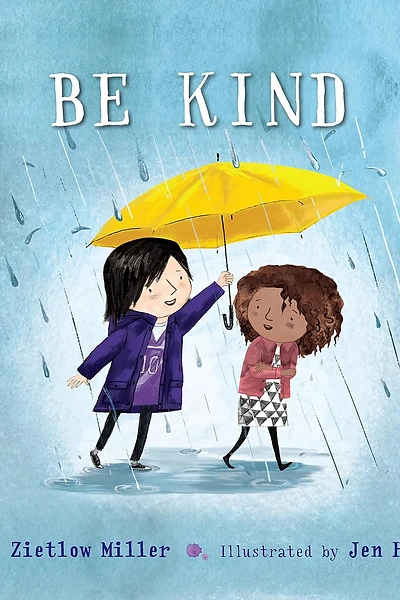
 PreK-3
P MILLER
Be Kind
by Pat Zietlow Miller
Pacing MaterialWhen a classmate's painting is ruined, a child wonders what kindness really means — and discovers that small acts of kindness can ripple outward in big ways.
Big Idea
Kindness is not just a feeling but an action — and even the smallest gesture can make a difference.
Discussion Questions
- 1.What happens when Tanisha spills grape juice on herself?
- 2.What are some ways the narrator tries to be kind?
- 3.Why does the narrator wonder if kindness is enough?
- 4.What is a small act of kindness you can do today?
Classroom Activity
Kindness Ripple
Create a kindness chain. Each student writes one kind act they did or received on a paper strip, then link them together to show how kindness ripples.
Lesson Plan
Learning Goals
- Identify how the narrator responds when a classmate’s painting is ruined and explain why kindness can be difficult to put into action.
- Use examples from Be Kind to distinguish kind feelings from kind actions.
- Describe a kind act they have done or received through writing, drawing, or dictation.
- Explain how small acts of kindness can encourage others to act kindly.
Activity Steps
- 1.Read Be Kind aloud, pausing after the classmate’s painting is ruined. Ask: “How might the classmate feel? What could someone do to help?” Invite students to use details from the pictures and words.
- 2.After reading, revisit the narrator’s examples of kindness. Discuss: “Which actions helped someone feel included, supported, or cared for?” Explain that kindness involves what we do, not only how we feel.
- 3.Introduce the Kindness Ripple chain. Model a specific example on a paper strip, such as “A friend helped me clean up a spill.” Explain that each link will represent a real kind act someone did or received.
- 4.Give each student a paper strip to record one kind act. PreK–K students may draw and dictate a caption; grades 1–3 may write a sentence explaining the act and how it helped.
- 5.Invite students to share their strips, then help them link the strips into one class chain using tape or glue. Ask: “How might receiving kindness inspire someone to be kind to another person?” Connect their answers to the book’s idea that small actions can spread.
- 6.Display the chain with the title “Kindness Ripple.” Close by inviting each student to name one small kind action they could try today. Add new links during the week as students notice kindness.
Standards Connections
- ELA: RL.K.3 / RL.1.3 — Identify characters and major events; describe characters and their responses to events using story details.
- ELA: SL.K.1 / SL.1.1 / SL.2.1 / SL.3.1 — Participate in collaborative conversations about the book and classmates’ kindness examples.
- ELA: W.K.3 / W.1.3 — Use drawing, dictation, or writing to recount a kind act and describe a reaction.
- SEL: Social awareness — Recognize others’ feelings and consider how supportive actions can help.
- SEL: Relationship skills — Practice helping, including others, and expressing appreciation.
Pace-Write-Read Study with Pace-Write It!
Focus question: How does an author slow down a simple moment to help readers feel kindness growing? In Be Kind by Pat Zietlow Miller, a child reflects on what kindness means after Tanisha’s painting is ruined at school. The book uses gentle pacing, short reflective moments, and examples of small actions to show how one kind choice can spread from person to person.
| Element | How to notice or teach it in the novel |
|---|---|
| Pace | Read: Notice how Be Kind moves at a calm, thoughtful pace as the narrator thinks about many small ways to help after Tanisha’s purple paint spills. The slow pacing gives each act of kindness importance. Classroom Activity: Write 3 short sentences about one kind act, stretching the moment across beginning, middle, and end. |
| Plot | Read: The plot begins with Tanisha’s ruined painting and follows the narrator’s thinking as she searches for ways to be kind at school, at home, and in the community. The story grows from one problem into many possible solutions. Classroom Activity: Write a simple plot line with 3 parts: a problem, a kind action, and a hopeful ending. |
| Prosody | Read: Listen to the smooth, gentle sound of the sentences as the narrator wonders, remembers, and imagines kindness. The language invites a soft, caring read-aloud voice. Classroom Activity: Read one page aloud with expression, then write one sentence that sounds gentle and caring. |
| Word pause | Read: Notice where the sentences naturally make you stop after an idea, such as after the narrator names one possible kind action. These pauses help readers think about kindness. Classroom Activity: Write a sentence about kindness and add a slash / where you want the reader to pause. |
| Concept | Read: The big concept in Be Kind is that kindness can be small, hard, powerful, and contagious all at once. The narrator learns that kindness is not just one big act but many daily choices. Classroom Activity: Finish the frame: “Kindness is ______ because ______.” |
| Voice & World View | Read: The narrator’s voice is thoughtful, honest, and curious, showing a child’s world view as she tries to understand fairness, friendship, and helping others. She does not pretend to know everything right away. Classroom Activity: Write 2 sentences in a child’s voice beginning with “I wondered…” and “Maybe kindness is…”. |
| Setting & Place | Read: The story moves through familiar places like the classroom, home, and neighborhood, showing that kindness can happen anywhere. These everyday settings make the message feel real for young readers. Classroom Activity: Choose one place in your day and write about one kind act that could happen there. |
| Point of View | Read: Be Kind is told in first person, so readers stay close to the narrator’s thoughts after Tanisha’s painting is ruined. This point of view makes the questions about kindness feel personal. Classroom Activity: Write 3 first-person sentences about seeing someone need help. |
| Original Characters | Read: Tanisha is remembered through one important moment, while the narrator becomes memorable because of her caring thoughts and careful noticing. The characters feel real because they are ordinary children in an ordinary school day. Classroom Activity: Invent a child character who notices a classmate’s problem and writes one kind idea. |
| Dialogue | Read: The book uses very little dialogue, which keeps the focus on the narrator’s inner thinking instead of long conversations. That choice slows the story and makes it reflective. Classroom Activity: Add one short line of dialogue to a kindness scene, such as “Do you want to sit with me?” |
| Details | Read: Notice the specific detail of Tanisha’s grape juice spilled all over her drawing and the purple paint image that stays in the reader’s mind. Small details make the problem feel vivid and important. Classroom Activity: Write 2 details that show a problem before a kind act happens. |
| Descriptions | Read: The descriptions in Be Kind are simple but meaningful, helping readers picture kindness as smiling, helping, giving, or including. The language stays clear for young readers while still feeling powerful. Classroom Activity: Describe one kind action using sight and feeling words. |
| Strong First Lines | Read: The opening quickly introduces the problem with Tanisha and makes readers care right away. A strong first line sets the emotional direction of the story. Classroom Activity: Write an opening sentence that begins with a small school problem. |
| Immediacy & Engagement | Read: Readers feel pulled in because the story begins with something children recognize—an accident, embarrassment, and the wish to help. The narrator’s direct wondering keeps the book emotionally close. Classroom Activity: Write a sentence that starts with “Right then, I knew…” to create immediacy. |
| Story Scenes & Summaries & Unique Structures | Read: The book blends one clear scene with Tanisha’s painting and many summary-style examples of what kindness could look like. This structure helps the message widen from one moment to a bigger idea. Classroom Activity: Write one scene from lunch or recess, then add two summary sentences naming other kind things you could do. |
| Flashback & Flash Forward & Cliffhangers | Read: The story does not use dramatic flashbacks or cliffhangers, but it does look forward by imagining how kindness can spread and ripple outward. This forward-looking structure creates hope. Classroom Activity: Write one sentence about a kind act now and one sentence about what might happen next because of it. |
| Tension & Suspense & Surprise | Read: The tension is emotional rather than scary: the narrator wants to help Tanisha but is unsure what kindness really means. The surprise comes from realizing that kindness can be many small actions. Classroom Activity: Write about a moment when a character is not sure how to help, then chooses one small act. |
| Page Turns and Chapter Breaks | Read: In this picture book, page turns help each new example of kindness land softly and give readers time to think. There are no chapters, so each spread carries its own pause and meaning. Classroom Activity: Fold a paper into 3 parts and plan what happens before, during, and after a page turn in your kindness story. |
| Performance | Read: This book works well in read-aloud because the reader can use a gentle tone, pauses, and facial expression to highlight empathy for Tanisha and the narrator’s thinking. Performance helps children feel the mood. Classroom Activity: Practice reading one kindness sentence aloud in a warm, calm voice, then write your own read-aloud line. |
| Personality | Read: The narrator’s personality comes through as caring, reflective, and determined to do better after missing the chance to help Tanisha right away. Her honesty makes her believable. Classroom Activity: Write 2 sentences that show a character who wants to be kind but is still learning how. |
| Humor | Read: Be Kind is mostly tender and serious, not laugh-out-loud funny, because it treats feelings with care. Any lightness comes from familiar everyday moments rather than jokes. Classroom Activity: Write a gentle school moment that feels warm and friendly without making fun of anyone. |
| Pause | Read: The book often pauses after one example of kindness so readers can reflect before the next idea appears. These pauses slow the pace and deepen meaning. Classroom Activity: Write 3 short lines about kindness, leaving a line break between each one. |
| Poetry and Poetic Devices | Read: The text has a poetic feeling because it uses images like kindness rippling outward and repeating sentence patterns that sound lyrical. These choices make the message memorable. Classroom Activity: Write a simile or image for kindness, such as “Kindness is like ______.” |
| Repetition | Read: Notice how the book repeats the idea of kindness in many forms, building understanding through example after example. Repetition helps young readers hold onto the theme. Classroom Activity: Write 4 sentences that begin with “Kindness is…” and give a different example each time. |
| Rhythm | Read: The rhythm of the sentences is steady and calm, matching the thoughtful mood of the narrator. Short and medium-length phrases help the book feel soothing. Classroom Activity: Write two short sentences and one longer sentence about a kind act to create rhythm. |
| Punctuation | Read: The punctuation in Be Kind is simple and purposeful, helping the reader hear wondering, listing, and gentle emphasis. The marks support clear meaning without rushing. Classroom Activity: Write one kindness sentence with a comma in a list and one sentence with a question mark. |
| Questions | Read: Questions are central to this book because the narrator keeps asking what kindness really is and what it looks like. These questions invite readers to think along with her. Classroom Activity: Write 2 questions a character might ask after seeing a classmate feel sad. |
| Compare-Contrast | Read: The story compares unkind moments, missed chances, and kind choices to show how behavior affects others. Tanisha’s hurt feeling contrasts with the hope created by caring actions. Classroom Activity: Make a T-chart with “Not kind” and “Kind,” then write one sentence for each side. |
| Objects | Read: Objects matter in this story, especially Tanisha’s painting and the spilled purple liquid, because they carry the problem that begins the narrator’s thinking. Everyday objects help make the lesson concrete. Classroom Activity: Choose one object from school, like a crayon or lunch tray, and write how it could be part of a kindness story. |
| Threes | Read: You can notice how examples of kindness can be grouped in sets of three to help ideas feel complete and memorable. The book’s many examples invite this pattern. Classroom Activity: Write 3 ways a child could be kind before school, during school, and after school. |
| Whitespace & Negative Space | Read: The book’s layout and open space give the words and illustrations room to breathe, which slows readers down and keeps attention on feelings. The quiet space matches the quiet thinking. Classroom Activity: On a page, write one short kindness sentence and leave lots of blank space around it to show calm. |
| Art & Graphics | Read: The illustrations support the pacing by showing emotions, school moments, and the spreading effect of kindness in soft, expressive ways. The art helps readers understand Tanisha’s sadness and the narrator’s hope. Classroom Activity: Draw a simple picture of one kind act and write a caption underneath. |
| Interactives & Gamification | Read: This book invites interaction because readers can spot examples of kindness and connect them to their own lives. Its theme works well with classroom choice and action. Classroom Activity: Create a “Kindness Ripple” chart where students add one written kind act that could inspire another act. |
Pace-Write It!
20-Minute Classroom Flow\nRead (5 min): Read aloud the page where Tanisha’s painting is ruined and 2-3 later pages where the narrator names different kinds of kindness. Ask students to listen for places where the story slows down to help us think.\nNotice (5 min): Discuss: How does the author make one small moment feel important? Notice the first-person voice, the gentle repetition of kindness ideas, and the calm pauses between examples. Chart 3 moves: small problem, thinking voice, many little examples.\nWrite (7 min): Students write a short kindness piece about one small school moment. Writing frame: “When ______ happened, I felt ______. I wondered if kindness meant ______. So I ______. Then ______.” Encourage students to add one small detail and one sentence about what happened next.\nShare (3 min): Partners read their writing in a soft, expressive voice. Listeners tell which sentence slowed down the moment and showed kindness best.\nExit ticket: Write one sentence answering: “How did slowing down your writing help show kindness?”
Pace-Write-Read Connection
Teach this book using the Pace-Write-Read method — Tool 20: Play.
Open the Mastery Manual