 K-3
K-3P GIANFERRARI
Be a Tree!
by Maria Gianferrari
Pacing MaterialAn exploration of trees and the interconnectedness of all living things, from deep roots to sprawling branches full of life.
Big Idea
We are all connected like the roots of a tree — strong together.
Discussion Questions
- 1.What are the parts of a tree? How are we like a tree?
- 2.How do the roots connect to the branches?
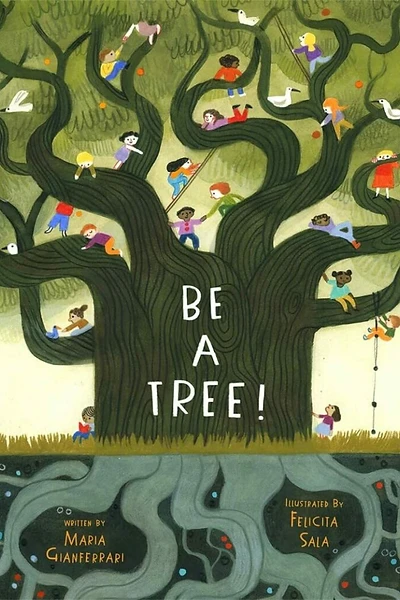
- 3.What did you notice about the children in the tree? How are they different? How are they the same?
- 4.What does it mean to be 'rooted' in your community?
- 5.How can we stand tall like a tree and support each other?
Classroom Activity
Be a Tree Mural
Students create a collaborative classroom tree mural, with each student adding a handprint leaf and writing one way they are connected to their community.
Lesson Plan
Learning Goals
- Understand the structure and function of trees
- Explore the metaphor of interconnectedness
- Develop awareness of community and belonging
- Practice collaboration on a group project
Activity Steps
- 1.Lay out the large butcher paper on the floor or wall.
- 2.Draw a large tree trunk in the center.
- 3.Have each student trace and cut out their handprint on colored paper.
- 4.On their handprint, students write: 'I am connected to ___.'
- 5.Students glue their handprints as leaves on the tree.
- 6.Discuss how the roots connect the tree — just like we are all connected underground.
Standards Connections
- ELA: RL.K-3.7 (Illustrations)
- ELA: W.K-3.3 (Narrative Writing)
- Science: LS1.A (Structure and Function)
- SEL: Social Awareness and Relationship Skills
Pace-Write-Read Study with Pace-Write It!
Focus question: How does an author slow down and speed up a story to help us feel the life of a tree and its connection to a whole community? In Be a Tree! by Maria Gianferrari, readers are invited to look closely at a tree from roots to branches and to notice how many living things depend on it. The pacing moves gently, using poetic language, repetition, and page-by-page discoveries to help readers pause, observe, and feel the interconnection of the natural world.
| Element | How to notice or teach it in the novel |
|---|---|
| Pace | Read: Notice how Be a Tree! moves at a calm, steady pace as the book travels from roots underground to branches overhead, letting readers linger with each part of the tree’s life and community. Classroom Activity: Write 3 short lines that move slowly through one part of nature, such as a root, leaf, or nest, so the reader pauses and notices each detail. |
| Plot | Read: Notice that this book does not follow a problem-and-solution plot; instead, it grows outward like a tree, showing how the tree supports birds, insects, fungi, and people through connected moments. Classroom Activity: Create a simple beginning-middle-end map for a nonfiction-style idea book about one natural object, showing how its role expands across the pages. |
| Prosody | Read: Listen to the musical flow of Maria Gianferrari’s sentences as they rise and fall like branches and roots, making the book sound rich when read aloud. Classroom Activity: Write 4 lines about a tree or plant and read them aloud to revise for smooth, expressive sound. |
| Word pause | Read: Notice how carefully chosen words in Be a Tree! encourage readers to stop and picture roots stretching, trunks standing, and branches sheltering life. Classroom Activity: Write one sentence about a tree and underline 3 words where you want the class to pause while reading. |
| Concept | Read: Notice that the big idea is interconnection—trees are not alone, because their roots, bark, leaves, and branches support a whole community of living things. Classroom Activity: Write a concept statement beginning with “Everything is connected because…” and add 2 examples from nature. |
| Voice & World View | Read: Notice the book’s admiring, inviting voice, which encourages readers to respect trees as strong, generous beings at the center of a living world. Classroom Activity: Write 3 sentences in a voice that sounds full of wonder about one part of nature you want others to appreciate. |
| Setting & Place | Read: Notice how the setting includes both underground and aboveground places, turning the tree into a meeting place for roots, soil, animals, air, and light. Classroom Activity: Draw and label a place map of a tree habitat, then write 2 sentences describing what happens below and above the ground. |
| Point of View | Read: Notice how Be a Tree! speaks in a way that invites readers to imagine the tree’s experience and the life around it, creating closeness between reader and nature. Classroom Activity: Write from the point of view of a tree saying “I help…” and list 3 ways it supports other living things. |
| Original Characters | Read: Notice that the tree acts like the central character, while birds, insects, fungi, and other living things become part of its community rather than side characters in a usual story. Classroom Activity: Invent an original nature character, such as an old oak or a young sapling, and write 3 traits that make it memorable. |
| Dialogue | Read: Notice that the book relies more on description and poetic invitation than on spoken dialogue, which keeps the pacing reflective and focused on observation. Classroom Activity: Add 2 lines of imagined dialogue between a tree and one creature that depends on it, such as a bird or squirrel. |
| Details | Read: Notice the specific details about roots, bark, branches, and the life gathered around the tree, which build the book’s sense of a busy but balanced ecosystem. Classroom Activity: Make a detail list of 5 things you might see on, in, or under a tree, then use 3 of them in a short paragraph. |
| Descriptions | Read: Notice how descriptions in Be a Tree! help readers picture the shape, strength, and reach of the tree while also showing its gentleness as a home and helper. Classroom Activity: Write a 4-sentence description of a tree using at least one word for texture, one for sound, and one for movement. |
| Strong First Lines | Read: Notice how the opening quickly invites readers into the idea of becoming like a tree, immediately creating curiosity and a reflective mood. Classroom Activity: Write 3 possible first lines for a nature book that begin with a strong invitation, such as “Be…,” “Look…,” or “Imagine….” |
| Immediacy & Engagement | Read: Notice how the book makes readers feel present with the tree by using direct, vivid language and by focusing on actions happening in each part of the tree. Classroom Activity: Write 2 sentences that make the reader feel they are standing beside a tree right now using the word “you” or a direct invitation. |
| Story Scenes & Summaries & Unique Structures | Read: Notice that Be a Tree! blends scene-like moments of creatures living in and around the tree with summary ideas about how all life is connected, creating a structure that feels layered like the tree itself. Classroom Activity: Write one scene sentence about a creature in a tree and one summary sentence about why trees matter to many living things. |
| Flashback & Flash Forward & Cliffhangers | Read: Notice that this book does not depend on flashbacks or cliffhangers; instead, its pacing comes from unfolding ideas page by page as the tree’s world expands. Classroom Activity: Write one sentence about a seed in the past and one sentence about the full-grown tree in the future to show time change. |
| Tension & Suspense & Surprise | Read: Notice that the book builds wonder rather than danger, and the surprise comes from how many creatures and systems are connected to one tree. Classroom Activity: Write a sentence that begins “You might think a tree is alone, but actually…” and finish it with a surprising connection. |
| Page Turns and Chapter Breaks | Read: Notice how page turns help reveal new parts of the tree and new members of its community, giving readers small discoveries as they move through the book. Classroom Activity: Plan a 4-page mini-book about one plant or habitat and write what new idea will be revealed on each page turn. |
| Performance | Read: Notice how this book is powerful for oral reading because its poetic lines, repeating ideas, and gentle pace invite expressive gestures and changes in tone. Classroom Activity: Choose 3 lines you could perform with hand motions showing roots, trunk, and branches, then mark where your voice should grow stronger or softer. |
| Personality | Read: Notice how the tree’s personality feels steady, generous, patient, and strong, even though it is described through images and actions rather than conversation. Classroom Activity: Write a character sketch of a tree using the frame “My tree is ___ because it ___.” |
| Humor | Read: Notice that Be a Tree! is more thoughtful and awe-filled than funny, which helps maintain its peaceful pacing and reflective tone. Classroom Activity: Write one playful but respectful sentence about a busy squirrel, hopping bird, or wiggly bug living in a tree. |
| Pause | Read: Notice how the book creates pauses for thinking by focusing on one image or one connected idea at a time, giving readers room to absorb the meaning. Classroom Activity: Write a short paragraph about a tree and add slash marks / where a reader should pause for meaning. |
| Poetry and Poetic Devices | Read: Notice the poetic style of Be a Tree!, including vivid imagery, invitation, and sound play that make the tree feel alive and important. Classroom Activity: Write 3 poetic lines about a tree using personification, such as giving roots, leaves, or branches human-like actions. |
| Repetition | Read: Notice how repeated ideas about growing, reaching, holding, and connecting help unify the book and reinforce the message of community. Classroom Activity: Write a 4-line poem where the same beginning phrase is repeated in each line, such as “A tree can…” or “Under the tree….” |
| Rhythm | Read: Notice the slow, natural rhythm of the language, which feels like breathing, swaying, or growing and helps the pacing feel calm and thoughtful. Classroom Activity: Clap out the rhythm of one sentence you write about nature, then revise it so it sounds smoother when read aloud. |
| Punctuation | Read: Notice how punctuation helps shape the reading pace in Be a Tree!, signaling where to stop, lift the voice, or move gently into the next idea. Classroom Activity: Write 3 short sentences about a tree and revise the punctuation to change the pace—one calm, one excited, and one wondering. |
| Questions | Read: Notice how the book encourages wondering about how trees live and support others, even when the text is making statements rather than asking many direct questions. Classroom Activity: Write 3 questions a child might ask after reading about roots, branches, or animals living in a tree. |
| Compare-Contrast | Read: Notice the contrast between what happens underground in the roots and what happens aboveground in the branches, showing two connected worlds. Classroom Activity: Make a T-chart comparing “Below the tree” and “Above the tree,” then write 2 compare-contrast sentences. |
| Objects | Read: Notice how objects such as roots, bark, leaves, nests, seeds, and soil help carry the meaning of interconnection throughout the book. Classroom Activity: Choose one tree object, like a leaf or acorn, and write 3 sentences explaining how it connects to other living things. |
| Threes | Read: Notice whether ideas in Be a Tree! can be grouped in threes, such as roots-trunk-branches or shelter-food-air, which helps readers remember key concepts. Classroom Activity: Write a set of 3 connected actions a tree does for its community and use them in one sentence. |
| Whitespace & Negative Space | Read: Notice how open space on the page gives the words and art room to breathe, slowing readers down and helping them focus on one image or idea at a time. Classroom Activity: Create a page layout for one sentence about a tree, leaving blank space around the most important words. |
| Art & Graphics | Read: Notice how the illustrations work with the text to show the tree as both an individual living thing and a whole habitat full of relationships. Classroom Activity: Sketch a tree cross-section or full tree scene and label 5 parts or creatures that your writing mentions. |
| Interactives & Gamification | Read: Notice that the book naturally invites interactive thinking because readers can trace the path from roots to trunk to branches and name who depends on the tree. Classroom Activity: Play a “Tree Community Chain” game where each student adds one living thing connected to a tree, then write one sentence about your place in the chain. |
Pace-Write It!
20-Minute Classroom Flow\nRead (5 min): Read Be a Tree! by Maria Gianferrari aloud. Pause to let students notice how the language slows them down to look closely at roots, trunk, branches, and the living things around the tree.\nNotice (5 min): Ask: “Where did the author make us slow down and notice?” and “How does the book show that a tree is part of a community?” Chart student responses under: Words, Repetition, Page Turns, and Tree Connections.\nWrite (7 min): Students write a short nature piece inspired by the book’s pacing. Writing frame: “Be a ____. Reach ____. Hold ____. Help ____.” Encourage students to choose one nature subject such as a tree, flower, river, or rock and write 3-4 lines that show how it connects to other living things. Challenge students to include one repeated phrase and one strong detail.\nShare (3 min): Partners read their pieces aloud slowly. Listeners name one place where the writer used pacing to help them pause and picture the scene.\nExit ticket: Write one sentence answering: “How did Maria Gianferrari help readers feel connected to the tree’s world?”