 K-3
K-3P SWEET
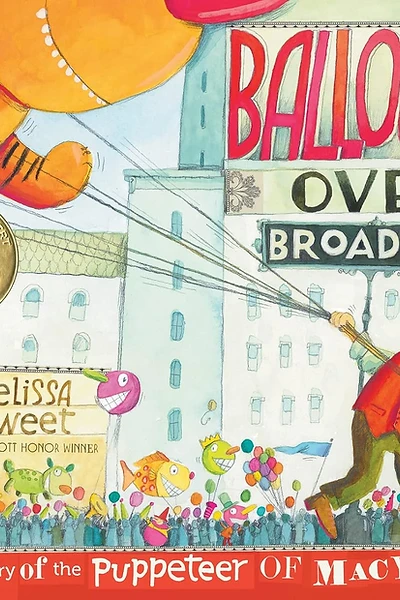
Balloons Over Broadway: The True Story of the Puppeteer of Macy's Parade
by Melissa Sweet
Pacing MaterialThe true story of Tony Sarg, the puppeteer who invented the giant helium balloons that have floated above Macy's Thanksgiving Day Parade since 1927.
Big Idea
A creative inventor's curiosity and problem-solving can turn a simple idea into a beloved cultural tradition.
Discussion Questions
- 1.What problem was Tony Sarg trying to solve when he created the parade balloons?
- 2.How did Sarg's background in puppetry help him invent the balloons?
- 3.What does this story teach us about perseverance and creativity?
- 4.How do the Macy's Parade balloons connect to traditions in your own family?
Classroom Activity
Design a Parade Balloon
Students design their own parade balloon, considering scale, engineering, and character design.
Lesson Plan
Learning Goals
- Understand the engineering process behind the Macy's parade balloons
- Explore the connection between puppetry and invention
- Design and describe a creative balloon concept
- Connect historical innovation to modern traditions
Activity Steps
- 1.Read the story and discuss how Tony Sarg solved problems step by step
- 2.Have students brainstorm a character or object for a parade balloon
- 3.Students sketch their balloon design and explain how it would float
- 4.Share designs with the class and discuss the engineering involved
- 5.Connect to modern parade traditions and watch clips of the Macy's Parade
Standards Connections
- ELA: RL.K.1 — Ask and answer questions about key details
- ELA: RL.K.2 — Retell stories, including key details
- ELA: RL.K.3 — Describe characters, setting, and events
- ELA: RL.3.6 — Acknowledge differences in characters' points of view
- ELA: SL.K.1 — Participate in collaborative conversations about the text
- ELA: W.K.3 — Write narratives recounting events with descriptive details
- SEL: Social Awareness
- SEL: Relationship Skills
- Art: VA:Re7 — Perceive and analyze artistic work
Pace-Write-Read Study with Pace-Write It!
Focus question: How does Melissa Sweet pace Tony Sarg’s true story so readers can feel his curiosity, problem-solving, and the excitement of the Macy’s Parade? In Balloons Over Broadway by Melissa Sweet, the author moves from Tony’s childhood tinkering to the thrilling invention of giant parade balloons, using short moments, lively facts, and page-by-page reveals to keep readers engaged. The pacing speeds up during invention and parade scenes, then slows down to highlight key ideas about creativity, perseverance, and innovation.
| Element | How to notice or teach it in the novel |
|---|---|
| Pace | Read: Notice how Melissa Sweet moves quickly through Tony Sarg’s early interests, then slows down when he experiments with puppets and solves the problem of making parade animals rise into the air. Classroom Activity: Write 3-4 sentences about a time you made or built something, using one fast sentence for the action and one slower sentence to explain your thinking. |
| Plot | Read: Track the true-story sequence from Tony’s childhood fascination with moving objects, to his puppet work, to Macy’s asking for window displays and parade ideas, to the creation of the giant helium balloons. Classroom Activity: Make a four-box timeline and write one sentence in each box showing the main events that led to the first giant balloons. |
| Prosody | Read: Listen to how the words and page layouts create a lively, energetic read-aloud, especially in scenes about puppets swinging, parade animals marching, and balloons floating above Broadway. Classroom Activity: Choose one parade page and rewrite it as 2-3 expressive lines to read aloud with excitement, stretching your voice on important words. |
| Word pause | Read: Notice where a reader naturally pauses to take in a new idea, such as when Tony studies how things move or when the big balloon solution is revealed. Classroom Activity: Write two sentences about Tony Sarg and place a slash (/) where a reader should pause for effect. |
| Concept | Read: Think about the big idea that creativity grows from noticing problems and inventing solutions, shown when Tony turns parade puppets into giant floating balloons. Classroom Activity: Write a sentence starter and finish it: 'Tony Sarg was innovative because he ______.' Then add one detail from the book. |
| Voice & World View | Read: Notice Melissa Sweet’s playful, admiring voice and how the book presents the world as a place full of moving parts, imagination, and possibility, much like Tony saw it. Classroom Activity: Write 2-3 sentences in a curious voice about an everyday object as if you were an inventor like Tony. |
| Setting & Place | Read: Pay attention to the shift from Tony’s early life and workshop-like spaces to bustling New York City, Macy’s store windows, and Broadway during the Thanksgiving Day Parade. Classroom Activity: Write a place description of Broadway on parade day using at least three sensory details. |
| Point of View | Read: Notice that the story is told in third person, helping readers learn about Tony Sarg’s life from the outside while still understanding his ideas and challenges. Classroom Activity: Rewrite one event from the book in first person, beginning with 'I am Tony Sarg, and today I…' |
| Original Characters | Read: Even in a biography, Tony Sarg stands out as an original character because he is playful, inventive, and fascinated by puppets, mechanics, and movement. Classroom Activity: Write a character sketch of Tony using three traits and one example from the book for each trait. |
| Dialogue | Read: Notice how the book relies more on narrative than conversation, but readers can still imagine what Macy’s organizers or parade watchers might have said when they saw the balloons. Classroom Activity: Write a short 4-line dialogue between Tony Sarg and a Macy’s planner about how to make the parade more exciting. |
| Details | Read: Look for specific details about marionettes, moving figures, store windows, and helium balloons that help readers understand Tony’s work step by step. Classroom Activity: Write three factual details from the book that show how Tony’s ideas changed the parade. |
| Descriptions | Read: Notice how the descriptions help readers picture the giant animals floating above the city and the clever systems Tony designed to make things move. Classroom Activity: Write 2-3 descriptive sentences about one balloon animal from the book, using vivid adjectives. |
| Strong First Lines | Read: Study how the beginning quickly introduces Tony Sarg as a child who loved figuring out how things worked, inviting readers into his inventive mind right away. Classroom Activity: Write a strong first line for a biography about a kid inventor, using Tony Sarg as inspiration. |
| Immediacy & Engagement | Read: Notice how Melissa Sweet keeps the story engaging by focusing on action—making, testing, performing, and solving problems—so readers feel close to each step of Tony’s process. Classroom Activity: Write a short action paragraph about Tony preparing for parade day using strong action verbs. |
| Story Scenes & Summaries & Unique Structures | Read: Notice how the book blends scene-like moments, such as parade excitement, with short summaries of Tony’s life and inventions, creating a lively biography structure. Classroom Activity: Write one scene sentence and one summary sentence about the same event from Tony’s life. |
| Flashback & Flash Forward & Cliffhangers | Read: See how the biography moves from Tony’s childhood interests to later success, almost like a flash forward from playful experiments to the famous parade balloons, while page turns build anticipation. Classroom Activity: Write two sentences—one about young Tony and one about future Tony—to show how an early interest led to a big invention. |
| Tension & Suspense & Surprise | Read: Notice the tension in the problem Tony had to solve: how could parade figures be bigger, safer, and more amazing than animals pulled on sticks? The surprise comes when the solution is giant helium balloons. Classroom Activity: Write 3 sentences that build suspense before revealing an invention idea. |
| Page Turns and Chapter Breaks | Read: In this picture book biography, page turns act like mini cliffhangers, especially when readers are waiting to see Tony’s next creation or the first giant balloons. Classroom Activity: Create a two-page book plan: on page 1, write a problem Tony faces; on page 2, write the big reveal after the page turn. |
| Performance | Read: Performance is central to this book because Tony Sarg was a puppeteer, and his inventions were meant to delight crowds in windows and in the Thanksgiving Day Parade. Classroom Activity: Write a 3-sentence announcement a parade host could say to introduce one of Tony’s giant balloons. |
| Personality | Read: Notice Tony’s playful, persistent personality and how his love of tricks, motion, and making things work shapes every part of the story. Classroom Activity: Write about which Tony Sarg trait—curious, playful, or determined—you think mattered most, and give one reason. |
| Humor | Read: Look for the whimsical, playful feeling in the art and storytelling, especially in the funny idea of giant animals floating over crowded New York streets. Classroom Activity: Write a humorous sentence about what a parade balloon might do if it had its own silly personality. |
| Pause | Read: Notice the moments when readers pause to admire Melissa Sweet’s illustrations, diagrams, and collage details before moving on with the story. Classroom Activity: Choose one important moment in Tony’s story and write one short sentence, then leave a blank line after it to show a dramatic pause. |
| Poetry and Poetic Devices | Read: Notice how some language and image pairings feel poetic, using playful sound and image patterns to capture movement, floating, and wonder in Tony Sarg’s creations. Classroom Activity: Write a 3-line poem about a balloon rising over Broadway, using one simile or personification. |
| Repetition | Read: Watch for repeated ideas about movement, making things, and figuring out how things work, which reinforce Tony’s inventor mindset. Classroom Activity: Write three sentences that each begin with 'Tony liked to…' and add a different action from the book. |
| Rhythm | Read: Feel the rhythm created by short phrases, visual spacing, and the repeated motion of puppets marching, strings pulling, and balloons bobbing. Classroom Activity: Write a rhythmic list sentence about the parade, such as 'Up they went, over the street, past the buildings…' |
| Punctuation | Read: Notice how punctuation helps control excitement and information, especially when big reveals or energetic parade scenes appear. Classroom Activity: Write two sentences about the first balloon parade—one with a dash and one with an exclamation point. |
| Questions | Read: Think about the questions Tony must have asked himself: How can things move? How can a puppet become huge? How can people look up in wonder? Classroom Activity: Write three inventor questions Tony Sarg might have asked before creating the balloons. |
| Compare-Contrast | Read: Compare Tony’s earlier puppets and window displays with the later giant helium balloons, noticing what stayed the same—movement and spectacle—and what changed—size and method. Classroom Activity: Write two compare-contrast sentences using 'both' and 'but' about puppets and parade balloons. |
| Objects | Read: Pay attention to meaningful objects in the story, such as marionettes, strings, pulleys, parade figures, and helium balloons, because they carry the action and ideas. Classroom Activity: Choose one object from the book and write 2-3 sentences explaining how it helped Tony innovate. |
| Threes | Read: Notice how ideas can be grouped in threes to make them memorable, such as Tony being curious, creative, and determined. Classroom Activity: Write a sentence about Tony using a list of three traits or three actions. |
| Whitespace & Negative Space | Read: Notice how open space on some pages helps the giant balloons feel tall, airy, and dramatic, giving readers room to imagine them floating over Broadway. Classroom Activity: Write one short sentence about a balloon in the sky and place it in the middle of your page with lots of blank space around it. |
| Art & Graphics | Read: Study how Melissa Sweet’s collage art, labels, diagrams, and mixed-media illustrations add pacing by slowing readers down to examine how Tony’s ideas worked. Classroom Activity: Draw and label your own parade balloon design, then write one sentence explaining how it moves. |
| Interactives & Gamification | Read: As you read, turn the story into an invention challenge by noticing each problem Tony Sarg faced and the solution he created, from puppets to parade balloons. Classroom Activity: Make a 'Tony Sarg Inventor Card' with three boxes: Problem, Idea, Solution. Fill it in for one event from the book. |
Pace-Write It!
20-Minute Classroom Flow\nRead (5 min): Read aloud the pages that show Tony Sarg’s love of figuring out how things move and the pages where he develops the giant Macy’s Parade balloons. Ask students to listen for places where the story speeds up and slows down.\nNotice (5 min): Discuss: Where did Melissa Sweet give us a quick summary? Where did she slow down for an exciting scene? How do the illustrations, labels, and page turns help build excitement about Tony’s inventions? Chart student ideas under: Fast Part, Slow Part, Big Reveal.\nWrite (7 min): Students write a short inventor moment inspired by Tony Sarg. Writing frame: 'First, ______ noticed a problem. Next, ______ tried ______. Then, ______ had an idea. At last, ______.' Encourage students to use one action word, one feeling word, and one detail about movement.\nShare (3 min): Partners read their writing aloud and point to the sentence where they slowed down the most important moment. Invite 1-2 volunteers to share with the class.\nExit ticket: Write one sentence answering: 'How did Melissa Sweet make Tony Sarg’s invention feel exciting in Balloons Over Broadway?'