
 3-7
3-7GN GALLIGAN
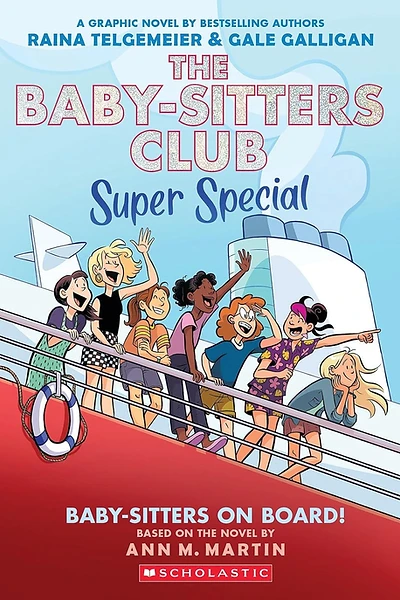
The Baby-Sitters Club: Super Special: Baby-Sitters on Board!
by Raina Telgemeier & Gale Galligan
Pacing MaterialThe Baby-Sitters Club embarks on a cruise and a week at Disney World, with each club member narrating her own adventures, mishaps, and discoveries along the way.
Big Idea
Friendship can weather any adventure — even when everyone's going in different directions on the same trip.
Discussion Questions
- 1.How does each babysitter's personality affect the way she experiences the trip?
- 2.What challenges arise when friends travel together?
- 3.How do the babysitters balance responsibility with fun?
- 4.What would you pack for a cruise with your friends?
Classroom Activity
Travel Journal Story
Students write a travel journal entry from the perspective of a character on a group trip, using voice and personality to bring it to life.
Lesson Plan
Learning Goals
- Analyze how different characters' perspectives shape a story
- Understand the structure of a multi-narrator novel
- Develop authentic character voice in personal writing
- Explore themes of friendship and responsibility
Activity Steps
- 1.Discuss how the book uses multiple narrators to tell one story
- 2.Have students choose a character and write a journal entry about a trip
- 3.Students share entries and discuss how voice changes the story
- 4.Compare journal entries to see how the same event reads differently
- 5.Reflect on how friendships grow through shared experiences
Standards Connections
- ELA: RL.3.1 — Ask and answer questions about key details
- ELA: RL.3.2 — Retell stories, including key details
- ELA: RL.3.3 — Describe characters, setting, and events
- ELA: RL.7.6 — Acknowledge differences in characters' points of view
- ELA: SL.3.1 — Participate in collaborative conversations about the text
- ELA: W.3.3 — Write narratives recounting events with descriptive details
- SEL: Relationship Skills
- SEL: Social Awareness
- Art: VA:Re7 — Perceive and analyze artistic work
Pace-Write-Read Study with Pace-Write It!
Focus question: How do authors and artists control the speed of a story so readers feel every exciting, funny, and meaningful moment? In The Baby-Sitters Club: Super Special: Baby-Sitters on Board! by Raina Telgemeier & Gale Galligan, the Baby-Sitters Club members take a cruise and visit Disney World, with different girls narrating their own adventures. The graphic novel uses pacing through changing narrators, lively dialogue, page turns, panels, and quick shifts between hectic group scenes and quieter moments of friendship and kindness.
| Element | How to notice or teach it in the novel |
|---|---|
| Pace | Read: Notice how the story speeds up during travel problems, crowded group moments, and Disney excitement, then slows down for conversations, worries, and acts of friendship between Kristy, Mary Anne, Claudia, Stacey, Dawn, Mallory, and Jessi. Classroom Activity: Write one fast-paced vacation scene and one slower reflective scene about the same character, using sentence length to control speed. |
| Plot | Read: Track how the trip moves from preparing for the cruise to adventures on the ship and then to Disney World, with each babysitter facing small conflicts and discoveries along the way. Classroom Activity: Make a 5-part plot map for one club member’s trip storyline, then write a new mini-episode that could fit between two existing events. |
| Prosody | Read: Listen to how the dialogue sounds different for each narrator and how excitement, embarrassment, and kindness come through in the wording. Classroom Activity: Choose one scene and rewrite the dialogue for a read-aloud, marking where your voice should speed up, soften, or pause. |
| Word pause | Read: Notice where short words, ellipses, dashes, or one-word reactions make you stop during awkward, funny, or surprising moments on the trip. Classroom Activity: Write a comic-style exchange between two friends on vacation that uses at least three intentional word pauses to show emotion. |
| Concept | Read: Think about the big idea that friendship and kindness help people handle mishaps, jealousy, homesickness, and unexpected travel problems. Classroom Activity: Write a paragraph explaining how one problem on the trip becomes easier because of friendship, then add a short scene showing it. |
| Voice & World View | Read: Notice how each babysitter’s narration reflects her personality, opinions, and way of seeing the cruise and Disney World. Classroom Activity: Write about the same vacation event twice from two different club members’ voices, making their world views clearly different. |
| Setting & Place | Read: Pay attention to how the cruise ship and Disney World are shown as exciting, busy, and sometimes overwhelming places that shape what happens. Classroom Activity: Write a setting paragraph about a ship deck, hotel room, or theme park line that affects your character’s mood and choices. |
| Point of View | Read: Notice how the book shifts among the Baby-Sitters Club members so readers experience the trip through multiple perspectives. Classroom Activity: Rewrite one group scene from the point of view of a different babysitter and show what that new narrator notices most. |
| Original Characters | Read: Study how Kristy, Mary Anne, Claudia, Stacey, Dawn, Mallory, and Jessi each feel recognizable because of their habits, reactions, and friendships during the trip. Classroom Activity: Invent an original travel companion for the club and write a short introduction scene that shows the character’s traits through actions. |
| Dialogue | Read: Notice how conversations reveal friendship, teasing, stress, and support while moving scenes along quickly. Classroom Activity: Write a dialogue-only scene in which two friends disagree about what to do on vacation but end by showing kindness. |
| Details | Read: Look for small details about the ship, food, crowds, rides, clothing, and facial expressions that make the vacation feel real. Classroom Activity: Write a 6-sentence scene using at least five precise details from a trip or outing to make the moment vivid. |
| Descriptions | Read: Notice how visual and written descriptions work together to show exciting attractions, cramped spaces, or quiet emotional moments. Classroom Activity: Describe one location from the book in a way that matches a feeling such as wonder, nervousness, or disappointment. |
| Strong First Lines | Read: Pay attention to how new sections or narrator shifts quickly pull readers into a fresh part of the adventure. Classroom Activity: Write three possible opening lines for a babysitter’s vacation diary entry: one funny, one dramatic, and one thoughtful. |
| Immediacy & Engagement | Read: Notice how the graphic novel makes readers feel close to the action through expressive panels, direct narration, and scenes that begin in the middle of events. Classroom Activity: Write the start of a scene that drops the reader right into a problem on a family trip without long explanation first. |
| Story Scenes & Summaries & Unique Structures | Read: Observe how some moments are shown fully as scenes while others are quickly summarized, and how the multiple-narrator graphic novel structure keeps the trip moving. Classroom Activity: Write one detailed scene from a vacation and one short summary of the rest of the day, then explain why each needed a different amount of space. |
| Flashback & Flash Forward & Cliffhangers | Read: Notice any times a narrator refers back to earlier experiences or ends a section at a moment that makes you want to keep reading. Classroom Activity: End a diary-style page with a cliffhanger about a vacation problem, then write a brief flashback explaining why it matters to the character. |
| Tension & Suspense & Surprise | Read: Look for moments when plans go wrong, feelings get hurt, or readers wonder how the club members will handle a challenge during the cruise or at Disney World. Classroom Activity: Write a suspenseful scene in which a character gets separated from a group for a moment, then show how kindness helps solve the problem. |
| Page Turns and Chapter Breaks | Read: Notice how the end of a page or section often lands on a joke, surprise, or new problem, making you turn the page. Classroom Activity: Create a two-part scene outline that ends page one with a strong page-turn moment. |
| Performance | Read: Think about how facial expressions, posture, and dramatic reactions in the panels help characters perform emotions like excitement, embarrassment, and frustration. Classroom Activity: Write stage directions for a short readers’ theater version of a vacation mishap scene from the book. |
| Personality | Read: Notice how each babysitter’s personality affects pacing—for example, a bold or dramatic reaction can speed a scene up, while a shy or thoughtful moment can slow it down. Classroom Activity: Write a scene in which a character’s personality changes how a group solves a problem on a trip. |
| Humor | Read: Look for funny misunderstandings, exaggerated reactions, and awkward travel moments that lighten the story even when things go wrong. Classroom Activity: Write a humorous vacation scene that includes one mistake, one overreaction, and one kind ending. |
| Pause | Read: Notice the quieter beats between busy activities when a character reflects, worries, or connects with a friend. Classroom Activity: Add a pause moment to a fast scene by writing 3-4 lines of internal thinking before the action starts again. |
| Poetry and Poetic Devices | Read: Notice how sound words, strong images, and repeated phrases in the narration can create a poetic feel even in a realistic graphic novel. Classroom Activity: Write a short free-verse poem from Mallory’s or Jessi’s point of view about seeing something amazing on the trip. |
| Repetition | Read: Look for repeated worries, running jokes, friendship patterns, or visual callbacks that help connect different narrators’ experiences. Classroom Activity: Write a scene that repeats one phrase three times, with the meaning changing each time as the character’s feelings change. |
| Rhythm | Read: Notice how the pattern of short panels, quick dialogue, and longer reflective moments creates rhythm across the trip. Classroom Activity: Write eight sentences about a busy day at an amusement park, mixing short and long sentences to create a clear rhythm. |
| Punctuation | Read: Pay attention to exclamation points, question marks, ellipses, and dashes that help show excitement, confusion, or interruption in the girls’ conversations. Classroom Activity: Rewrite a plain dialogue exchange using punctuation to show strong emotion and shifting pace. |
| Questions | Read: Notice how characters ask questions when they are worried, curious, or trying to solve problems, and how those questions keep scenes moving. Classroom Activity: Write a scene built around at least four questions a character asks during a confusing moment on a trip. |
| Compare-Contrast | Read: Compare how different babysitters react to the same vacation experiences and contrast the fast energy of Disney World with quieter ship or room scenes. Classroom Activity: Write a compare-contrast paragraph about how two club members experience the same event differently, then add a short dialogue exchange between them. |
| Objects | Read: Notice how tickets, suitcases, souvenirs, maps, snacks, or cabin items can trigger action, memory, or conflict. Classroom Activity: Choose one travel object and write a scene in which it becomes important to a friendship problem or solution. |
| Threes | Read: Look for places where actions, details, or reactions come in groups of three to build humor, emphasis, or momentum. Classroom Activity: Write a paragraph about a vacation mishap using a pattern of three details, three actions, or three reactions. |
| Whitespace & Negative Space | Read: Notice how open space in panels or between scenes can create a pause, show distance, or highlight an emotional beat in the graphic novel. Classroom Activity: Plan a comic page with one silent panel that uses empty space to show loneliness, calm, or wonder. |
| Art & Graphics | Read: Study how the illustrations, panel sizes, expressions, and background details help pace the story and show friendship and kindness without extra words. Classroom Activity: Sketch a 4-panel comic of a vacation problem being solved by friends, making one panel large to slow the moment down. |
| Interactives & Gamification | Read: Think about how readers can track different narrators, recurring problems, and favorite scenes almost like collecting story clues across the trip. Classroom Activity: Create a reading challenge chart where students follow one babysitter’s journey, noting one problem, one act of kindness, and one page-turn moment for that character. |
Pace-Write It!
20-Minute Classroom Flow\nRead (5 min): Read a short section from The Baby-Sitters Club: Super Special: Baby-Sitters on Board! that shows a busy travel or theme-park moment followed by a quieter friendship moment. Ask students to notice how Raina Telgemeier & Gale Galligan use panels, dialogue, and narrator voice to speed up or slow down the action.\nNotice (5 min): Discuss: Where does the pacing feel fast? Where does it slow down? Which character’s point of view shapes that feeling? Have students point to one page turn, one visual detail, and one line of dialogue that affects pacing.\nWrite (7 min): Students write their own graphic-novel-style vacation scene about friendship and kindness. Writing frame: 'At first, ______ was excited about ______. Then everything sped up when ______. “______!” said ______. For a moment, time seemed to slow as ______ noticed ______. In the end, ______ showed kindness by ______, and the day changed because ______.' Encourage students to include one fast part, one pause, and one strong final panel idea.\nShare (3 min): Partners read their scenes aloud and explain one craft move they used to control pacing. Invite 1-2 volunteers to share how they used a pause or page-turn moment.\nExit ticket: Write one sentence answering: How did the authors use pacing to help show friendship and kindness in this book, and what is one pacing move you used in your own writing?