 3-7
3-7GN KIBUISHI
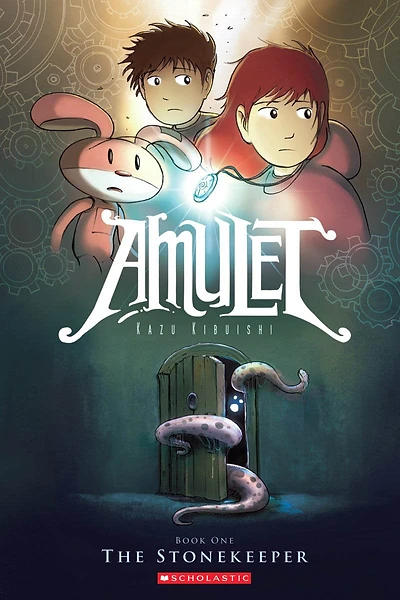
Amulet: The Stonekeeper
by Kazu Kibuishi
Pacing MaterialAfter their father's death, Emily and Navin discover a magical amulet that pulls them into a dangerous underground world.
Big Idea
Courage means choosing to protect others even when you're afraid — and power comes with the responsibility to use it wisely.
Discussion Questions
- 1.How does Emily feel about the amulet's power?
- 2.What risks come with the amulet?
- 3.How do Emily and Navin work together?
- 4.What would you do with a powerful amulet?
- 5.How do the panels build suspense?
Classroom Activity
Amulet Design
Design your own magical amulet. Draw it, name its power, and write one rule for using it responsibly.
Lesson Plan
Learning Goals
- Explain how Emily shows courage while trying to protect her family, using details from words and illustrations.
- Describe how the amulet creates both opportunities and dangers for Emily.
- Design an original magical amulet with a power that could help someone in the story’s underground world.
- Write a clear rule for using the amulet responsibly and explain whom the rule protects.
Activity Steps
- 1.Discuss Emily’s response when her mother is taken into the underground world. Ask: How does Emily act to protect her family even when she is afraid? Invite students to support their answers with a panel or story detail.
- 2.Examine a teacher-selected page featuring Emily and the amulet. Identify how facial expressions, color, and panel arrangement communicate the amulet’s power or the danger Emily faces.
- 3.Brainstorm powers that could help Emily and Navin protect others. For each idea, discuss one possible risk or unintended consequence.
- 4.Draw an original amulet and give it a name. Label its magical power and add visual details that suggest what it does.
- 5.Write one specific rule for using the amulet responsibly. Add a short explanation of how the rule prevents harm and a scenario in which using the power would require courage. Younger students may use sentence frames; older students should develop a short paragraph.
- 6.Share designs with a partner. Partners identify who benefits from the power and suggest whether the responsibility rule adequately protects others. Revise the rule if needed.
Standards Connections
- ELA: CCSS RL.3.3–RL.5.3; RL.6.3–RL.7.3 — Analyze characters, their responses to challenges, and interactions with story events, at the appropriate grade level.
- ELA: CCSS RL.3.7 — Explain how illustrations contribute to a story’s meaning, including mood and characterization.
- ELA: CCSS W.3.2–W.7.2 — Write explanatory text describing an original amulet’s power and responsible-use rule.
- ELA: CCSS SL.3.1–SL.7.1 — Participate in collaborative discussions and build on others’ ideas.
- SEL: Responsible decision-making — Consider consequences, prevent harm, and explain choices that protect others.
Pace-Write-Read Study with Pace-Write It!
Focus question: How does Kazu Kibuishi control the speed of a story so readers feel both wonder and danger at the same time? In Amulet: The Stonekeeper by Kazu Kibuishi, Emily and Navin move from ordinary family grief into a fast, strange underground world filled with robots, monsters, and mystery. The graphic novel uses pacing through panel size, page turns, dialogue, action scenes, and quiet pauses so readers can feel suspense, urgency, and emotional weight.
| Element | How to notice or teach it in the novel |
|---|---|
| Pace | Read: Notice how Amulet: The Stonekeeper shifts between quick danger scenes and slower emotional moments, such as family conversations before the action speeds up underground. Classroom Activity: Write two short scenes about a character entering a new world—one slow and careful, one fast and urgent—and underline the words that change the pace. |
| Plot | Read: Track how the plot moves from Emily and Navin's ordinary life after their father's death to the discovery of the house, the amulet, and the rescue mission for their mother. Classroom Activity: Create a 5-step plot ladder for a portal adventure, making each step raise the stakes the way Kibuishi does. |
| Prosody | Read: Listen to how dialogue and narration would sound aloud, especially in tense moments when Emily must make quick choices and in quieter scenes with Navin or their mother. Classroom Activity: Choose one scene and rewrite the dialogue to make it sound calmer first, then more dramatic, using line breaks and word choice to change the rhythm. |
| Word pause | Read: Notice where single words, short speech bubbles, or reaction beats slow the reader down, especially when Emily first senses the amulet's power. Classroom Activity: Write a 6-line moment of discovery using one- or two-word lines to create pauses. |
| Concept | Read: Focus on the big idea of a portal to another world and how grief, courage, and responsibility are woven into the fantasy adventure. Classroom Activity: Write a story idea statement for your own portal tale: 'When ___ enters ___, they must ___ before ___.' |
| Voice & World View | Read: Notice how the story's voice balances fear, hope, and wonder, showing a world where children must act bravely in situations adults cannot control. Classroom Activity: Write a paragraph in the voice of a young hero who sees a frightening place but refuses to give up. |
| Setting & Place | Read: Study how the old house, the basement doorway, and the underground world each feel different, with place shaping the story's speed and mood. Classroom Activity: Describe a doorway to another world and then the world beyond it, using details that make the second place feel dangerous and magical. |
| Point of View | Read: Notice how readers mostly experience events through Emily and Navin, which keeps the danger immediate and personal. Classroom Activity: Rewrite one rescue moment from Navin's point of view, focusing on what he notices that Emily might miss. |
| Original Characters | Read: Look at how Emily, Navin, Miskit, Silas, and the Elf King each bring different energy to the story, from courage to humor to menace. Classroom Activity: Invent an original guide character for a portal world and list three traits, one secret, and one way the character changes the pace of scenes. |
| Dialogue | Read: Notice how dialogue reveals character fast—Emily sounds determined, Navin often adds humor or honesty, and villains create threat with few words. Classroom Activity: Write 8 lines of dialogue between two siblings in danger, making each voice sound different without using dialogue tags every line. |
| Details | Read: Pay attention to small details, like mechanical creatures, shadows, glowing objects, and facial reactions, that build tension in the underground world. Classroom Activity: Write a paragraph about a strange room using at least five precise details that hint something is wrong. |
| Descriptions | Read: Study how Kibuishi's visual descriptions and sparse text work together so readers quickly understand the mood, danger, and setting. Classroom Activity: Describe a monster chase in 4-5 sentences, choosing strong nouns and verbs instead of many extra words. |
| Strong First Lines | Read: Think about how the opening quickly creates emotion and danger, helping readers trust the story and keep turning pages. Classroom Activity: Write three possible first lines for a graphic-novel-style adventure, one sad, one mysterious, and one action-filled. |
| Immediacy & Engagement | Read: Notice how readers feel pulled into events right away when Emily must react, decide, and protect others with little time to think. Classroom Activity: Write a present-tense action paragraph that begins with a problem on the first sentence. |
| Story Scenes & Summaries & Unique Structures | Read: Notice how some parts unfold moment by moment in panels while other parts move quickly through time to get readers to the next important event. Classroom Activity: Write one scene in full detail and then one 3-sentence summary that jumps your character ahead to the next challenge. |
| Flashback & Flash Forward & Cliffhangers | Read: Notice how the family's loss shapes the story and how dangerous stopping points make readers want to continue after each big reveal or threat. Classroom Activity: End a short scene with a cliffhanger sentence that makes the reader ask what will happen next. |
| Tension & Suspense & Surprise | Read: Watch how suspense builds when Emily and Navin do not fully understand the amulet, the creatures, or who can be trusted underground. Classroom Activity: Write a suspense paragraph in which a character hears something before seeing it, then add one surprise in the last line. |
| Page Turns and Chapter Breaks | Read: In this graphic novel, page turns often hide reveals—new creatures, attacks, or discoveries—so readers feel a burst of surprise. Classroom Activity: Plan a 4-panel page and write what secret or shock should be saved for the page turn. |
| Performance | Read: Notice how character poses, expressions, and dramatic visual moments make scenes feel like a performance on a stage, especially during confrontations. Classroom Activity: Write stage directions for a confrontation between a child hero and a monster, then add 4 lines of dialogue. |
| Personality | Read: Study how Emily's bravery, Navin's wit, and Miskit's loyal oddness shape the mood and pacing of scenes. Classroom Activity: Write a character sketch of a hero with one strength, one fear, and one habit that appears during stressful moments. |
| Humor | Read: Notice how humor, often through Navin or surprising creature moments, gives readers a breath between frightening events. Classroom Activity: Add one funny line or reaction to a tense scene so the scene still feels dangerous but not overwhelming. |
| Pause | Read: Notice the quiet beats when characters look, listen, or think before acting; these pauses make the next action feel bigger. Classroom Activity: Write a 5-sentence scene in which the third sentence is a pause before the main action begins. |
| Poetry and Poetic Devices | Read: Even in an action-heavy graphic novel, images and language can feel poetic through contrast, repetition, and vivid imagery in scenes of glowing darkness and strange machines. Classroom Activity: Write 4 lines describing a magical object using simile, metaphor, or personification. |
| Repetition | Read: Notice how repeated dangers, warnings, and visual patterns remind readers that Emily's choices carry growing power and risk. Classroom Activity: Write a paragraph that repeats one key phrase three times to build fear or determination. |
| Rhythm | Read: Watch the rhythm created by alternating speech, movement, silence, and reaction shots as Emily and Navin travel deeper underground. Classroom Activity: Write a sequence of 6 short sentences and 2 long sentences to imitate a fast-slow-fast rhythm. |
| Punctuation | Read: Notice how question marks, dashes, ellipses, and exclamation points shape the speed and emotion of dialogue in dangerous scenes. Classroom Activity: Rewrite the same line of dialogue three ways using different punctuation to change the feeling. |
| Questions | Read: Readers keep asking: What is the amulet? Who can Emily trust? What kind of world is this? These unanswered questions drive pacing. Classroom Activity: Write five story questions your opening scene should make readers ask. |
| Compare-Contrast | Read: Compare the ordinary family world aboveground with the mechanical, threatening underground world, and compare Emily's caution with Navin's responses. Classroom Activity: Write a compare-contrast paragraph about two worlds or two siblings facing the same danger differently. |
| Objects | Read: The amulet is not just an object; it drives the story, changes Emily, and increases suspense every time it appears. Classroom Activity: Invent a story object with power and cost, then write 5 sentences showing how it helps and harms its owner. |
| Threes | Read: Look for patterns of three in challenges, details, or traits that help readers remember key ideas in a fast-moving story. Classroom Activity: Write a sentence that introduces a setting with three details and a sentence that introduces a hero with three traits. |
| Whitespace & Negative Space | Read: In a graphic novel, open space, dark space, and uncrowded panels can slow readers down and spotlight fear, isolation, or mystery around Emily. Classroom Activity: Plan a comic panel or paragraph where empty space matters, then explain in one sentence what the emptiness makes the reader feel. |
| Art & Graphics | Read: Study how Kibuishi's art carries pacing through panel size, facial expressions, action lines, color shifts, and the reveal of creatures and machines. Classroom Activity: Sketch or describe a 3-panel sequence showing a character finding a portal, stepping in, and reacting to the new world. |
| Interactives & Gamification | Read: The quest structure of Amulet: The Stonekeeper feels game-like because characters face levels of danger, helpers, enemies, and urgent goals. Classroom Activity: Design a simple 'quest card' for Emily, Navin, or your own hero with a mission, obstacle, tool, and reward. |
Pace-Write It!
20-Minute Classroom Flow\nRead (5 min): Read a short excerpt from the part where Emily and Navin move from the strange house into the underground world and face rising danger. Ask students to track where the story speeds up and where it slows down.\nNotice (5 min): Students turn and talk: How do the panels, dialogue, and page turns build suspense? Chart 3 craft moves students notice, such as short dialogue, sudden reveals, or quiet reaction panels.\nWrite (7 min): Students write their own portal moment using this frame: 'At first, ___ seemed ordinary. Then I noticed ___. When I touched/entered ___, everything changed. I wanted to ___, but ___ . Just as I took another step, ___.' Encourage students to include one pause, one sensory detail, and one cliffhanger ending.\nShare (3 min): Partners read their scenes aloud and identify where the pacing feels slow, fast, or suspenseful. Invite 1-2 volunteers to share a strongest cliffhanger line.\nExit ticket: Write one sentence answering: 'What is one way Kazu Kibuishi controls pacing in Amulet: The Stonekeeper, and how did you try that move in your own writing?'
Pace-Write-Read Connection
Teach this book using the Pace-Write-Read method — Tool 16: Tension / Suspense / Surprise.
Open the Mastery Manual