
 3-7
3-7GN KIBUISHI
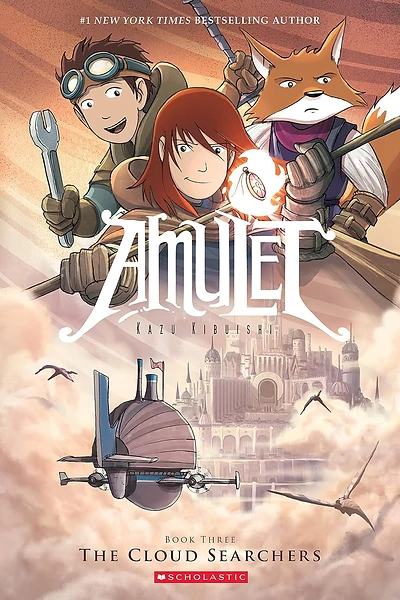
Amulet: The Cloud Searchers
by Kazu Kibuishi
Pacing MaterialEmily, Navin, and their friends journey to the lost city of Cielis, searching for answers among the Cloud Searchers — but the path is full of danger, deception, and tests of trust.
Big Idea
The search for truth requires courage, trust in your companions, and the willingness to keep going even when the path is unclear.
Discussion Questions
- 1.What are the Cloud Searchers searching for?
- 2.What dangers do Emily and Navin face on their journey?
- 3.How does the team learn who to trust?
- 4.What's a journey you've been on where you didn't know what to expect?
Classroom Activity
Map the Journey
Draw a map of a fictional journey. Include at least three stops, one danger, and one discovery. Write a sentence about what your character learns along the way.
Lesson Plan
Learning Goals
- Explain how Emily, Navin, and their companions show courage and make decisions about trust during their search for Cielis.
- Use details from dialogue and illustrations to explain how a setting or obstacle affects the characters’ journey.
- Create a fictional journey map with at least three stops, one danger, and one discovery inspired by the book’s adventure.
- Write a sentence explaining how a character learns to seek truth, trust others, or persevere when the path is unclear.
Activity Steps
- 1.Introduce “Map the Journey.” Discuss why Emily, Navin, and their friends seek Cielis. Ask: “How do they decide whom to trust when they do not know what lies ahead?”
- 2.Examine a selected sequence from the book together. Identify how panel order, dialogue, and illustrations reveal a danger, a decision, or an uncertain route. Have students point to evidence.
- 3.Plan an original adventure inspired by the search for Cielis. Choose a main character, a companion, and a destination where they hope to find answers. List at least three stops, one danger, and one discovery.
- 4.Draw the journey map using arrows or a dotted path to connect the stops. Label each location and add a map key. Include an obstacle that requires courage and a moment when the character must decide whether to trust a companion.
- 5.Write a sentence beginning, “Along the way, my character learns…” Connect the lesson to a specific event on the map. Younger students may dictate or use the sentence starter; older students may add a short explanation comparing their character’s choice with Emily’s or Navin’s.
- 6.Share maps with a partner. Partners identify the danger, discovery, and trust decision, then discuss how the journey illustrates the book’s big idea.
Standards Connections
- ELA: CCSS RL.3.3–RL.7.3 — Analyze characters, settings, and events, with grade-appropriate emphasis on how decisions and obstacles shape the journey.
- ELA: CCSS RL.3.7 — Explain how illustrations contribute to a story’s meaning, including mood, characters, and setting.
- ELA: CCSS W.3.3–W.7.3 — Develop an imagined narrative with sequenced events, descriptive details, and a meaningful conclusion.
- ELA: CCSS SL.3.1–SL.7.1 — Participate in collaborative discussions, build on others’ ideas, and support interpretations with textual evidence.
- SEL: Relationship skills and responsible decision-making — Consider how companions build trust and make choices under uncertain conditions.
Pace-Write-Read Study with Pace-Write It!
Focus question: How does Kazu Kibuishi speed up and slow down the story to show courage, danger, and hard choices? In Amulet: The Cloud Searchers by Kazu Kibuishi, Emily, Navin, and their companions travel toward Cielis through a world filled with giant creatures, hidden motives, and risky decisions. The graphic novel uses pacing through action-packed panels, tense pauses, visual page turns, and quieter moments of trust and reflection to help readers feel resilience and courage.
| Element | How to notice or teach it in the novel |
|---|---|
| Pace | Read: Notice how the story quickly moves through danger during escapes and battles, then slows down when Emily must think carefully about her powers and choices. Classroom Activity: Write two short scenes about a character on a dangerous journey—one fast-paced action moment and one slowed-down thinking moment. |
| Plot | Read: Track how Emily, Navin, Miskit, Leon, and the others move closer to Cielis while new threats and secrets complicate their mission. Classroom Activity: Make a 5-step plot ladder for an adventure story with a goal, obstacles, a betrayal or surprise, and a brave choice. |
| Prosody | Read: Listen to how the dialogue and narration would sound aloud during urgent scenes with the elf prince Trellis, dangerous attacks, or quiet conversations about trust. Classroom Activity: Choose one tense moment and rewrite the dialogue for read-aloud performance, marking where your voice should speed up, slow down, or grow quiet. |
| Word pause | Read: Notice where single words, short speech bubbles, or reaction beats make readers stop, especially when Emily faces fear or uncertainty. Classroom Activity: Write a comic-style exchange in which a character hears surprising news and include 3 one-word pauses to build tension. |
| Concept | Read: Think about how the big idea of resilience and courage develops as the characters keep moving toward Cielis despite danger, loss, and doubt. Classroom Activity: Write a paragraph explaining how an adventure can show courage not just in fighting, but in trusting, leading, or continuing after fear. |
| Voice & World View | Read: Notice how the story presents a world where danger, mystery, and responsibility are everywhere, especially through Emily's role as a Stonekeeper. Classroom Activity: Write 6-8 sentences in the voice of a young hero who understands that bravery means making difficult choices in a complicated world. |
| Setting & Place | Read: Study how the skies, creatures, machines, and the lost city of Cielis create a setting that feels both wondrous and threatening. Classroom Activity: Describe a fantasy place in 5-7 sentences, showing one beautiful detail and one dangerous detail that affect the pace of the scene. |
| Point of View | Read: Notice how the story often follows Emily and Navin, helping readers experience danger and uncertainty alongside them. Classroom Activity: Rewrite one adventure moment from two points of view—first from a brave leader, then from a worried companion. |
| Original Characters | Read: Pay attention to how characters like Emily, Navin, Trellis, Miskit, and Leon each bring different strengths, fears, and motives to the journey. Classroom Activity: Invent an original adventure companion and write a character card with name, role, fear, strength, and one secret. |
| Dialogue | Read: Notice how dialogue reveals trust, doubt, urgency, and teamwork, especially in conversations between Emily and Trellis or Emily and Navin. Classroom Activity: Write 8-10 lines of dialogue between two allies who must decide whether to trust a risky guide. |
| Details | Read: Look closely at the small visual and story details—faces, machines, creatures, and gestures—that help readers understand danger without long explanation. Classroom Activity: Write a short action scene using at least 5 precise details instead of general words like nice, bad, or scary. |
| Descriptions | Read: Notice how Kibuishi balances short text with strong visual description so readers can quickly picture the world and feel its mood. Classroom Activity: Describe a chase through a fantasy setting in 6 sentences, using vivid verbs and sensory details. |
| Strong First Lines | Read: Think about how an opening to an adventure must quickly create mystery, danger, or a mission, just as this book continues a high-stakes journey. Classroom Activity: Write 3 different opening lines for a graphic novel chapter about a hero entering a dangerous city in the clouds. |
| Immediacy & Engagement | Read: Notice how readers feel pulled into events right away through urgent conflict, visual action, and Emily's difficult decisions. Classroom Activity: Write a first paragraph that drops readers into the middle of a problem with no long backstory. |
| Story Scenes & Summaries & Unique Structures | Read: Notice how some parts are shown as full dramatic scenes while other parts move quickly through travel or transition, keeping the adventure from slowing too much. Classroom Activity: Write one detailed scene of a confrontation and one 3-sentence summary of travel between locations. |
| Flashback & Flash Forward & Cliffhangers | Read: Notice how suspense grows when the story hints at past conflicts, future dangers, and uncertain outcomes for Emily and her friends. Classroom Activity: End a short scene with a cliffhanger just before a character discovers whether an ally is telling the truth. |
| Tension & Suspense & Surprise | Read: Watch how Kibuishi builds tension through hidden motives, dangerous creatures, and the question of whom Emily can trust on the way to Cielis. Classroom Activity: Write a suspenseful paragraph in which a team hears something approaching in the dark but does not know if it is friend or enemy. |
| Page Turns and Chapter Breaks | Read: Notice how page turns in a graphic novel can reveal a new threat, a creature, or a dramatic expression at exactly the right moment. Classroom Activity: Plan a 4-panel comic page and decide what surprise should appear only after the page turn. |
| Performance | Read: Imagine performing a scene in which Emily shows determination, Navin shows concern, and Trellis speaks with uncertainty or hidden knowledge. Classroom Activity: Script a short dramatic reading for three characters in a tense decision-making scene. |
| Personality | Read: Notice how each character's personality affects pacing—Emily's intensity, Navin's loyalty, Trellis's complexity, and Miskit's helpful energy all shape scene speed and mood. Classroom Activity: Write a paragraph showing a character's personality through actions and speech during a crisis. |
| Humor | Read: Look for moments when humor or lightness briefly relieves tension in the middle of danger, helping the pacing breathe before the next threat. Classroom Activity: Add one humorous line or reaction to a tense adventure scene without ruining the serious mood. |
| Pause | Read: Notice the quiet pauses before choices, revelations, or attacks, when characters look, wait, or think instead of speaking. Classroom Activity: Write a 5-sentence moment in which a hero pauses before making a brave decision. |
| Poetry and Poetic Devices | Read: Notice how the imagery of clouds, flight, light, shadow, and stone can feel poetic even in an action story. Classroom Activity: Write a 4-line poem about traveling through the clouds toward a dangerous city, using imagery and personification. |
| Repetition | Read: Notice how repeated ideas—trust, courage, danger, the journey to Cielis, and Emily's responsibilities—help unify the story. Classroom Activity: Write a paragraph that repeats one key phrase 3 times for emphasis, such as 'Keep going' or 'Trust is hard.' |
| Rhythm | Read: Notice the rhythm created by fast action panels, short bursts of dialogue, and slower reflective beats. Classroom Activity: Write 6 sentences that create rhythm by alternating short, urgent sentences with longer descriptive ones. |
| Punctuation | Read: Notice how punctuation like dashes, ellipses, question marks, and exclamation points can change the speed and feeling of a line, especially in tense moments. Classroom Activity: Rewrite the same line of dialogue 3 ways using different punctuation to show fear, urgency, and uncertainty. |
| Questions | Read: Pay attention to the questions raised in the story: Who can be trusted? What waits in Cielis? How will Emily handle her power? Classroom Activity: Write 5 story questions you want readers to keep wondering during an adventure chapter. |
| Compare-Contrast | Read: Compare Emily's courage with Navin's steadier support, or compare the beauty of the cloud world with its hidden dangers. Classroom Activity: Write a compare-contrast paragraph about two characters or two settings in an adventure story. |
| Objects | Read: Notice how important objects, especially Emily's stone and the machines and tools around the travelers, carry danger, power, and meaning. Classroom Activity: Invent one important object for a fantasy quest and explain how it helps and threatens the hero. |
| Threes | Read: Notice how groups of three details, dangers, or choices can make moments feel complete and memorable in adventure writing. Classroom Activity: Write a sentence or short paragraph that lists 3 obstacles a hero must overcome before reaching a city. |
| Whitespace & Negative Space | Read: Study how open sky, silent panels, and visual space in the artwork create pauses that make danger or emotion feel bigger. Classroom Activity: Plan a comic panel sequence with one mostly empty panel that shows loneliness, suspense, or awe. |
| Art & Graphics | Read: Notice how Kibuishi's artwork controls pacing through panel size, facial expressions, motion, color, and dramatic reveals, especially during scenes in the skies and near Cielis. Classroom Activity: Sketch or describe a 3-panel sequence showing a character moving from confidence to fear to courage. |
| Interactives & Gamification | Read: Think about how the journey in Amulet: The Cloud Searchers feels like advancing through levels, facing bosses, unlocking clues, and making risky choices. Classroom Activity: Design a simple quest map with 4 checkpoints based on a courage journey, including one choice point, one danger, one helper, and one final goal. |
Pace-Write It!
20-Minute Classroom Flow\nRead (5 min): Read a short section from Amulet: The Cloud Searchers that includes both action and a quieter decision-making moment with Emily, Navin, or Trellis. Ask students to notice where the story speeds up and where it slows down.\nNotice (5 min): Discuss: What did Kazu Kibuishi do with panels, dialogue, pauses, and page turns to build suspense? Chart two columns: Fast Pace and Slow Pace. Students name specific examples such as chase moments, quiet looks, short lines, or big reveal panels.\nWrite (7 min): Students write their own short adventure scene inspired by the book's pacing. Writing frame: '_____ gripped _____. Ahead, _____ waited. First, __________. Then, __________. For one long moment, __________. "__________?" said _____. _____ took a breath and decided to __________ because __________.' Encourage students to include one fast action moment, one pause, and one line of dialogue.\nShare (3 min): Partners read their scenes aloud and identify the exact sentence where the pace speeds up and the exact sentence where it slows down. Invite 1-2 volunteers to share with the class.\nExit ticket: Write one sentence answering: How does slowing down a scene help show courage in an adventure story?