 3-7
3-7GN BROWN
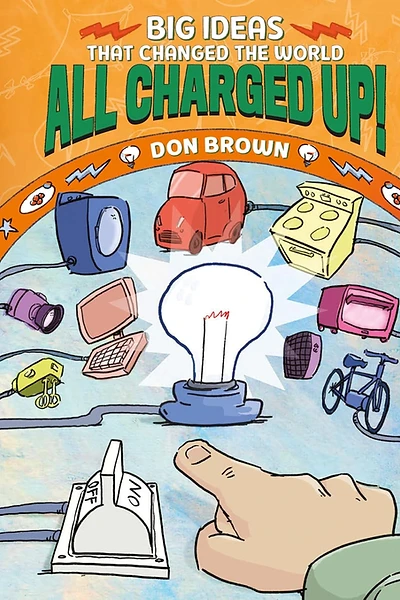
All Charged Up!
by Don Brown
Pacing MaterialA graphic novel history of electricity, from Benjamin Franklin's kite experiment through Faraday's discoveries, Edison and Tesla's rivalry, to the modern power grid and renewable energy.
Big Idea
Electricity transformed human civilization, and understanding its history helps us build a sustainable energy future.
Discussion Questions
- 1.How did early experiments with static electricity lead to practical applications?
- 2.What was the rivalry between Edison and Tesla, and how did it shape our world?
- 3.How does the modern power grid work?
- 4.What are the challenges and opportunities of renewable energy?
Classroom Activity
Circuit Building Lab
Students build simple circuits and trace the journey of electricity from power plant to light bulb.
Lesson Plan
Learning Goals
- Understand the history of electricity from discovery to modern grid
- Identify key scientists and inventors in electrical history
- Build and explain simple electrical circuits
- Analyze the environmental impact of energy production
Activity Steps
- 1.Introduce key figures: Franklin, Faraday, Edison, Tesla
- 2.Demonstrate a simple circuit using a battery, wire, and bulb
- 3.Have students build their own circuits in small groups
- 4.Students create diagrams tracing electricity from power plant to home
- 5.Discuss renewable energy and the future of electricity
Standards Connections
- ELA: RL.3.1 — Ask and answer questions about key details
- ELA: RL.3.2 — Retell stories, including key details
- ELA: RL.3.3 — Describe characters, setting, and events
- ELA: RL.7.6 — Acknowledge differences in characters' points of view
- ELA: SL.3.1 — Participate in collaborative conversations about the text
- ELA: W.3.3 — Write narratives recounting events with descriptive details
- SEL: Responsible Decision-Making
- Art: VA:Re7 — Perceive and analyze artistic work
Pace-Write-Read Study with Pace-Write It!
Focus question: How does Don Brown pace big scientific ideas so they feel exciting, clear, and easy to follow? In All Charged Up! by Don Brown, readers move quickly through the history of electricity, from Benjamin Franklin and Michael Faraday to Thomas Edison, Nikola Tesla, and today’s energy systems. Brown uses fast-moving graphic-novel panels, short bursts of text, dramatic page turns, and shifts across time to speed up discoveries, slow down important moments, and make science history feel alive.
| Element | How to notice or teach it in the novel |
|---|---|
| Pace | Read: Notice how All Charged Up! moves briskly across hundreds of years of scientific discovery but slows down for key moments like Franklin’s kite experiment, Faraday’s investigations, and the Edison-Tesla rivalry. Classroom Activity: Write a 6-sentence mini-history of one invention, using 4 short fast sentences and 2 longer slow-down sentences for the most important moment. |
| Plot | Read: Notice that the plot is not fictional but still has a clear sequence: early questions about electricity, major discoveries, competing inventors, and the modern power grid and renewable energy. Classroom Activity: Create a plot ladder with 5 steps showing how one discovery in the book led to the next, then turn it into a short paragraph. |
| Prosody | Read: Notice how the words and panel flow in All Charged Up! can be read with changing expression—calm for explanation, excited for breakthroughs, and dramatic for risky experiments and rivalries. Classroom Activity: Choose one page and rehearse reading it aloud with three voice changes, then write 3 lines of narration meant to be performed with expression. |
| Word pause | Read: Notice where short phrases, commas, dashes, and separate panels make you pause to think about electricity, danger, or surprise. Classroom Activity: Write 4 facts about a scientist from the book, adding intentional pauses with punctuation or line breaks to control how your reader thinks. |
| Concept | Read: Notice how Don Brown makes the concept of electricity understandable by connecting people, experiments, inventions, and systems over time. Classroom Activity: Write an explanation of how electricity changed people’s lives, using one scientist from the beginning of the book and one modern example from the end. |
| Voice & World View | Read: Notice that Brown’s voice is informative, energetic, and curious, showing that science is full of experimentation, mistakes, competition, and progress. Classroom Activity: Write 5 sentences in an excited expert voice explaining why learning about electricity matters today. |
| Setting & Place | Read: Notice how the story travels through many places—stormy skies with Franklin, laboratories with Faraday, cities lit by Edison’s systems, and the larger world of the modern power grid. Classroom Activity: Pick one setting from the book and write a scene that shows how that place affected the discovery happening there. |
| Point of View | Read: Notice that All Charged Up! is mainly told from an outside narrator’s point of view, but the panels help readers imagine what inventors may have seen, feared, or hoped. Classroom Activity: Rewrite one event, such as Franklin’s kite experiment or Tesla’s work, in first person beginning with “I noticed…” |
| Original Characters | Read: Notice how real historical figures such as Benjamin Franklin, Michael Faraday, Thomas Edison, and Nikola Tesla are presented as memorable characters with different goals and styles. Classroom Activity: Write a character card for one figure from the book with traits, motivations, and one important action. |
| Dialogue | Read: Notice how dialogue and speech bubbles can make historical information feel immediate, especially during moments of rivalry, discovery, or explanation. Classroom Activity: Write an 8-line dialogue between Edison and Tesla or between a scientist and a curious student about alternating current, direct current, or electric power. |
| Details | Read: Notice the specific details Brown includes about experiments, machines, wires, sparks, and systems so readers can picture how electricity was studied and used. Classroom Activity: Write a descriptive paragraph about one invention or experiment from the book using at least 5 precise details. |
| Descriptions | Read: Notice how descriptions in All Charged Up! are concise but vivid, helping readers imagine dangerous storms, busy labs, glowing lights, and expanding power systems. Classroom Activity: Describe one moment from the book in 5-7 sentences so a reader can clearly see it. |
| Strong First Lines | Read: Notice how a strong opening in a nonfiction graphic novel needs to grab readers quickly and introduce a big idea like electricity, discovery, or human curiosity. Classroom Activity: Write 3 possible first lines for a biography comic about a scientist, choosing the one that creates the most energy. |
| Immediacy & Engagement | Read: Notice how Brown makes old history feel immediate by using action-filled panels, quick facts, and dramatic moments of experimentation and invention. Classroom Activity: Write a short scene about a scientific breakthrough using present-tense verbs so it feels like it is happening right now. |
| Story Scenes & Summaries & Unique Structures | Read: Notice how All Charged Up! blends close-up scenes, like a single experiment, with summary sections that cover years of change in just a few panels. Classroom Activity: Write one 4-sentence scene about a single moment and one 4-sentence summary about years of progress, then compare the effect. |
| Flashback & Flash Forward & Cliffhangers | Read: Notice how the book moves across time, looking back at early discoveries and forward to today’s energy questions, which keeps readers curious about what comes next. Classroom Activity: Write a short comic script that starts with modern electricity, flashes back to an earlier inventor, and ends with a cliffhanger question about future energy. |
| Tension & Suspense & Surprise | Read: Notice the tension in risky experiments, the suspense in unanswered scientific questions, and the surprise when one discovery changes everything. Classroom Activity: Write a suspenseful paragraph about a scientist testing an idea, saving the result for the final sentence. |
| Page Turns and Chapter Breaks | Read: Notice how page turns in a graphic nonfiction book can reveal a new scientist, invention, or major change in the history of electricity. Classroom Activity: Plan a 4-panel page ending with a page-turn moment, then write what the reader discovers on the next page. |
| Performance | Read: Notice how this book invites dramatic reading because the history includes storms, sparks, arguments, inventions, and bold claims. Classroom Activity: Turn one event from the book into a 30-second performance script with a narrator and one historical figure. |
| Personality | Read: Notice how Franklin, Faraday, Edison, and Tesla each come across with distinct personalities through actions, expressions, and achievements. Classroom Activity: Write a paragraph showing the personality of one figure from the book without using the words smart, famous, or important. |
| Humor | Read: Notice how graphic novels can use visual exaggeration, expressions, and quick lines to make serious science history more inviting and fun. Classroom Activity: Write a 3-panel comic moment that teaches a fact about electricity while adding gentle humor. |
| Pause | Read: Notice how readers naturally pause after a dramatic panel, a big fact, or a shift from one inventor to another. Classroom Activity: Write a short nonfiction passage and mark 3 places where you want the reader to pause, then explain why. |
| Poetry and Poetic Devices | Read: Notice that even factual writing can use sound devices, vivid imagery, and metaphor-like language to make energy and motion memorable. Classroom Activity: Write 6 lines about electricity using personification or alliteration, inspired by the sparks, currents, and lights in the book. |
| Repetition | Read: Notice how repeated ideas—questioning, testing, failing, discovering, improving—create momentum through the history of electricity. Classroom Activity: Write a paragraph about scientific discovery that repeats one key phrase, such as “They kept testing,” for emphasis. |
| Rhythm | Read: Notice the rhythm created by short captions, action panels, and quick movement from one idea to the next in All Charged Up! Classroom Activity: Write 5 sentences about an invention using a pattern of short, short, long, short, long to control rhythm. |
| Punctuation | Read: Notice how exclamation points, dashes, commas, question marks, and panel breaks can shape excitement and timing in a graphic biography. Classroom Activity: Rewrite a plain fact from the book three ways using different punctuation to create excitement, suspense, or seriousness. |
| Questions | Read: Notice how the history of electricity is driven by questions: What is electricity? How can people control it? How can it power homes and cities? Classroom Activity: Write 5 research or wonder questions inspired by the book, then choose one to answer in 3-4 sentences. |
| Compare-Contrast | Read: Notice how Brown invites readers to compare scientists, experiments, and especially Edison’s and Tesla’s different approaches to electric power. Classroom Activity: Write a compare-contrast paragraph explaining one similarity and two differences between Edison and Tesla. |
| Objects | Read: Notice the importance of objects in the story: the kite, key, wires, bulbs, generators, and parts of the power grid all help carry the history forward. Classroom Activity: Choose one object from the book and write from its point of view as it witnesses a discovery. |
| Threes | Read: Notice how information becomes memorable when grouped in threes, such as three scientists, three inventions, or three steps in a process. Classroom Activity: Write a short explanatory piece organized around three turning points in the history of electricity from the book. |
| Whitespace & Negative Space | Read: Notice how open space between panels or around text gives readers time to process big ideas and dramatic visual moments. Classroom Activity: Sketch a simple 3-panel layout for a nonfiction comic and label where you would leave extra space to slow the reader down. |
| Art & Graphics | Read: Notice how the illustrations in All Charged Up! help explain invisible ideas like current, energy, and networks while also adding action and mood. Classroom Activity: Create one comic panel with caption text that teaches a fact about electricity mostly through the art. |
| Interactives & Gamification | Read: Notice how the book naturally invites timeline building, scientist matching, invention sorting, and cause-and-effect thinking because of its clear sequence of discoveries. Classroom Activity: Design a 5-question classroom quiz game based on Franklin, Faraday, Edison, Tesla, and modern renewable energy, then add one bonus writing challenge. |
Pace-Write It!
20-Minute Classroom Flow\nRead (5 min): Read aloud a short section from All Charged Up! that includes one early discovery and one later invention, such as Benjamin Franklin’s experiment and a section on Edison, Tesla, or the power grid. Ask students to listen for where the book moves quickly and where it slows down.\n\nNotice (5 min): Students turn and talk: Where did Don Brown speed up time? Where did he zoom in on one important moment? Chart student ideas under two headings: Fast Summary and Slow Scene. Point out how captions, panel size, dialogue, and page turns affect pacing.\n\nWrite (7 min): Students write their own paced science-history paragraph or comic script about a discovery, invention, or experiment. Writing frame: “At first, __________. Then, over time, __________. But one important moment changed everything: __________. In that moment, __________. After that, __________. This mattered because __________.” Challenge students to include 2 short sentences for speed and 1 longer sentence for a slow, important moment.\n\nShare (3 min): Invite partners to read their pieces aloud and identify the sentence where the writer slowed the pacing on purpose. Ask 1-2 volunteers to share with the class.\n\nExit ticket: Write one sentence answering: How did Don Brown use pacing in All Charged Up! to make the history of electricity more exciting and clear for readers?