 3-7
3-7GN BROWN
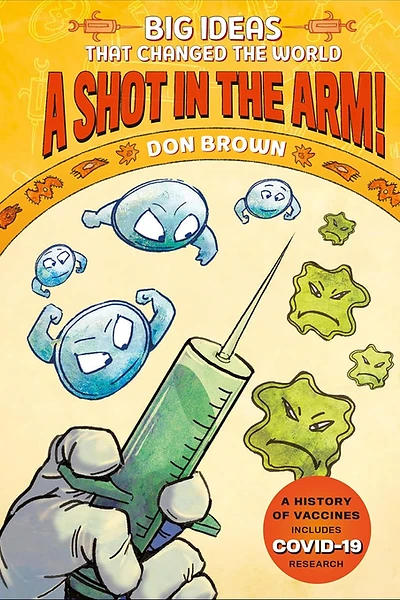
A Shot in the Arm!
by Don Brown
Pacing MaterialA graphic novel history of vaccines, from Lady Mary Montagu's smallpox variolation to Edward Jenner's cowpox breakthrough, through to Jonas Salk's polio vaccine and modern COVID-19 mRNA technology.
Big Idea
Vaccines are one of humanity's greatest scientific achievements, saving millions of lives through centuries of innovation.
Discussion Questions
- 1.Why were people initially afraid of early vaccines, and how did scientists build public trust?
- 2.How did the development of the COVID-19 vaccine build on centuries of prior research?
- 3.What role did Lady Mary Montagu play in the history of immunization?
- 4.Why is herd immunity important for community health?
Classroom Activity
Timeline of Immunization
Students create an illustrated timeline tracing key milestones in vaccine development from the 1700s to today.
Lesson Plan
Learning Goals
- Trace the historical development of vaccines from variolation to mRNA technology
- Understand the scientific method behind vaccine creation and testing
- Evaluate how public health decisions impact communities
Activity Steps
- 1.Introduce the concept of immunization and its historical significance
- 2.Have students research a key figure or milestone in vaccine history
- 3.Students create illustrated timeline cards with dates and descriptions
- 4.Assemble the timeline on a classroom wall and have students present their findings
- 5.Discuss as a class how each breakthrough built upon previous discoveries
Standards Connections
- ELA: RL.3.1 — Ask and answer questions about key details
- ELA: RL.3.2 — Retell stories, including key details
- ELA: RL.3.3 — Describe characters, setting, and events
- ELA: RL.7.6 — Acknowledge differences in characters' points of view
- ELA: SL.3.1 — Participate in collaborative conversations about the text
- ELA: W.3.3 — Write narratives recounting events with descriptive details
- SEL: Responsible Decision-Making
- Art: VA:Re7 — Perceive and analyze artistic work
Pace-Write-Read Study with Pace-Write It!
Focus question: How does Don Brown speed up and slow down the story of scientific discovery to help readers understand the history of vaccines? In A Shot in the Arm! by Don Brown, readers move through a graphic-novel timeline from Lady Mary Montagu and smallpox variolation to Edward Jenner, Jonas Salk, and COVID-19 mRNA science. Brown uses quick scene shifts, short bursts of dialogue, labeled illustrations, and dramatic page moments to pace a long history in a way that feels clear, urgent, and engaging.
| Element | How to notice or teach it in the novel |
|---|---|
| Pace | Read: Notice how Don Brown moves quickly across centuries but slows down at key breakthroughs, such as Lady Mary Montagu observing variolation, Edward Jenner testing cowpox, and Jonas Salk developing the polio vaccine. Classroom Activity: Write a 6-sentence mini-history of one invention, using 3 quick sentences for background and 3 slower, detailed sentences for the most important moment. |
| Plot | Read: Track the book’s plot as a chain of problems and solutions: disease spreads, people experiment, scientists learn, and vaccines save lives. Classroom Activity: Create a problem-solution plot map for A Shot in the Arm! and then write your own short biography scene using the same pattern. |
| Prosody | Read: Listen to how the short lines, speech bubbles, and dramatic captions in this graphic biography create a read-aloud rhythm that can sound urgent, serious, or hopeful. Classroom Activity: Choose one page about smallpox, polio, or COVID-19 and rehearse reading it aloud with changes in speed, stress, and tone, then write 4 lines meant to be read with dramatic prosody. |
| Word pause | Read: Notice where Brown’s wording and panel breaks make readers pause on powerful ideas like fear, risk, disease, and discovery. Classroom Activity: Write 5 short lines about a scientific breakthrough, placing one important word or phrase on its own line to create a pause. |
| Concept | Read: Notice that the big concept is that scientific discovery takes time, courage, testing, and public trust. Classroom Activity: Write a paragraph explaining how A Shot in the Arm! teaches that vaccines are both a science story and a human story. |
| Voice & World View | Read: Notice Brown’s informative, curious voice and his world view that values evidence, persistence, and public health while still showing fear and debate around vaccines. Classroom Activity: Write 2 short captions on the same event—one in an excited science-museum voice and one in a worried citizen’s voice. |
| Setting & Place | Read: Pay attention to how the story travels through places such as Ottoman Turkey, England, laboratories, hospitals, and modern vaccine research spaces. Classroom Activity: Write a setting description of one place from the book and explain how that place affects what happens there. |
| Point of View | Read: Notice that the book mainly uses an explanatory narrator’s point of view, but readers also see events through the experiences of people like Lady Mary Montagu, Jenner, and Salk. Classroom Activity: Rewrite one event from the first-person point of view of Lady Mary Montagu, Edward Jenner, or a child waiting for the polio vaccine. |
| Original Characters | Read: Even though this is biography, Brown helps historical figures feel vivid and memorable, from Lady Mary Montagu to Edward Jenner and Jonas Salk. Classroom Activity: Invent an original young reporter character who interviews one real person from the book, and write the interview scene. |
| Dialogue | Read: Notice how brief dialogue and speech bubbles make complex history feel immediate, especially in moments of debate, worry, or discovery. Classroom Activity: Write 8 lines of dialogue between Jonas Salk and a parent who hopes the polio vaccine will protect children. |
| Details | Read: Watch for specific details about smallpox, cowpox, polio, and mRNA that help readers understand the science without slowing the book too much. Classroom Activity: Write a short explanatory paragraph using at least 4 precise details from one section of the book. |
| Descriptions | Read: Notice how Brown combines visual and written description to show sickness, fear, experiments, and relief. Classroom Activity: Describe one panel from the book in words only so clearly that someone could imagine the scene without seeing the picture. |
| Strong First Lines | Read: Think about how the opening quickly introduces danger, disease, and the importance of vaccines, pulling readers into a true story with high stakes. Classroom Activity: Write 3 different strong opening lines for a nonfiction comic about an important medical discovery. |
| Immediacy & Engagement | Read: Notice how the comic format, direct facts, and dramatic turning points make old history feel like it is happening right now. Classroom Activity: Write a 5-sentence scene about Jenner’s cowpox breakthrough using present tense to create immediacy. |
| Story Scenes & Summaries & Unique Structures | Read: Notice how Brown blends short dramatic scenes with summary passages so he can cover hundreds of years without losing the reader. Classroom Activity: Write one detailed scene and one 3-sentence summary about the same historical topic, then compare which feels faster. |
| Flashback & Flash Forward & Cliffhangers | Read: Notice how the book’s historical structure naturally looks back to earlier outbreaks and forward to later breakthroughs, creating anticipation about what science will discover next. Classroom Activity: Write a comic-script page that ends with a cliffhanger after a disease outbreak, then flashes forward to a future cure. |
| Tension & Suspense & Surprise | Read: Pay attention to the tension in risky experiments, the suspense of waiting to see whether vaccines will work, and the surprise of using cowpox to fight smallpox or new mRNA technology to fight COVID-19. Classroom Activity: Write a suspenseful paragraph about waiting for the results of a new vaccine test. |
| Page Turns and Chapter Breaks | Read: Notice how page turns in a graphic novel can reveal a new scientist, a new disease, or a major breakthrough at just the right moment. Classroom Activity: Plan a 4-panel comic and decide what important fact or image should appear only after a page turn. |
| Performance | Read: Notice how facial expressions, panel size, and short dramatic text make the book feel performable, almost like a script about science history. Classroom Activity: In a small group, perform a short scene from the book and then write stage directions for movement, expression, and pauses. |
| Personality | Read: Notice how Brown gives historical figures personality traits such as courage, curiosity, determination, and compassion. Classroom Activity: Write a character sketch of Jonas Salk, Lady Mary Montagu, or Edward Jenner using 3 personality traits and evidence from the book. |
| Humor | Read: Look for places where the illustrations or phrasing lighten a serious topic and make science feel more approachable. Classroom Activity: Write a respectful, funny caption or speech bubble that could fit beside a panel about scientists working hard to solve a problem. |
| Pause | Read: Notice how readers may pause after panels showing suffering, risk, or major change, such as communities facing smallpox or families hoping for a polio vaccine. Classroom Activity: Write a short passage with a deliberate pause after an important moment, using line breaks or a dash. |
| Poetry and Poetic Devices | Read: Notice that although the book is nonfiction, Brown sometimes uses compressed language, powerful images, and repeated ideas that can feel poetic. Classroom Activity: Write a 6-line free-verse poem about vaccines using imagery from A Shot in the Arm!, such as shields, storms, scars, or hope. |
| Repetition | Read: Notice how repeated ideas—disease returns, scientists test, communities hope, vaccines protect—help unify the long timeline. Classroom Activity: Write a paragraph about medical discovery that repeats one key phrase 3 times for emphasis. |
| Rhythm | Read: Feel the rhythm created by short captions, quick panel sequences, and occasional slower explanatory moments. Classroom Activity: Write 6 sentences that alternate between short and long to copy the rhythm of fast panels followed by explanation. |
| Punctuation | Read: Notice how question marks, dashes, exclamation points, and colons help shape tone and pacing in both dialogue and narration. Classroom Activity: Rewrite a plain factual sentence from your notes 3 ways using different punctuation to create surprise, tension, or excitement. |
| Questions | Read: Notice the questions readers naturally ask: How did people stop smallpox? Why was Jenner’s idea so important? How did mRNA vaccines appear so quickly? Classroom Activity: Write 4 guiding questions a reader could ask while reading this book, then answer one in a strong paragraph. |
| Compare-Contrast | Read: Compare how the book presents early variolation, Jenner’s cowpox method, Salk’s polio vaccine, and modern COVID-19 vaccines to show change over time. Classroom Activity: Write a compare-contrast paragraph about two vaccine moments from the book, using signal words like both, however, and unlike. |
| Objects | Read: Notice how important objects—needles, lab tools, medicine bottles, microscopes, and charts—carry meaning and move the story forward. Classroom Activity: Choose one object from the book and write from its point of view as it 'watches' history happen. |
| Threes | Read: Notice how ideas in the book can often be grouped in threes, such as problem, experiment, solution or fear, hope, relief. Classroom Activity: Write a summary of one scientist’s work using a rule-of-three sentence pattern. |
| Whitespace & Negative Space | Read: Notice how open space around panels or text can slow readers down and make a fact or image feel more important. Classroom Activity: Plan a comic panel about a vaccine breakthrough and explain where you would leave whitespace to create emphasis. |
| Art & Graphics | Read: Study how Brown’s illustrations, panel layouts, labels, and expressions help explain science and emotion at the same time. Classroom Activity: Create a 3-panel informational comic about one vaccine breakthrough using captions and images that each add new information. |
| Interactives & Gamification | Read: Notice how the timeline-like structure invites readers to track discoveries almost like completing levels in a history-of-science quest. Classroom Activity: Design a simple 'Vaccine Discovery Quest' with 4 checkpoints based on events in A Shot in the Arm!, and write one challenge question for each checkpoint. |
Pace-Write It!
20-Minute Classroom Flow\nRead (5 min): Read aloud a short section from A Shot in the Arm! that shows one major breakthrough, such as Lady Mary Montagu learning about variolation, Edward Jenner testing cowpox, or Jonas Salk and the polio vaccine. Ask students to listen for where the story speeds up and where it slows down.\n\nNotice (5 min): Students turn and talk: What made this part feel fast? What made it feel slow and important? Chart student notices under headings such as short dialogue, quick summaries, dramatic panel moments, page turns, and scientific details.\n\nWrite (7 min): Students write a short historical-scene paragraph or comic script that copies Brown’s pacing style. Writing frame: 'At first, __________ was a serious problem. Many people __________. Then __________ noticed/learned __________. In that important moment, __________. After that, __________ changed because __________.' Encourage students to use one quick summary sentence and one slowed-down dramatic moment.\n\nShare (3 min): Invite 2-3 students to read their writing aloud. After each share, classmates name one pacing move they heard, such as repetition, suspense, short sentences, or a strong pause.\n\nExit ticket: Write one sentence answering this question: How did Don Brown’s pacing help you understand why vaccine discoveries mattered?