 2-5
2-5R TABOR
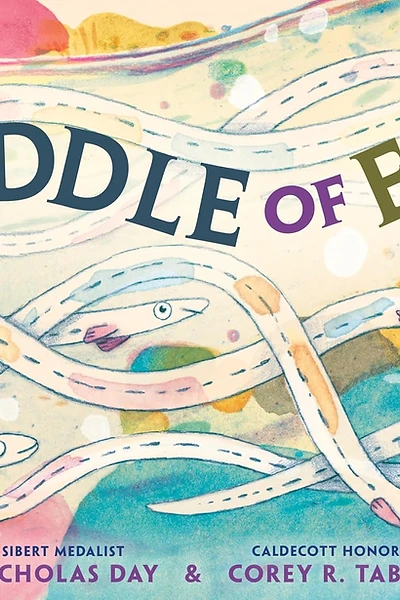
A Riddle of Eels
by Nicholas Day & Corey R. Tabor
Pacing MaterialA fascinating exploration of the mysterious lives of eels, blending science, storytelling, and stunning watercolor illustrations to unravel one of nature's most puzzling creatures.
Big Idea
Every creature has a mystery worth unraveling — curiosity is the key to understanding.
Discussion Questions
- 1.What makes eels so mysterious?
- 2.How do the author and illustrator work together to tell this story?
- 3.What did you learn about eels that surprised you?
- 4.Why do you think the author chose eels as the subject?
Classroom Activity
Animal Riddle Makers
Create a riddle about an unusual animal, then trade with a partner and try to solve each other's.
Lesson Plan
Learning Goals
- Explore nonfiction narrative structure
- Develop curiosity-driven inquiry skills
- Analyze author-illustrator collaboration
Standards Connections
- ELA: RI.2.1 — Ask and answer questions about key details
- ELA: RI.2.2 — Identify main topic and retell key details
- ELA: RI.2.3 — Describe connection between events
- ELA: RI.5.6 — Acknowledge differences in characters' points of view
- ELA: SL.2.1 — Participate in collaborative conversations about the text
- ELA: W.2.3 — Write narratives recounting events with descriptive details
- SEL: Social Awareness
- SEL: Relationship Skills
Pace-Write-Read Study with Pace-Write It!
Focus question: How does an author slow down and speed up information to build curiosity and keep readers turning pages? In A Riddle of Eels by Nicholas Day and Corey R. Tabor, the author tells the true story of scientists and storytellers trying to understand the secret life of eels. The book uses pacing by stretching out the mystery with questions, surprising discoveries, and carefully placed page turns so readers feel the wonder of discovery step by step.
| Element | How to notice or teach it in the novel |
|---|---|
| Pace | Read: Notice how A Riddle of Eels moves back and forth between slow, wondering moments and quicker moments of discovery as Nicholas Day reveals what people know and do not know about eels. Classroom Activity: Write 4-6 sentences about an animal mystery, using one slow sentence that wonders and one fast sentence that reveals a discovery. |
| Plot | Read: Notice that the plot is not about one made-up hero, but about the real mystery of where eels come from and how scientists searched for answers over time. Classroom Activity: Make a beginning-middle-end plan for a short nonfiction story about solving a mystery in nature. |
| Prosody | Read: Listen to how the sentences in A Riddle of Eels sound when read aloud, especially the lines that build wonder and the lines that land on surprising facts. Classroom Activity: Choose three facts from your own topic and write them so one sounds quiet and curious, one sounds excited, and one sounds amazed. |
| Word pause | Read: Notice how key words and short sentences make readers pause and think about the eel's strange, hidden life. Classroom Activity: Write a 5-sentence paragraph and include one very short sentence to make your reader stop and think. |
| Concept | Read: Notice that the big concept in A Riddle of Eels is that curiosity leads people to keep asking questions, even when answers take a long time to find. Classroom Activity: Write about a real mystery or question you still wonder about, and explain why it matters. |
| Voice & World View | Read: Notice how Nicholas Day's voice sounds thoughtful, fascinated, and respectful of science, showing a world view that values wonder, patience, and discovery. Classroom Activity: Write 3-5 sentences in a curious voice about something in nature that seems mysterious to you. |
| Setting & Place | Read: Notice how the book travels through rivers, oceans, and faraway spawning waters, using place to deepen the mystery of the eel's journey. Classroom Activity: Describe a real place in nature and explain how that place adds to a mystery or question. |
| Point of View | Read: Notice that the book is told from an outside narrator's point of view, but it guides readers to think alongside scientists who are puzzled by eels. Classroom Activity: Write a short paragraph from the point of view of a young observer trying to solve a real-world mystery. |
| Original Characters | Read: Notice that the 'characters' are real people, including scientists and observers, plus the eels themselves, which are presented as mysterious living creatures at the center of the story. Classroom Activity: Introduce a real person and a real animal in your writing, and show how both matter to the mystery. |
| Dialogue | Read: Notice that this book likely uses very little direct dialogue, so questions and explanations do the work that conversation often does in fiction. Classroom Activity: Add one line of imagined dialogue from a scientist or observer, such as 'Where do they come from?' to bring your nonfiction writing to life. |
| Details | Read: Notice the precise details about eel bodies, behavior, and migration that help readers understand why they were so hard to study. Classroom Activity: Write a fact-filled paragraph with at least three specific details about an animal or natural event. |
| Descriptions | Read: Notice how the writing and Corey R. Tabor's watercolor illustrations help readers picture slippery eels, shadowy water, and long journeys through rivers and seas. Classroom Activity: Write 3 descriptive sentences about an animal using color, movement, and texture words. |
| Strong First Lines | Read: Notice how the opening of A Riddle of Eels invites readers into a mystery right away instead of giving every answer at the start. Classroom Activity: Write two possible opening lines for a nonfiction piece, and make one begin with a mystery. |
| Immediacy & Engagement | Read: Notice how the author keeps readers engaged by making them feel the mystery is happening as they read, even though the events come from real scientific history. Classroom Activity: Write a paragraph that starts with a question and includes a surprising fact to pull readers in immediately. |
| Story Scenes & Summaries & Unique Structures | Read: Notice how the book blends scene-like moments of searching and wondering with summary sections that explain scientific ideas about eel life cycles. Classroom Activity: Write one scene sentence about a person observing nature and two summary sentences explaining the facts. |
| Flashback & Flash Forward & Cliffhangers | Read: Notice how the book may look back at what people once believed about eels and then move forward to later discoveries, keeping readers wondering what scientists learned next. Classroom Activity: Write a short piece that says what people first thought, what happened later, and end with one unanswered question. |
| Tension & Suspense & Surprise | Read: Notice how tension grows because for so long no one knew exactly where eels came from, and surprise appears as new clues are uncovered. Classroom Activity: Write 4-5 sentences about a mystery, saving the most surprising fact for the end. |
| Page Turns and Chapter Breaks | Read: Notice how page turns in A Riddle of Eels likely hold back an answer or image so readers must keep going to learn the next clue. Classroom Activity: Fold a paper into pages and plan where to put a question on one page and the answer on the next. |
| Performance | Read: Notice how this text can be performed through expressive reading, with pauses for mystery and stronger emphasis on discoveries about the eel's life. Classroom Activity: Mark up a short passage you write with slash marks for pauses and stars for words to stress when reading aloud. |
| Personality | Read: Notice how the book gives the eel a kind of personality by showing it as secretive, surprising, and hard to follow, even in a factual text. Classroom Activity: Write about a real animal and give it personality traits based on its true behavior. |
| Humor | Read: Notice whether moments of surprise or the oddness of eel life add a light, playful feeling to parts of the mystery. Classroom Activity: Write one factual sentence and one slightly funny sentence about a strange animal behavior. |
| Pause | Read: Notice how the author pauses to let big questions sit with the reader, which builds wonder instead of rushing to explain everything at once. Classroom Activity: In your paragraph, add one question line by itself to create a pause for your reader. |
| Poetry and Poetic Devices | Read: Notice the lyrical quality of the language and how vivid comparisons or repeated sounds may make the eel's journey feel almost magical while staying true. Classroom Activity: Write two nonfiction lines about water or movement using alliteration or a simile. |
| Repetition | Read: Notice how ideas like mystery, searching, and not knowing may repeat across A Riddle of Eels to strengthen the theme of curiosity and discovery. Classroom Activity: Repeat one important phrase, such as 'No one knew,' two or three times in your own writing for emphasis. |
| Rhythm | Read: Notice the rhythm of longer explanatory sentences mixed with shorter wondering sentences that shape how fast or slow the book feels. Classroom Activity: Write one long sentence and two short sentences about the same topic to create rhythm. |
| Punctuation | Read: Notice how question marks are especially important in a book built around a scientific mystery, and how commas and periods control the flow of facts. Classroom Activity: Write three sentences about a mystery topic and use at least one question mark and one dash or comma to control pacing. |
| Questions | Read: Notice how A Riddle of Eels uses questions to pull readers into the same curiosity scientists felt about eel beginnings and migrations. Classroom Activity: Write three strong questions that could guide a nonfiction piece about an animal mystery. |
| Compare-Contrast | Read: Notice how readers may compare what people once believed about eels with what scientists later discovered. Classroom Activity: Write two sentences comparing an old idea and a new fact about a topic you know. |
| Objects | Read: Notice the role of real-world objects such as nets, maps, water routes, or scientific tools that help make the eel investigation feel concrete. Classroom Activity: Choose one object a scientist might use and write how it helps solve a mystery. |
| Threes | Read: Notice places where the writing groups ideas in threes, such as three facts, three clues, or three stages in a journey, to make information memorable. Classroom Activity: Write a sentence that includes three clues about an animal or natural event. |
| Whitespace & Negative Space | Read: Notice how the space on the page and the placement of text and art can slow readers down and make the eel's mystery feel quiet and open. Classroom Activity: Create a mini page layout with a short sentence at the top, space in the middle, and an illustration or labeled sketch at the bottom. |
| Art & Graphics | Read: Notice how Corey R. Tabor's watercolor illustrations add mood, movement, and clues that support the text's mystery about eels. Classroom Activity: Draw a simple watercolor-style or colored-pencil sketch to match your nonfiction paragraph and add one label that teaches a fact. |
| Interactives & Gamification | Read: Notice how the book invites readers to act like detectives, collecting clues about where eels live and how they grow. Classroom Activity: Make a 'mystery clues' box in your notebook and list 3 clues, 1 theory, and 1 new question about your topic. |
Pace-Write It!
20-Minute Classroom Flow\nRead (5 min): Read aloud a short section of A Riddle of Eels that introduces the mystery of where eels come from or how scientists searched for answers. Ask students to listen for places where the author slows down to wonder and speeds up to reveal a fact.\nNotice (5 min): Chart what students notice under two headings: 'Slows pacing' and 'Speeds pacing.' Look for questions, short sentences, surprising facts, page-turn moments, and descriptive details about eels, rivers, and the sea.\nWrite (7 min): Students write a short nonfiction mystery paragraph about a real animal or natural topic. Writing frame: 'People wondered about _____. At first, no one knew _____. They looked in _____, _____, and _____. Then they discovered _____. But one question still remained: _____?' Encourage students to use at least one question, one short sentence, and three specific details.\nShare (3 min): Partners read their paragraphs aloud with expression, pausing at the question and emphasizing the discovery sentence. Invite 1-2 students to share how they controlled pacing.\nExit ticket: Write one sentence answering: 'How did I slow down or speed up my writing today to build curiosity?'