 3-6
3-6GN FEUTI
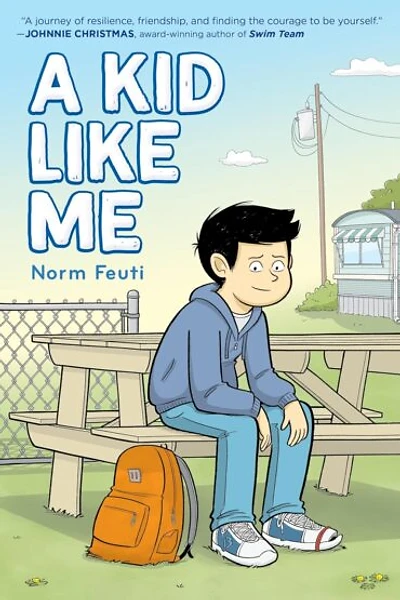
A Kid Like Me
by Norm Feuti
Pacing MaterialA boy navigates the challenges of growing up — friendships, identity, and finding the courage to be himself in a world that doesn't always understand.
Big Idea
Being yourself takes courage — and you're never as alone as you might feel.
Discussion Questions
- 1.What challenges does the main character face?
- 2.What does it mean to have 'the courage to be yourself'?
- 3.How does friendship help the boy through tough times?
- 4.When have you felt different from everyone else? What helped?
Classroom Activity
My Story
Write a short story or comic about a kid like you. Include one challenge they face and how they find the courage to be themselves.
Lesson Plan
Learning Goals
- Explain how the boy in A Kid Like Me responds to challenges involving friendship, identity, and belonging, using details from the text and illustrations.
- Identify how graphic novel features, such as panels, facial expressions, and dialogue, communicate a character’s feelings.
- Create a short story or comic about a kid with a personally meaningful interest, trait, or experience who finds the courage to be themselves.
- Develop a clear challenge, a response that shows courage, and an ending that reveals support or a sense of belonging.
Activity Steps
- 1.Revisit a selected scene from A Kid Like Me in which the boy faces a friendship or identity challenge. Ask: What makes being himself difficult? What do his words, actions, and expressions reveal? Have students support their ideas with details from the scene.
- 2.Discuss the big idea: Being yourself takes courage—and you are not as alone as you might feel. Brainstorm everyday challenges, such as sharing an unusual interest, joining a new group, or disagreeing respectfully with a friend. Explain that students may invent a character and do not need to share private experiences.
- 3.Introduce “My Story.” Students plan a kid like themselves by listing a meaningful trait or interest, one challenge, an action that shows courage, and someone who offers support. Encourage realistic courage, such as asking for help or speaking honestly.
- 4.Students create either a short story with a beginning, middle, and end or a four- to six-panel comic. Stories should include dialogue and descriptive details; comics should use speech bubbles, facial expressions, and panel order to show the challenge and the character’s response.
- 5.Invite students to exchange drafts with a partner or receive teacher feedback. Readers identify the challenge and the moment of courage, then suggest one detail that could make the character’s feelings or source of support clearer. Students revise.
- 6.Offer an optional sharing gallery. Close with a written reflection: “My character showed courage by ___” and “My character discovered they were not alone when ___.” Connect these reflections to the boy’s experiences in A Kid Like Me.
Standards Connections
- ELA: CCSS RL.3.3–RL.6.3 — Describe and analyze characters, their responses to challenges, and how events shape the story; select the grade-appropriate standard.
- ELA: CCSS W.3.3–W.6.3 — Write narratives using effective details, dialogue, and clear event sequences; select the grade-appropriate standard.
- ELA: CCSS W.3.5–W.6.5 — Strengthen writing through planning, revising, and editing with appropriate support.
- SEL: Self-awareness — Recognize personal interests, feelings, and aspects of identity.
- SEL: Relationship skills — Identify supportive relationships and practice respectful feedback and help-seeking.
Pace-Write-Read Study with Pace-Write It!
Focus question: How does an author-illustrator control speed to show a character’s courage growing over time? In A Kid Like Me by Norm Feuti, a boy faces the everyday adventures of friendship, identity, and being misunderstood while trying to stay true to himself. Feuti uses graphic-novel pacing—panels, page turns, dialogue, silence, and visual reactions—to speed up stressful moments and slow down emotional ones so readers can feel the main character’s resilience and courage.
| Element | How to notice or teach it in the novel |
|---|---|
| Pace | Read: Notice how Norm Feuti moves quickly through funny or awkward school and friendship moments, then slows down when the boy reflects on who he is and how others see him. Classroom Activity: Write a 6-panel scene about a time a character must choose courage, using 3 quick panels and 3 slower panels to control pacing. |
| Plot | Read: Track how the story builds from everyday growing-up problems—friendships, identity, and feeling different—into moments where the main character must act bravely and be himself. Classroom Activity: Make a mini plot line with beginning, middle, and end, then write one paragraph for each part showing how a character grows more resilient. |
| Prosody | Read: Listen to the way dialogue and narration in this graphic novel create feeling—some lines sound light and playful, while others carry hurt, worry, or determination. Classroom Activity: Choose one important scene and rewrite the dialogue two ways—first nervous, then confident—to show how sound changes meaning. |
| Word pause | Read: Notice where short words, hesitations, or small pauses in speech show the boy’s uncertainty when he feels misunderstood or unsure of himself. Classroom Activity: Write 8 lines of dialogue between two friends and add pause words such as “um,” “well,” or “wait” to reveal emotions. |
| Concept | Read: Think about the big idea that courage is not always loud; sometimes it is quietly choosing to be yourself even when others do not understand. Classroom Activity: Write a short theme statement about resilience in A Kid Like Me, then create a new scene that teaches the same idea. |
| Voice & World View | Read: Notice how the story’s voice stays close to a kid’s experience of school, friendship, embarrassment, and hope, helping readers see the world through a young person trying to belong. Classroom Activity: Write a first-person diary entry from the main character explaining what adults might miss about his struggles. |
| Setting & Place | Read: Pay attention to how everyday places such as school, home, hallways, or social spaces become emotionally charged depending on whether the boy feels accepted or judged. Classroom Activity: Describe one ordinary setting twice—once as a safe place and once as a stressful place—to show how setting affects pacing and mood. |
| Point of View | Read: Notice how the reader stays closely connected to the main character’s experience, making his confusion, bravery, and growth feel immediate. Classroom Activity: Rewrite a key moment from the point of view of a friend who does not fully understand him at first. |
| Original Characters | Read: Look at how Norm Feuti creates characters who feel recognizable and real—friends, peers, and adults who each respond differently to the boy’s identity and courage. Classroom Activity: Invent an original side character who could either support or challenge the main character, and write a short character sketch plus one panel of dialogue. |
| Dialogue | Read: Study how conversations reveal friendship problems, misunderstandings, and support without long explanations, which helps the story move briskly. Classroom Activity: Write a dialogue-only scene between the main character and a friend after a hurtful misunderstanding, making sure the conflict and care are both clear. |
| Details | Read: Notice the small details in expressions, clothing, body language, and setting clues that help readers understand when the boy feels confident, embarrassed, or brave. Classroom Activity: Write 5 precise details that show a character is nervous without ever using the word “nervous.” |
| Descriptions | Read: In a graphic novel, description often comes from both words and pictures, so notice how brief text works together with visual moments to show emotional change. Classroom Activity: Write a 5-sentence scene description for an illustrator, showing a character moving from fear to courage. |
| Strong First Lines | Read: Think about how an opening in a book like A Kid Like Me needs to quickly invite readers into the boy’s world of challenge, humor, and self-discovery. Classroom Activity: Draft three different opening lines for a graphic-novel story about a kid facing a social problem, and choose the most engaging one. |
| Immediacy & Engagement | Read: Notice how the story keeps readers close to the action through quick reactions, relatable problems, and emotional honesty as the boy navigates friendship and identity. Classroom Activity: Write a short scene that begins in the middle of a problem so readers feel immediate tension. |
| Story Scenes & Summaries & Unique Structures | Read: Watch how some moments are shown as full scenes while others are passed over quickly, helping Feuti focus on the most important turning points in the boy’s growth. Classroom Activity: Write one event as a full scene with dialogue, then summarize the next week in just 3 sentences. |
| Flashback & Flash Forward & Cliffhangers | Read: Consider where a memory, a thought about what might happen next, or a panel ending in uncertainty could deepen the story’s emotional stakes. Classroom Activity: Create a 4-panel sequence that includes a flashback to an earlier hurt and ends with a cliffhanger before an important choice. |
| Tension & Suspense & Surprise | Read: Notice how tension grows when the boy fears rejection, misunderstanding, or friendship trouble, and how even small surprises can shift his confidence. Classroom Activity: Write a scene where a character expects teasing but receives unexpected support instead. |
| Page Turns and Chapter Breaks | Read: In graphic novels, page turns can hide a reaction, reveal a problem, or deliver an emotional surprise, so notice where Feuti might place important moments for impact. Classroom Activity: Plan two facing pages of a graphic story and mark what readers should discover only after the page turn. |
| Performance | Read: Notice how characters perform versions of themselves in social situations, especially when the boy is deciding whether to hide parts of himself or be honest. Classroom Activity: Write a monologue in which a character explains the difference between acting okay and actually feeling okay. |
| Personality | Read: Pay attention to how the main character’s personality comes through in reactions, choices, humor, and the way he keeps going even when things are hard. Classroom Activity: List 4 personality traits for a new protagonist, then write one short scene that proves each trait through action. |
| Humor | Read: Notice how humor helps balance the harder parts of the story, making awkward moments, friendship mix-ups, and growing-up troubles feel real but still readable. Classroom Activity: Write a comic scene about an embarrassing misunderstanding that ends with kindness instead of cruelty. |
| Pause | Read: Look for quiet visual or emotional pauses where the boy thinks, hesitates, or absorbs what has happened; these slower beats help readers feel his inner struggle. Classroom Activity: Write a silent 3-panel moment in which a character decides to be brave, using only action notes and facial expressions. |
| Poetry and Poetic Devices | Read: Even in a graphic novel, repeated images, strong comparisons, and carefully chosen words can create poetic feeling around identity and courage. Classroom Activity: Write 4 lines comparing a character’s courage to something from everyday life, such as a backpack, a hallway, or a storm. |
| Repetition | Read: Notice whether repeated worries, phrases, or social patterns show how hard it can be for the boy to keep facing the same kinds of misunderstanding. Classroom Activity: Write a paragraph that repeats one key phrase three times, each time with a slightly different meaning as a character grows. |
| Rhythm | Read: Pay attention to the rhythm created by alternating busy, talk-filled panels and quieter reflective panels as the main character moves through challenges. Classroom Activity: Create a storyboard pattern of fast-slow-fast-slow for 8 panels and label what happens in each. |
| Punctuation | Read: Notice how question marks, ellipses, dashes, and exclamation points can shape tone in dialogue when the boy feels confused, excited, defensive, or brave. Classroom Activity: Take one line of dialogue and rewrite it four times with different punctuation to change the emotion. |
| Questions | Read: The story raises questions about belonging, identity, friendship, and what it means to be yourself when others do not understand you. Classroom Activity: Write 5 questions the main character might ask himself before making a courageous choice, then answer one in his voice. |
| Compare-Contrast | Read: Compare moments when the boy feels alone with moments when he feels seen and supported; contrast hiding with honesty, and fear with courage. Classroom Activity: Make a T-chart comparing two scenes—one where the character feels misunderstood and one where he feels accepted—then write a reflection. |
| Objects | Read: Notice whether everyday objects in the boy’s life—school supplies, clothes, notes, doors, or personal items—help show mood, identity, or change. Classroom Activity: Choose one object that represents a character’s struggle to be himself and write a paragraph explaining its meaning. |
| Threes | Read: Look for patterns of three in reactions, attempts, or events, since three beats often build humor, emphasis, or emotional change in graphic storytelling. Classroom Activity: Write a short scene where a character tries three times to say something important before finally speaking honestly. |
| Whitespace & Negative Space | Read: In A Kid Like Me, empty space around a panel or character can slow the reader down and highlight loneliness, thought, or a big emotional shift. Classroom Activity: Design a 4-panel page plan and decide where to leave extra blank space to emphasize a feeling of isolation or relief. |
| Art & Graphics | Read: Study how facial expressions, panel size, movement lines, and visual framing help tell the story of resilience just as much as the words do. Classroom Activity: Sketch or describe 3 panels that show a character moving from embarrassment to confidence, using changing panel sizes. |
| Interactives & Gamification | Read: Think about how readers could interact with the themes of friendship, identity, and courage by making choices at key moments in the story. Classroom Activity: Create a choose-your-path chart with two decisions for a character like the boy in A Kid Like Me, showing how each choice changes the pace and outcome. |
Pace-Write It!
20-Minute Classroom Flow\nRead (5 min): Read a short excerpt from A Kid Like Me by Norm Feuti that shows the main character facing a friendship or identity challenge. Ask students to notice where the panels move quickly and where the story slows down to show feelings.\nNotice (5 min): Discuss: How do dialogue, facial expressions, panel size, and page turns help us feel the boy’s courage and resilience? Chart student observations under two headings: “Fast Pace” and “Slow/Reflective Pace.”\nWrite (7 min): Students write a short graphic-novel scene about a kid facing a moment of misunderstanding and choosing courage. Writing frame: “At first, ___ felt ___ because ___. Then, when ___ said/did ___, everything seemed to speed up. In the quiet moment after, ___ noticed ___. Finally, ___ chose to ___, showing courage because ___.” Encourage students to add notes for 4-6 panels, including one pause panel with no dialogue.\nShare (3 min): Partners read their scenes aloud and point out one place where they used fast pacing and one place where they slowed the moment down. Invite 1-2 volunteers to share how their character showed resilience.\nExit ticket: In one or two sentences, explain how slowing down one moment in a graphic novel can help readers better understand a character’s feelings and courage.