 1-4
1-4P SUMNER
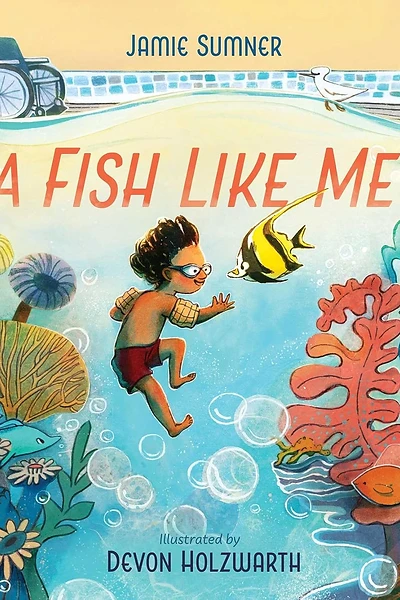
A Fish Like Me
by Jamie Sumner, illustrated by Devon Holzwarth
Pacing MaterialA child who uses a wheelchair discovers the freedom of swimming — a story about finding where you belong and the joy of being a fish in the water.
Big Idea
Freedom and joy can be found when we're brave enough to try — and everyone finds their own way to swim, to play, to be free.
Discussion Questions
- 1.How does the child feel about the water?
- 2.What does it mean to be 'a fish'?
- 3.Have you ever been afraid to try something new?
- 4.What helped you be brave?
Classroom Activity
Brave Moment Narrative
Students write a 'brave moment' narrative — describing a time they tried something new or faced a fear.
Lesson Plan
Learning Goals
- Write a short personal narrative.
- Describe a moment of courage using sensory detail.
- Identify and name emotions around trying new things.
- Practice sharing personal stories with peers.
Activity Steps
- 1.Read the book, noting how the child finds freedom and joy in the water.
- 2.Discuss what it means to be brave.
- 3.Students write a 3-5 sentence narrative about a brave moment.
- 4.Share stories and celebrate each other's courage.
Standards Connections
- ELA: RL.1.1 — Ask and answer questions about key details
- ELA: RL.1.2 — Retell stories, including key details
- ELA: RL.1.3 — Describe characters, setting, and events
- ELA: RL.4.6 — Acknowledge differences in characters' points of view
- ELA: SL.1.1 — Participate in collaborative conversations about the text
- ELA: W.1.3 — Write narratives recounting events with descriptive details
- SEL: Relationship Skills
- SEL: Social Awareness
- Art: VA:Re7 — Perceive and analyze artistic work
Pace-Write-Read Study with Pace-Write It!
Focus question: How does an author slow down and speed up a story to help us feel courage growing? In A Fish Like Me by Jamie Sumner, illustrated by Devon Holzwarth, a child who uses a wheelchair discovers freedom and belonging in the water. The book’s pacing moves gently at first, then stretches important swimming moments so readers can feel fear, bravery, and joy right alongside the child.
| Element | How to notice or teach it in the novel |
|---|---|
| Pace | Read: Notice how A Fish Like Me begins with careful, quieter moments and then lingers on the child’s experience in the pool, slowing down the important parts where courage and belonging grow. Classroom Activity: Write 3 short sentences about a moment when you felt unsure, then 3 longer sentences that slow down the moment when you felt strong or free. |
| Plot | Read: Track the story arc as the child moves from being on land in a wheelchair to feeling powerful in the water like a fish, showing a clear change from uncertainty to confidence. Classroom Activity: Draw and label a beginning-middle-end plot map for a character who discovers a place where they truly belong. |
| Prosody | Read: Listen to how the language in A Fish Like Me sounds smooth and flowing, almost like strokes through water, helping the reading feel calm and buoyant. Classroom Activity: Read one page aloud and then write 4 lines that use soft, flowing words to match a water setting. |
| Word pause | Read: Notice where Jamie Sumner’s wording invites you to pause so you can feel the child’s hesitation before movement and then the release of floating and swimming. Classroom Activity: Write 5 sentences about trying something new and underline the word in each sentence where a reader should pause for feeling. |
| Concept | Read: Think about the big idea that belonging can look different in different places; on land the child is limited, but in water the child feels free, capable, and at home. Classroom Activity: Write a sentence starter and finish it twice: 'I belong when _____ because _____.' |
| Voice & World View | Read: Notice the tender, hopeful voice that centers the child’s experience and shows the world through a lens of courage, disability, and joy rather than pity. Classroom Activity: Write a first-person paragraph in a hopeful voice about a place where you feel most like yourself. |
| Setting & Place | Read: Study how the pool becomes more than a setting in A Fish Like Me; it becomes a place of freedom, movement, and belonging. Classroom Activity: Write 4 sensory details that turn an ordinary place, like a pool, park, or classroom, into a place that feels special. |
| Point of View | Read: Notice how the story stays close to the child’s perspective so readers can feel what it means to move through the world in a wheelchair and then through water with greater ease. Classroom Activity: Write the same moment from two points of view: one from a child watching the pool and one from a child in the water. |
| Original Characters | Read: Pay attention to how the main character feels specific and memorable because of the wheelchair, the emotional journey, and the strong connection to water as a place of identity. Classroom Activity: Create a character who feels different in two places and write what makes them unique in each one. |
| Dialogue | Read: Notice any spoken words or implied conversation that support the child’s journey toward bravery, and how little dialogue can make the inner experience feel even more important. Classroom Activity: Write a short dialogue between a nervous child and a supportive adult before a first swim lesson. |
| Details | Read: Look for small details in the child’s body, movement, and surroundings that help readers understand both challenge and freedom in A Fish Like Me. Classroom Activity: Make a list of 6 tiny details from a moment of trying something new, then turn them into complete sentences. |
| Descriptions | Read: Notice how the descriptions help readers picture the water, the wheelchair, and the child’s changing feelings from cautious to joyful. Classroom Activity: Write 3 describing sentences about water without using the word 'water.' |
| Strong First Lines | Read: Study how the opening quickly introduces the child’s experience and invites readers into a story about movement, difference, and possibility. Classroom Activity: Write an opening line for a story about a character who discovers a place where they can do something they could not do before. |
| Immediacy & Engagement | Read: Notice how the book keeps readers close to the child’s emotions so the experience feels immediate, especially as the child enters the pool and begins to move differently. Classroom Activity: Write 5 sentences about a first-time experience using present tense to make it feel like it is happening right now. |
| Story Scenes & Summaries & Unique Structures | Read: Notice how A Fish Like Me likely balances brief summary with close-up scenes, giving extra space to the moments in the water that matter most. Classroom Activity: Write one summary sentence about a whole day, then write 3 scene sentences zooming in on the most important moment. |
| Flashback & Flash Forward & Cliffhangers | Read: Think about how this story mostly stays in the present, which keeps the emotional focus on the child’s immediate experience of courage and belonging rather than jumping in time. Classroom Activity: Add one flashback sentence to a story about learning something new: 'Before this, I used to _____.' |
| Tension & Suspense & Surprise | Read: Notice the gentle tension as readers wonder whether the child will feel afraid or free, and how the surprise comes in the powerful feeling of becoming fish-like in the water. Classroom Activity: Write 4 sentences that build gentle suspense before a character tries something brave for the first time. |
| Page Turns and Chapter Breaks | Read: In this picture book, page turns help pace the emotional journey, making readers pause before seeing the next stage of the child’s movement and confidence in the pool. Classroom Activity: Fold a paper into 4 pages and plan what a reader would see after each page turn in a mini story about bravery. |
| Performance | Read: Read parts of A Fish Like Me aloud and notice how your voice can become quieter during uncertainty and stronger during the swimming scenes. Classroom Activity: Practice performing 4 lines from your own writing, changing your voice to match fear first and confidence later. |
| Personality | Read: Notice how the child’s personality shines through not by long explanation but through reactions, persistence, and the joy of feeling like a fish. Classroom Activity: Write 3 actions that show a character’s personality without saying traits like 'brave' or 'shy.' |
| Humor | Read: Notice that the tone of A Fish Like Me is more heartfelt and uplifting than funny, which helps the pacing stay focused on courage and belonging. Classroom Activity: Write one gentle, playful comparison that could lighten a serious moment in a story, such as comparing a splash to something silly. |
| Pause | Read: Pay attention to moments where the text or illustrations seem to rest, giving readers time to absorb the child’s feelings before the next movement. Classroom Activity: Write a short paragraph and add slash marks where a reader should pause to think or feel. |
| Poetry and Poetic Devices | Read: Notice how the language may use comparison and imagery to connect the child to a fish, making the emotional transformation feel poetic and vivid. Classroom Activity: Write 3 similes about swimming or floating, such as 'I moved like ____.' |
| Repetition | Read: Look for repeated ideas, sounds, or images connected to fish, water, movement, or freedom, and notice how repetition strengthens the theme of belonging. Classroom Activity: Write a 5-line piece that repeats one important phrase, such as 'In the water, I can ____.' |
| Rhythm | Read: Listen to the rhythm of the sentences and how they may move slowly at first and more smoothly once the child feels at ease in the pool. Classroom Activity: Write 4 sentences with a calm rhythm, then 4 with a quicker, gliding rhythm to match action. |
| Punctuation | Read: Notice how punctuation helps control pace in A Fish Like Me, with stops that create reflection and flowing sentences that mirror swimming. Classroom Activity: Write the same sentence three ways using a period, commas, and an exclamation point, then discuss how the pace changes. |
| Questions | Read: Ask yourself what the child wonders before entering the water and what questions the book answers about courage, ability, and belonging. Classroom Activity: Write 3 questions a character might ask before trying something new, then answer one in a complete sentence. |
| Compare-Contrast | Read: Compare how the child experiences land and water; on land there are limits, while in water there is freedom, movement, and confidence. Classroom Activity: Make a two-column chart comparing a character in one place where they struggle and another place where they shine. |
| Objects | Read: Notice how meaningful objects, especially the wheelchair and the pool itself, help tell the child’s story and deepen the theme of identity. Classroom Activity: Choose one object from your life that matters to you and write 4 sentences explaining what it helps you do or feel. |
| Threes | Read: Look for places where ideas could be grouped in threes, such as feelings before, during, and after the swim, to create satisfying pacing. Classroom Activity: Write a set of three describing words for each stage of a brave moment: before, during, and after. |
| Whitespace & Negative Space | Read: Study Devon Holzwarth’s illustrations and the space around the child and water, noticing how open space can create calm, focus, and a sense of floating freedom. Classroom Activity: Make a simple illustrated page for your writing and leave open space around the most important sentence to slow the reader down. |
| Art & Graphics | Read: Notice how the illustrations work with Jamie Sumner’s words to show emotion, movement, and the child’s growing sense of being like a fish in the water. Classroom Activity: Sketch one scene from your own story and label where the art would show a feeling that the words do not need to explain. |
| Interactives & Gamification | Read: Turn the reading into a noticing game by hunting for places where the pacing slows, where the child feels brave, and where the art helps show belonging. Classroom Activity: Create a 3-box 'Pacing Hunt' checklist for your own story: slow moment, brave moment, and belonging moment. |
Pace-Write It!
20-Minute Classroom Flow\nRead (5 min): Read A Fish Like Me aloud, stopping at one early page before the child feels fully free in the pool and one later page when the child feels powerful in the water. Ask students to listen for places where the story feels slow and thoughtful and places where it feels smooth and joyful.\n\nNotice (5 min): Chart two headings: 'Before the water' and 'In the water.' Invite students to notice how Jamie Sumner changes the pace through sentence length, feeling words, and page turns, and how Devon Holzwarth’s illustrations create calm, motion, and belonging. Name the theme: courage grows when the child finds a place to move freely.\n\nWrite (7 min): Students write a short piece about a place where they felt nervous at first and then felt strong, calm, or happy. Writing frame: 'At first, I felt ____ when I was ____. I noticed ____, ____, and ____. Then I ____. In that place, I felt like ____ because ____.' Encourage students to use 1 short sentence at the start and 2 longer sentences to slow down the important moment.\n\nShare (3 min): Partners read their writing aloud and point to one place where they slowed the pace to help the reader feel the change. Invite 1-2 volunteers to share how their writing shows courage or belonging.\n\nExit ticket: Write one sentence answering: 'How did slowing down one moment help your reader feel the character’s courage?'