X E PRINCESS
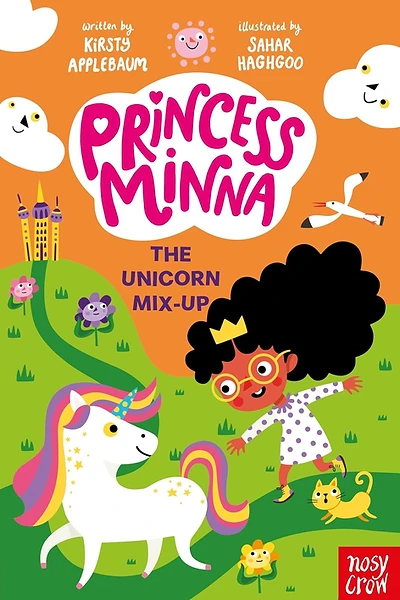
Princess Minna: The Unicorn Mix-Up,
by Kirsty Applebaum,
Pacing MaterialPrincess Minna lives in a castle and has an unusual gift: each morning, she knows exactly what she needs to do. When a unicorn mix-up needs sorting out, Minna must use her problem-solving skills to put things right in this accessible fantasy adventure.
Big Idea
Knowing that a problem needs solving is only the beginning: thoughtful action helps turn confusion into understanding. Readers can explore how writers control the speed of a story to make a problem, its complications, and its solution engaging.
Discussion Questions
- 1.How might Minna’s gift help her when the unicorn mix-up happens? What might she still need to figure out for herself?
- 2.Which moment makes the mix-up seem most confusing, and what words or pictures help you understand that confusion?
- 3.What do Minna’s choices reveal about her? Use a moment from the story to explain your thinking.
- 4.If you could suggest another way to solve the unicorn mix-up, what would you suggest, and why?
- 5.Where did you want to read quickly, and where did you want to stop and think? What made those parts feel different?
Classroom Activity
Minna’s Mix-Up: Slow Down, Then Solve!
Students make a four-panel story strip showing Minna’s everyday situation, the unicorn mix-up, a moment of careful thinking, and the solution. They use drawings, captions, and optional speech bubbles to contrast a quick problem moment with a slower thinking moment, then test the pacing by reading their strips aloud. Students may retell the book or create a clearly labeled imagined adventure inspired by it.
Lesson Plan
Learning Goals
- Retell the story’s beginning, problem, response, and resolution using relevant details.
- Explain how Minna’s actions contribute to solving the unicorn mix-up.
- Use captions, sentence length, and selected details to create a faster or slower reading experience.
- Read a short composition aloud with expression and revise it after partner feedback.
- Distinguish events from the book from ideas invented for an original fantasy story.
Activity Steps
- 1.Read the book together, or revisit selected passages after a complete reading. Identify Minna’s special gift, the unicorn mix-up, and the actions that resolve it.
- 2.Model two versions of an invented Minna moment: a brief action sentence and a longer version that includes observation or thinking. Ask students how the versions change the reader’s experience; explain that sentence length is one pacing tool, not a fixed rule.
- 3.Fold paper into four panels labeled Everyday Life, Mix-Up, Think, and Solve. Have students choose either an accurate retelling or an imagined Minna adventure, labeling invented stories accordingly.
- 4.Students draw each panel and add captions or speech bubbles. Encourage concise wording in the Mix-Up panel and an extra observation or thought in the Think panel; younger students may dictate captions.
- 5.Partners read their strips aloud, identify one quick moment and one slower moment, and suggest a change. Students revise and share how slowing down can support both storytelling and problem-solving.
Standards Connections
- ELA: CCSS RL.1.2 and RL.2.2 — Recount stories and identify their central message using relevant details.
- ELA: CCSS RL.1.3 and RL.3.3 — Describe characters and explain how their actions contribute to the sequence of events.
- ELA: CCSS W.1.3–W.4.3 — Develop narrative writing with sequenced events and, as appropriate to grade level, details, dialogue, and closure.
- ELA: CCSS SL.1.1–SL.4.1 — Participate in collaborative discussions, listen to others, and build on their ideas.
- SEL: Responsible decision-making — Identify a problem, consider possible responses, and reflect on the consequences of choices.
Pace-Write-Read Study with Pace-Write It!
Princess Minna: The Unicorn Mix-Up offers a useful starting point for studying how a writer moves readers from an ordinary situation into a problem and toward a solution. Minna’s daily certainty establishes an expectation: she wakes knowing what she needs to do. The unicorn mix-up gives readers a reason to follow her actions and discover how she puts things right. During reading, ask students to notice when the story moves forward quickly and when it gives them time to understand a character, a detail, or a decision. In a Pace-Write-Read study, students first notice a storytelling choice, then try that choice in their own writing, and finally read their work aloud to hear its effect. Use the actual book to investigate wording, dialogue, illustrations, page layout, and chapter endings rather than assuming every technique appears. The guidance below identifies places to investigate; techniques not found in the text become optional writing experiments, not claims about the author’s choices. For grades 1–2, emphasize oral storytelling, drawings, short captions, and expressive reading. For grades 3–4, invite students to compare two versions of a scene and explain how added details, shorter phrasing, or a delayed answer affect pace. Across the grades, connect craft to the story’s problem-solving theme: a character may need to pause and think even while a reader is eager to find out what happens next.
| Element | How to notice or teach it in the novel |
|---|---|
| 1. Pacing | Compare the introduction to Minna’s daily gift with a passage involving the unicorn mix-up. Ask which feels faster and identify evidence in the actions, wording, or layout. |
| 2. Plot | Map the story as situation, mix-up, response, and resolution. Notice which actions change the situation rather than simply tell readers more about the castle or characters. |
| 3. Prosody | Read a Minna passage aloud with attention to phrasing, emphasis, and pauses. Try two expressive readings and discuss which better communicates the meaning of that moment. |
| 4. Word | Collect words the author uses for Minna’s actions and the unicorn-related confusion. Test how replacing one action word in a student-written sentence changes its energy or clarity. |
| 5. Concept | Explore the story’s central fantasy idea: a princess wakes knowing what she needs to do. Ask how that idea creates expectations when a unicorn mix-up needs solving. |
| 6. Voice & Worldview | Listen for how the storytelling language presents Minna and her unusual world. Ask what the story suggests about responding to confusion, supporting answers with her actions. |
| 7. Point of View | Identify who tells the story and whose thoughts the reader can access. Rewrite one small moment as Minna saying 'I,' then discuss what information becomes easier or harder to share. |
| 8. Setting & Place | Find words and pictures that establish Minna’s castle and any other places shown. Discuss how enough setting detail helps readers picture the adventure without delaying every action. |
| 9. Original Characters | Identify what makes Minna distinctive, especially her gift and her response to the mix-up. Students can design another fantasy character with a different helpful ability and a problem that still requires thought. |
| 10. Dialogue | If a selected passage contains dialogue, examine whether it reveals information, character, or a misunderstanding. Students can add an invented speech bubble to their own Minna scene and check whether it moves the scene forward. |
| 11. Details | Find a detail that helps readers understand the unicorn mix-up or Minna’s next action. Ask students to distinguish useful clues from details that mainly decorate a scene. |
| 12. Descriptions | Examine how the text and illustrations help readers imagine Minna’s fantasy world. Add one descriptive detail to a student-written scene and decide whether it clarifies the moment or distracts from it. |
| 13. Firsts | Study the first introduction of Minna, her gift, and the unicorn problem. Ask what each introduction teaches readers and what questions it leaves unanswered. |
| 14. Immediacy & Engagement | Locate the point where students first feel eager to know what Minna will do. Discuss whether an action, a question, an unusual idea, or a picture creates that interest. |
| 15. Story Scenes, Summaries & Structures | Compare any passage that describes Minna’s usual routine with a passage showing a particular event unfolding. Discuss how summarizing routine can save space while a scene lets readers experience an important moment. |
| 16. Tension / Suspense / Surprise | Pause before the resolution and list what readers still need to know about the mix-up. After reading on, distinguish worry about an outcome from surprise at new information. |
| 17. Flashback, Flash-Forward, Cliffhanger | Check whether the book shifts to an earlier event, hints at a later one, or stops at an unresolved moment; name only techniques actually present. As an extension, students can invent a cliffhanger for a Minna-inspired scene. |
| 18. Page Turns and Chapter Breaks | Inspect actual page turns and chapter endings for questions, unfinished action, or a change of scene. Ask how the placement encourages readers to continue or gives them a resting point. |
| 19. Pace & Creativity | Have students tell an invented unicorn mix-up twice: once in three quick sentences and once with a longer thinking moment. Compare how each version changes attention and anticipation. |
| 20. Play | Use simple paper figures to explore a clearly labeled imagined mix-up involving Minna and unicorns. Let students act out possibilities before choosing the clearest sequence to write. |
| 21. Performance | Perform a brief passage with a narrator and any speaking characters present. Use voice and movement to communicate changes in pace without racing so quickly that meaning is lost. |
| 22. Personality | Infer Minna’s personality from what she says and does while solving the problem. Students should connect each suggested trait to a specific story moment. |
| 23. Humor | Invite students to identify any moment they find funny and explain whether the humor comes from wording, pictures, or the mix-up itself. If humor is not evident in the chosen passage, experiment with a playful misunderstanding in an invented scene. |
| 24. Pause | Choose a moment when readers need time to understand new information or consider Minna’s choice. Practice a meaningful oral pause, then consider how a sentence or paragraph break could create a similar effect in student writing. |
| 25. Poetry / Poetic Devices | Look for sound patterns, comparisons, or vivid language in the actual text without assuming it rhymes. Students can try alliteration in an original castle or unicorn description and decide whether it suits their scene. |
| 26. Repetition | Check for repeated words, phrases, or situations connected to Minna’s routine or the developing problem. Discuss whether repetition builds familiarity, emphasis, or expectation. |
| 27. Rhythm | Read a short passage aloud and listen to the pattern of phrases and sentence endings. Compare its rhythm with a student-written quick-action sentence and a more deliberate thinking sentence. |
| 28. Punctuation | Find punctuation in a selected Minna passage and demonstrate how it guides phrasing and meaning. In original writing, students can compare a full stop, a question mark, and an exclamation mark without treating punctuation alone as a speed control. |
| 29. Questions | Collect the questions readers have as the unicorn mix-up unfolds, alongside any questions spoken in the text. Notice when an answer arrives and how waiting for it sustains interest. |
| 30. Compare-Contrast | Compare Minna’s everyday certainty with the problem-solving work required by the mix-up. Students can also contrast the confusing situation before her actions with the situation after the resolution. |
| 31. Objects | Identify objects actually shown or named and ask whether any help explain the setting, problem, or solution. Do not assume a magical object solves the mix-up; use the book’s evidence. |
| 32. Threes | Check whether any actions, descriptions, or phrases occur in groups of three rather than imposing that pattern on the story. Students can experiment with three observations in an invented Minna scene and hear how the grouping affects rhythm. |
| 33. Lists | Look for any list-like wording in the text and consider how it organizes information. As a writing experiment, make a short list of what Minna might need to check in a newly invented unicorn problem. |
| 34. White Space & Negative Space | Inspect the space around text and images on an actual spread. Discuss how paragraph breaks and uncluttered areas can help readers navigate the page and give important moments room. |
| 35. Art & Graphics | Compare what the illustrations communicate about Minna and the unicorn mix-up with what the words explain. Ask whether a picture adds an expression, a setting detail, or information readers need to notice. |
| 36. Interactives & Gamification | Create a classroom prediction game at selected stopping points: students choose a possible next action and justify it with evidence. This is a teaching extension, not a claim that the book contains built-in games. |
| 37. Placement | Notice where the author introduces Minna’s gift and where readers learn information needed to understand the solution. Try moving a clue earlier or later in an invented scene and discuss the effect. |
| 38. Form | Examine how this illustrated easy-reader format divides the story into readable units. Compare a passage with a student-created comic panel to see how prose and sequential pictures distribute information differently. |
| 39. Dummy | Make a rough folded-paper book, or dummy, for an original Minna-inspired adventure. Plan where the mix-up appears, where readers pause to think, and which page turn reveals the solution. |
| 40. Passion | Ask students which part of Minna’s adventure most interests them: the special gift, the castle, the unicorns, or solving the problem. Encourage them to develop that interest with a purposeful detail in their own writing. |
Pace-Write It!
20-minute task — One Mix-Up, Two Speeds. Minutes 0–3: Revisit a brief passage involving the unicorn mix-up and identify what Minna knows and what remains unresolved. Minutes 3–5: Model two clearly invented versions of a Minna moment, one using concise action and one adding an observation or thought. Minutes 5–11: Students write or dictate two versions of the same moment inspired by the book: a quick version of 2–3 short sentences and a slower version that adds a meaningful detail before Minna acts. Label new events as imagined rather than part of the book. Minutes 11–16: Partners read both versions aloud, point to the words that change the pace, and explain which effect they prefer. Minutes 16–20: Students revise one version and share an exit statement: 'I changed the pace by ___ so the reader would ___.' Grades 1–2 may use drawings with dictated captions; grades 3–4 should explain how their revision affects suspense, clarity, or understanding of Minna.